
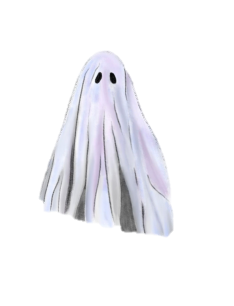
Imagine you’re strolling down JFK Street and you hear a strange sound. You turn to your right, peeking into the window of the Hicks House, an unassuming little abode on the corner of JFK and South Street. What you see inside astonishes you.
In one room, a small group of undergraduates sit in a circle, silent and contemplative. In another room, an amateur photographer aims her phone at the bookshelves, the walls, the portraits, and the halls, attempting to capture an image of an apparition or an orb. This sort of experience might seem ridiculous, but for Professor Lowell Brower and his cohort of supernatural storytellers, this is just another Tuesday night.
In the Folklore in Mythology course, “Supernatural Storytelling: Ghost-lore, Occult Legends, and the Politics of the Paranormal,” Brower and his students discuss the impact of supernatural discourses play on people’s everyday lives, politics, spiritual beliefs, and ritual traditions. He aims to explore “the ways in which otherworldly discourses dictate actions and ideologies in this world.”
Brower urges his students to begin “looking at the very familiar landscape of Harvard through the unfamiliar lens of its ghosts and the ghostly versions of itself that are hovering below its surface.” This study provides “a good opportunity to re-enliven, repopulate, and re-story the campus after a year and a half of silence,”
As a part of this re-enlivening process, Brower takes the class on various supernatural excursions on and around Harvard’s campus. These trips give students the chance to practice what folklorists call the art of ostension—the enacting of folk scripts in real life. Brower defines ostension as “thinking of legends not as folk literature but as folk action, and the ways in which folktale or a folk narrative can allow you to engage with the world in a new way.”
The Salem Witch Trials are an infamous example of ostension. Accusation of witchcraft led to the trial of 200 individuals and execution of 19 on the grounds of witchcraft. In this case, the citizens of Salem were performing an act of ostension by bringing folklore to life regardless of its scientific veritability—whether or not the people condemned at these trials were actually witches was less important than existing beliefs about witchcraft.
A much more positive example of ostensive action was the class’s trip to the Hicks House, the former home of John Hicks, a Cambridge city tax collector who is the subject of many legends. A member of the Boston Tea Party, Hicks was shot and killed on Massachusetts Avenue as he and a compatriot attempted to ambush the British soldiers who were retreating from the Battle at Lexington and Concord. Hicks was laid to rest in the Old Burying Ground on the corner of Massachusetts Avenue and Garden Street, but his spirit is said to haunt the Hicks House to this day.
When the students entered the Hicks House, they broke off into small groups and were “asked to respectfully and humbly practice the arts of ostension to bring legends to life in their own way.” Some students used ghost hunting apps, some silently contemplated the story of Hicks’s life and death, others snapped pictures, and still others tried to interact with Hicks’s ghost by flipping a coin.
Some students had supernatural experiences of their own. Multiple students reported having a flesh-creeping sensation, one of the course Teaching Fellows saw a ghost and took a photo, and others captured electronic voice phenomena on voice recorders. The students were “engaging in supernatural storytelling as storytellers, as characters in the stories they were telling,” Brower says.
These claims might seem outlandish to some, but such experiences are deemed abnormal for many of Brower’s students. In fact, many of the students were originally prompted to take the class because they had past experiences with the supernatural. On the first day of class, “everyone came and enraptured each other with these incredibly compelling narratives,” Brower says. “That provided us with this amazing corpus of supernatural storytelling that we come back to again and again.”
Multiple students reported having a flesh-creeping sensation, one of the course Teaching Fellows saw a ghost and took a photo, and others captured electronic voice phenomena on voice recorders.
In Brower’s eyes, it’s much more intellectually fruitful to study supernatural encounters and suspend disbelief than wholly discount such claims. Questions of truth or falsehood are less important when thinking through these movements and their adherents. “If your response is, ‘prove it,’ that doesn’t shed any light on the person’s experience or what it might mean to them or their lives,” Brower shares. “If your baseline is belief, that allows you to see the amazingly powerful effects of supernatural storytelling in people’s lives, regardless of its truth value.”
Seriously engaging with supernatural claims can have profound implications on our understanding of politics and society at large. “Supernatural storytelling is deeply consequential but often ridiculed. The more it’s ridiculed, the more powerful it becomes, I’m afraid,” says Brower.
Dr. Lowell Brower is a professor at Harvard College and the Head Tutor for the Committee on Degrees in Folklore in Mythology. He will teach the course “Internet Folklore, Online Communities, and Digital Storytelling” in Spring 2022.
Cade Williams ’23 (cadewilliams@college.harvard.edu) encourages all readers to really lean into supernatural experiences. They’re good for the spirit!
Graphics by Piper Tingleaf ’24