Thoughts from New Quincy: Dead Ends of Consensus
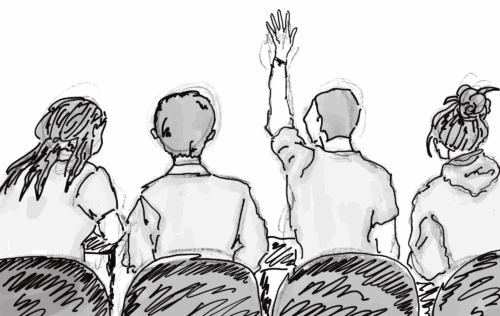
Graphic by Kerrie Zhu

I still remember the first time I stayed silent in section—watching the moment slip by until someone else jumped in with a safer, more polished thought. That pause felt small then, but it lingers now, as LFDOC photos flood my Instagram feed and I step into the rhythm of “last firsts.” It makes me reflect on how my time at Harvard has shaped me—not just in the obvious ways, but in the subtler ones.
Before I ever sat in a Harvard classroom, the institution was already part of my life. I grew up less than a mile from the Square, close enough that my family would walk there for dinner on weekends. I watched storefronts turn over, old favorites vanishing as new ones settled in their place. My sister even spent a summer working at Pinocchio’s, back when I was still too young to make it past two slices. Harvard was familiar long before I became a student.
Arriving at Harvard, in many ways felt like an extension of high school. I studied in the same coffee shops I had frequented for years. The streets were familiar, the restaurants unchanged in memory even as the architecture shifted. The friends were new, of course, and the meals a sharp downgrade from my mom’s chef-level dinners to whatever HUDS happened to be serving. Yet even as time moved forward, I felt like the same person inhabiting the same place.
That sameness extended to my mindset. In high school, I was never afraid of being wrong. I would argue points I barely understood, test out half-baked ideas, and invite my classmates to push back. Half the time I lost the argument—but that was the point. To be wrong was simply part of learning.
At Harvard, I expected more of that. I assumed that the “most intellectually curious” people in the world would also be the most open to debate, the most willing to listen. I had grown up in a family with a wide range of political ideologies and attended a high school that—while liberal—taught us how to think, not what to think. I looked forward to continuing that exploration. But the reality of Harvard did not match those expectations.
At first, I assumed the stalled moments—when ideas lingered unsaid—were simply freshman jitters: people uneasy in a new place, surrounded by brilliance, afraid of embarrassing themselves. I expected the conversations to loosen over time, but they did not. The silence isn’t about nerves. It’s about a lack of openness. Too often, students are not interested in real discourse—they are focused on protecting the views they already hold. Caution outweighs curiosity and prevents conversations from ever starting.
I’ve found myself playing devil’s advocate more times than I can count—not out of conviction, but because someone had to say it. In courses like “Hist-Lit 10,” it became almost a joke: the pushback was automatic, less about belief than about keeping the gears turning. Without it, the discussion collapsed into polite nodding, each comment a variation of the last. That is not a debate. And it is not learning.
This all stems from a deeper issue: at Harvard, speaking up is not measured by whether you are right or wrong—it is measured by whether you sound impressive. The classroom often feels less like a space to test ideas and more like a stage, where the goal is to signal knowledge and virtue rather than to learn.
This culture runs through every field. In English classes, a shaky interpretation of a poem rarely gets voiced; in philosophy, students frame their questions as mini-lectures to sound sharp rather than uncertain. Even in daily conversations, people trade polished takes for half-formed thoughts. Politics exposes it most clearly. Harvard prides itself on being “nonpartisan,” but here that usually means siding with the popular opinion. That is not neutrality. It is consensus dressed up as objectivity.
Only a narrow band of liberal views feels socially safe to voice, while everything else gets censored before it even leaves someone’s mouth. The result is an “acceptable liberalism”—a public script everyone can nod along to—while quieter, more complicated views retreat underground.
You feel it most in Gen Eds. In a lecture hall with a hundred people you barely know, no one wants to risk saying something that might not land. Instead of testing ideas, students pare their words down to the safest possible version—or say nothing at all.
That’s not really the institution’s fault. It is ours—the students. Because the most vocal voices tend to lean liberal, the culture tilts that way. Conservative students learn quickly that speaking up carries social costs, so most stop trying. The campus looks more lopsided than it is—not because those perspectives do not exist, but because they have been crowded out of the conversation.
That culture does not just make politics tense—it makes curiosity impossible. If you believe someone is wrong before you have heard them out, conversation becomes performance, not exchange. People stop asking questions, stop taking risks, stop letting others shift their views. Disagreement ceases to be a tool for learning and becomes a threat to identity.
Over my three years, I’ve watched the script get tighter. Freshman fall, students would still blurt out half-formed or clumsy points, feeling out the edges of debate. Now those edges are sharper, and fewer bother testing them. The cost is a quiet apathy: when people stop risking mistakes, they stop caring to push at all. Curiosity fades, and silence settles in.
And it does not stay in the classroom—those conversations spill into dining halls and dorms, where students pick apart what the more conservative voices said. The risk is not just embarrassment in class, but being remembered afterward as the one who said the “wrong” thing.
And the cost of that silence runs deeper than debate. It flattens curiosity. It trains students to mistake performance for knowledge, agreement for truth. It rewards those who mimic the right tone and punishes those who ask the wrong question. Slowly, it hollows out what a Harvard education is meant to be. We came here to learn how to think, but too often we’re only learning how to sound correct.
That’s why conversations here so often feel like battles to prove who’s right, rather than opportunities to discover what might be true. You can win points in section that way, but as a way of living, it’s a dead end. If every exchange is about convincing, you never leave one having learned.
If I have learned anything in three years here, it’s that consensus is overrated. The moments that shaped me were not when I sounded polished, but when I risked being wrong and allowed someone else’s perspective to shift my own. Harvard rewards caution—careful sentences, safe opinions, the same beliefs recycled. But the real education lives in the risk: saying what you actually think, and being willing to change.
Silence and performance do not just hollow out classrooms; they hollow out people. They teach us to polish instead of question, to defend what we know instead of risking what we don’t. If that follows us past Harvard—into leadership, politics, culture—it will narrow how we lead and what we imagine.
What Harvard needs most is not sharper takes but braver ones: words spoken before they are finished, an admission of not knowing, the curiosity to be vulnerable. In my final year, I want to practice that risk—speaking before the thought feels polished, admitting what I do not know—and I hope others will take that risk alongside me.
Luke Wagner ’26 (lukewagner@college.harvard.edu) is the Managing Director of the Harvard Independent.