The Next Chapter of Globalization
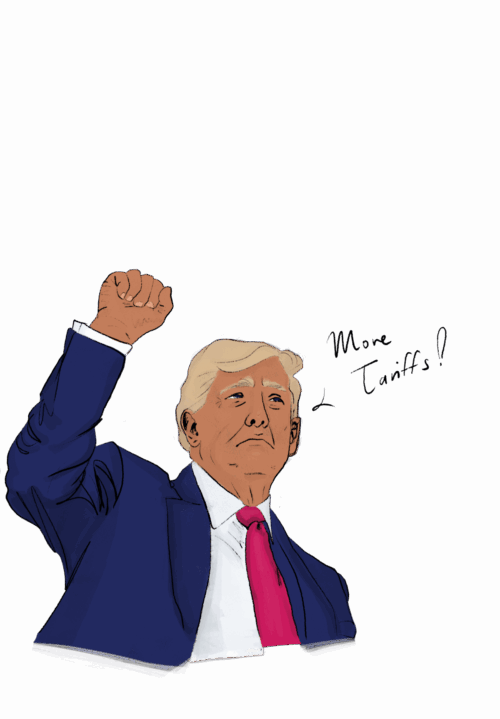
Graphic by Madison Krug

In recent months, the United States has shifted towards an increasingly isolationist trade stance, imposing wide-ranging tariffs and retreating from its traditional role as a champion of open markets. This change in commercial policy has sparked debates about the future of global economic integration and is raising questions about whether the world is entering a period of retreat, fragmentation, or reconfiguration.
To explore these issues, the Harvard Independent spoke with three leading Harvard Kennedy School economists: Dani Rodrik ’79, Ford Foundation Professor of International Political Economy, who is widely known for his work on globalization and industrial policy; Robert Lawrence, Albert L. Williams Professor of International Trade and Investment and former member of President Clinton’s Council of Economic Advisers, who is a leading scholar of international trade and global integration; and Ricardo Hausmann, Rafik Hariri Professor of the Practice of International Political Economy and Director of the Growth Lab, who studies development challenges and the role of productive capabilities in driving growth.
The following interviews were conducted separately and edited for clarity.
The Independent:
Some economists argue that protectionism can provide breathing space for domestic industrial policies. Given the U.S.’s recent shift towards an isolationist stance, do you think this could inadvertently create opportunities for emerging economies to prioritize their own industrial strategies? Could the current moment be an opportunity for growth?
Rodrik:
Yes, I think you’re right. I’m generally a proponent of industrial policy, because I think structural change in the economy—whether it is moving towards renewable and green industries, or whether it is creating the kinds of jobs for the middle class of the future, or whether it’s to foster innovation—always requires more strategic set of interventions by the government to promote those structural changes that markets aren’t always very good on their own. In that sense, I’m a proponent of industrial policy. Tariffs and protectionism can be indirectly of help to the extent that they provide a kind of shield, or, as you call it, a temporary breeding space for those industrial policies to work. They’re much less effective at promoting structural change directly.
I think my main criticism of Trump’s policies would be that you can put up these tariff barriers, but there’s no guarantee that, if you make certain local producers more profitable, they will necessarily end up innovating more, or they’ll invest in their workforce, or they’ll even expand capacity. They can take the profits and spend them on their shareholders, or they can spend them on their managers by paying themselves higher salaries. I think that the criticism of protectionism, although I’m not doctrinaire about it, is that it’s not a very blunt instrument, compared to industrial policy, which sort of more directly targets those structural changes by directly encouraging investments in the new areas.
Now, with respect to developing countries, I do think it’s both an opportunity and a threat. The opportunity is that as countries like the United States now freely talk about industrial policy, it removes the stigma that industrial policy has in developing countries. It is also a threat because in many areas, developing countries don’t necessarily have the capacity or the fiscal resources to engage in as wide-ranging industrial policy as the United States might. And in certain areas where industrial policy takes the form of subsidies—for example, fiscal subsidies or tax incentives—many developing countries might find themselves at a disadvantage because they are much more cash-strapped.
The Independent:
In your book, “The Globalization Paradox,” you argue that global economic integration, democracy, and national self-determination cannot all be fully pursued at the same time. Why is that the case?
Rodrick:
I call that the political trilemma of the world economy, and it says that you cannot pursue economic globalization, the deepening of democracy, and national sovereignty at the same time. If you want to start from the globalization end of the trilemma, what globalization calls is increasing integration of markets, firms, investors, and market participants playing according to a single set of rules, because that’s how you get markets to join together.
But nation-states call for a difference.
Each country has its own historical trajectory, its own cultural traditions, and its own economic policy requirements depending on its level of development. So, in terms of their own policy, the kinds of rules that they want to set for how their economy develops, their rules and regulations will often differ from each other.
And where democracy comes is that if we’re going to allow countries to be responsive to their electorates and choose those different rules, then they necessarily will have to keep a certain degree of globalization at bay, because there is going to be a conflict between what their democracies want and what the requirements of global marketing integration require.
Alternatively, of course, they can pursue policies that are purely in pursuit of global market integration. They normally are still nationally sovereign and they’re globalized, but they have to keep democracy at bay.
The third possibility is we forget about national sovereignty and we try to erect a democracy at the global level, where there’s a global political community, where you can decide on global rules according to sort of a global political, democratic accountability. But of course, that’s very far from where we are.
The Independent:
Given the diverse global attitudes toward globalization, if the U.S. continues down a protectionist path and further isolates itself, which countries or blocs are best positioned to fill the leadership vacuum? Or do you think the U.S. should retain that role and find a way to stay integrated?
Lawrence:
If you had tried to implement a set of American policies that would strengthen the hand of China in global leadership, you couldn’t have done a better job than Donald Trump is doing at the moment. What we’ve seen is that in recent times, China has become the primary trading partner of far more countries than the United States. In addition, it’s lowered its trade barriers, while the Americans have raised them.
One example in July: the Chinese said all African countries with whom they have diplomatic relations can sell in China without paying tariffs. You see the striking difference? It’s not that all those in the rest of the world will eagerly embrace many dimensions of China and its competitive capabilities, but certainly, they are now in a position where they can benefit from what America is doing.
But we’re also seeing that other countries are increasing their efforts to deepen the trade relationships between themselves. We’re seeing Canada negotiating more trade agreements. We’re seeing Europe doing that with the countries in Latin America. So I think other countries will benefit from what the United States [is doing]. Overall, the world will be worse off. Countries will lose the benefits they got from a deep relationship with the United States. But, let’s remember that the U.S. only accounts for something like 15% of global trade, and the other 85% is open for business.
Another preoccupation of the Trump Administration has been to focus on trade in goods. All of these discussions are about trade balances, but purely in goods. And yet, if you look at the data, trade in services has proven vibrant, has continued to grow, and with the potential of the internet and AI, I think this is transforming the nature of trade increasingly to be less about goods and more about services.
The Independent:
In one of your papers, you note that smaller economies already struggle with ‘original sin’ and limited market power. In today’s world of protectionism and friend-shoring, is there realistic space for them to insert themselves into global value chains? Are you suggesting they might do so through new alliances with the EU and China?
Hausmann:
The U.S. right now has more than ‘America First’—an America alone strategy. The message to everybody else is: ‘the U.S. is an unreliable, risky partner. You never know when they’re going to get mad at something and try to weaponize any relationship you have with them.’ So [countries] across the world [are thinking] you have to take risks [away] from the U.S., and I think that that’s going to come at a cost, especially to the countries that are more connected to us, like Canada, Mexico, and Central America. We’ve essentially seen the idea of value chains that originate in China and make things in Southeast Asia, targeting the U.S. market. I think they will have to target the rest of the world, but they may be able to rebuild themselves. They’ll initially pay a cost because of the reduction of the U.S. market or the unreliability of the U.S. market, but they might survive in a world where China plays a significant economic role for other countries in sub-Saharan Africa, North Africa, and Latin America. I think that they will need to rethink how they insert themselves in the world.
The Independent:
Many advanced economies—the U.S., EU, and China—are investing heavily in strategic industries like semiconductors and electric vehicles. Do you worry this new wave of investment could widen the gap for developing countries with fewer fiscal resources?
Hausmann:
Well, I think that economies have always had more degrees of freedom than they thought, and I think they still have quite a few degrees of freedom to map their course. We’ve seen dramatic improvements in levels of development in Asia, especially East Asia, Southeast Asia, and so there are growth opportunities.
We don’t know what artificial intelligence is going to mean. It could mean that catching up becomes easier. Maybe there will be a few artificial intelligence tools that get monopolized by a few large companies, but the use of those technologies might actually facilitate development, because essentially, you make more of the knowledge of the world available to more people through these tools. There is a world in which some of the technological changes might make development easier.
The Independent:
What is your perspective on the future of globalization? Professor Rodrik emphasized that while he does not foresee a full collapse of globalization, he does think we have reached a peak. Do you share a similar view, or do you see the current state of affairs as evidence of a reconfigured globalization rather than a full rollback?
Lawrence:
A key driver of the global trends that we saw until roughly 2016 was American leadership. The United States, since then, has turned inward and moved away from its efforts to achieve closer integration with its trading partners.
In 2016, we were still negotiating the Trans-Pacific Partnership. We were also trying to negotiate with Europe in what was known as the T-tip negotiations—so-called “mega-regional agreements.” With the election of 2016, both Hillary Clinton and Donald Trump rejected the Trans-Pacific Partnership, and we’ve seen since then the U.S. move in this highly protectionist direction. We’ve had a number of shocks which have also reinforced the tendency to global fragmentation—COVID, the war in Ukraine, and the shortages that were associated with supply chains not operating—all of which have turned people more skeptical about just simply relying on global markets.
But if you look around the world today, you don’t see the same kind of rejection of global forces, of the potential for globalization in many other countries in the world that you are seeing in the United States and somewhat in Europe. We saw what happened with the Trans-Pacific Partnership, which was that the other countries that have negotiated the agreement have gone ahead, have implemented it, have expanded its membership, and in effect, continue to commit themselves to deeper international integration. We’ve seen that most of the countries, except China, have not retaliated against the United States nor erected higher barriers against each other.
We’re likely to see a fragmented globalization rather than a disintegration, and that’s very different from what happened in the 1930s when other countries followed Smoot-Hawley tariffs by adopting tariffs of their own.
Hausmann:
I think we’re in a period of very significant uncertainty because if these policies [backfire], we can see a lot of reversals and changes of direction. But if announced policies were to remain, I think it could be quite a significant change.
Globalization happened in the context of a somewhat more unipolar world in which we were all in more or less the same system. The Soviet Union collapsed, and Russia became part of the global economy, and China is [also] part of a global economy. But it may be that we’re moving in a world in which it might look very different from the world we’re used to, but I can imagine it moving in potentially very nasty directions.
I am concerned that one of the critical things for development is for countries to be able to earn foreign exchange with which to pay for imports of all the things that they need, then they cannot make themselves. And there are directions in which the world might go that would make it very difficult for emerging market economies, for developing countries, to earn more foreign exchange, and I can imagine scenarios in which the direction of the world might turn a little bit nastier.
That said, the U.S. is only 13% of global trade. The U.S. imports 13% of global imports. So there’s still 87% and it matters a lot. It could be that in this new world, there will be plenty of opportunities to earn foreign exchange, but because the U.S. is kind of excluding itself from the world and imposing tariffs on everybody, it may very well be that countries will want to diversify away from U.S. risks and get closer to other partners, whether it’s Europeans or the Chinese and so on. And when you change your trading alliances, you also tend to change your political alliances, or at least political influence.
So I can perfectly imagine worlds that will look very different from the current ones.
…
Rodrik, Lawrence, and Hausmann paint a nuanced picture of a world economy in transition. While none expect a complete decoupling of the global economy, all see globalization as having reached a turning point. Rodrik emphasized the political trade-offs between democracy, sovereignty, and integration; Lawrence pointed to a fragmented but ongoing globalization; and Haussmann stressed the need for developing countries to adapt by diversifying alliances, solving coordination problems, and seizing new opportunities in global value chains. What unites their views is the recognition that the global economy is not disappearing, but changing and forcing both advanced and developing nations to rethink how they engage with trade, technology, and growth in a more uncertain world.
Nashla Turcios ’28 (nashlaturcios@college.harvard.edu) writes News for the Harvard Independent.