Quad Life, Preseason Edition
Graphic by Amelie Lima

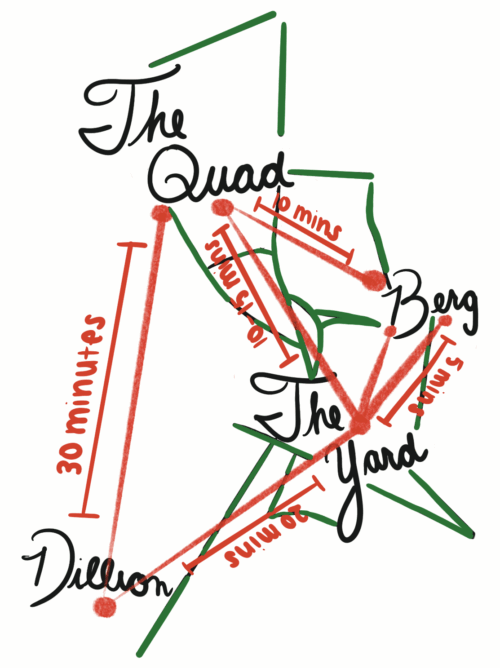
It’s 5:45 a.m., and Storage Squad still hasn’t delivered your scooter. Instead, you’re trudging across Cambridge with calves that feel as heavy as bricks. Before the sun is even up, you spill coffee all over yourself trying to juggle your belongings for the day. To top it off, you yelp from a hamstring cramp after tripping on the uneven bricks outside Joe’s. Welcome to preseason: the annual ritual where student-athletes spend two weeks training like professionals and commuting like bankers—minus the salary.
For Harvard student-athletes, preseason comes with mixed feelings. It’s a time to reunite and connect with teammates while getting sorted ahead of the academic year. However, it comes at the cost of associated performance anxiety and constant body aches before school even starts. For these reasons, completing preseason is a proud accomplishment. Even worse, the Harvard Radcliffe Quadrangle poses greater challenges for its commuters.
This year, athletes were housed in Kirkland from their arrival until Aug. 18. Few thought to bring box fans or even pillows, leaving them sweating through at least three nights in stifling rooms. With two rat sightings a day minimum and overheating phones that couldn’t charge overnight, the conditions were far from ideal for peak performance. Looking back, however, Quad residents remember Kirkland as a paradise and long to return.
The Quad houses about 1,050 undergraduates in Pforzheimer, Cabot, and Currier. While it is an oasis for some, for athletes who are expected to be in their locker rooms at ungodly hours, it can feel like a prison sentence. Sitting 1.2 miles from Dillon Fieldhouse, it takes just under 30 minutes on foot to make the dreaded trek across the river.
Waking up earlier and going to sleep later than teammates on the river, Quad athletes often lose crucial rest. “Most of my teammates have time to take a nap or just crash at their dorm between practices,” soccer player Nicholas Willen ’27 explained. “Living in the Quad makes this difficult or impossible.”
“By the time I scooter back to the Quad, walk up four flights of stairs and get sorted, I need to start heading back to the river, ultimately making it not worth it,” volleyball player Alicia Guo ’28 echoed.
Beyond exhaustion, the Quad can make athletes feel isolated from their teammates. “Most of the hanging out and socializing does happen on the river. I usually end my nights back in Cabot,” Guo said.
Yet, both athletes acknowledged that perspective matters. “Compared to most other college campuses, the distance to athletics from the Quad is not too far,” Willen said. “But the lack of cars and density of students closer to facilities makes it more frustrating than it would be elsewhere.” Guo has found ways to enjoy the experience. “After Currier dining reopened, my volleyball teammates began holding Quad dinners, and the three Quad residents on my team bonded over ice cream trips and evenings on the lawn,” she explained.
Quad houses will never be the most convenient places to live during preseason. The commute costs sleep and recovery. But it also builds community and strengthens organizational skills, while offering, as Willen put it, “a nice break from the intensity of preseason.”
For Guo, that lesson extends beyond the walk from Cabot to the River. She knows that good preparation matters just as much off the court as it does on it. Or, in her words: “It’s not the situation I’ve been given, but rather how I respond.”
Paige Cornelius ’28 (paigecornelius@college.harvard.edu) will likely try to transfer out of Cabot next year.