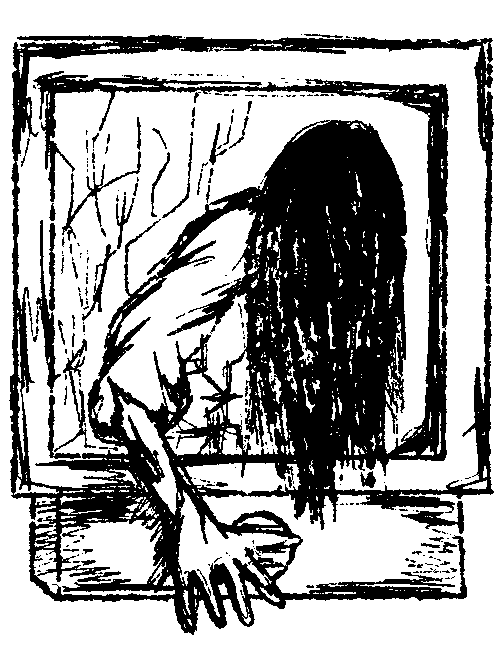
Thoughts from New Quincy: The Ring, The Mirror
Graphic by Christiana Zembrowski

It starts with a story.
Two teenage girls in a quiet suburban house whisper about a cursed videotape—one that kills anyone who watches it seven days after viewing. They laugh, half-believing, half-scared, until one admits she’s already seen it. That night, the curse keeps its promise.
I first saw “The Ring” in high school and thought it was almost tame. No jump scares, no loud music cues—just static, silence, and a screen that seemed to breathe. It didn’t scare me right away. It waited.
So what made Gore Verbinski’s 2002 remake of the Japanese horror film “Ringu” so hard-hitting? It’s not the blood or the violence that makes it terrifying, but how it turns looking itself into a source of horror. Every death begins with an image—an image that kills those who see it, unless they make a copy of the tape.
What’s striking is that we never actually see anyone die. Every death takes place off-screen, replaced by static, distortion, or the aftermath—a face frozen in shock, a body slumped on the floor. The violence happens somewhere we can’t reach: inside the image itself. It’s as if the movie refuses to give us what we came for, turning the act of watching into its own kind of punishment. With this, the horror isn’t in what’s shown, but in what’s withheld.
The tape doesn’t tell a story so much as it arranges sensations. A woman brushes her hair before a mirror. A horse collapses in water. A fly twitches against the glass of the screen. Then a well—dark, bottomless—and an eye that looks back.
But “The Ring” isn’t just horror—it’s about technology, and the strange power of images to look back. Long before TikTok or deepfakes, Verbinski understood that the media doesn’t record the world so much as remake it, feeding on our attention.
His adaptation carries over into the late ’90s anxiety about broadcast intimacy and technological isolation seen in “Ringu,” but translates it into something distinctly American: a fear of surveillance, replication, even information itself—a world where being seen becomes indistinguishable from being exposed.
Into this feedback loop steps Rachel Keller (played by Naomi Watts), a journalist chasing the tape’s origin. She’s not a hero so much as another witness, another node in the system. When she finally watches the video, the static crawls over her face and the film begins to fold in on itself. We’re watching her watch a screen that’s already watching us. The story collapses into its own reflection—a mirror flickering with everything we’ve mistaken for clarity.
When Rachel presses play, the movie begins to roll. We don’t just watch her reaction; we watch the tape, too—a ladder, a well, an eye—the same flickering images that killed the others. For a moment, the film erases the boundary between screen and spectator. Rachel’s reflection shimmers on the glass, and so does ours. The static flooding her living room spills into ours, as if the image were reaching outward, hungry for our eyes as much as hers.
Nowhere is this hunger clearer than in the hospital footage of Samara, the girl at the center of the curse. Rachel watches her psychiatric interview from behind a glass wall, but we don’t see Samara directly. Instead, we see what Rachel does: a monitor on the right side of the frame, playing the recording in real time.
Samara herself is blurry, half-obscured by distance, while her image on the monitor is sharp, luminous, disturbingly alive. Then the focus flips—Samara sharpens into clarity while the monitor fades. The film keeps shifting allegiance between body and image, unsure which one is alive.
By the time her face dissolves into static, the distinction collapses entirely. The image has taken her place.
The film starts to feel suffocating. Every action involves a screen—security footage, camera recordings, monitors, reflections—and the characters can’t stop handling them. They rewind, pause, zoom, copy, trying to control what they look at, but every attempt just deepens the trap. There’s no direct sight anymore, only images of images. The real horror isn’t in what’s shown but in the realization that there’s nothing outside the frame. The screen stops being a window and becomes a mirror that folds everything inward.
Watching this film, I couldn’t help but think about how easily I assume the same posture Rachel takes—leaning toward the screen, waiting for something to reveal itself. It’s less curiosity than compulsion: a faith that meaning hides somewhere inside the static. The film’s horror feels familiar because it mimics how we already live: searching for meaning through pixels, convinced that if we just look long enough, the image will return something.
Later, Rachel discovers these aren’t random images—they’re memories belonging to Samara. After her death, the images keep reproducing, detached from her body but alive in the machine. The curse isn’t supernatural in any ordinary sense. It’s technological. Samara doesn’t haunt a house. She haunts the medium itself. Her presence is grain, distortion, playback.
Before she was a curse, she was a child—one nobody wanted to see. Samara was adopted by Anna and Richard Morgan, who lived on a remote island horse ranch. From the beginning, something was wrong: Samara could project images from her mind onto physical surfaces and into other people’s thoughts.
The horses grew restless, tormented by the visions she projected into their heads, until one by one they threw themselves into the sea. Terrified, her father locked her in the barn, covering the walls with wallpaper to block out the images she couldn’t control. Her mother, driven mad by the noise that never stopped, finally put a plastic bag over Samara’s head and pushed her into the well.
The tape is what’s left of that erasure. It isn’t vengeance so much as residue—her voice encoded in static, replaying endlessly because no one would listen while she was alive.
By the time Samara dies, there’s no one left to witness her. Each viewing repeats the original violence: the desperate need to be seen colliding with the terror of being looked at. In that sense, “The Ring” isn’t just about the curse of visibility—it’s about what happens when seeing becomes the only way a silenced body can speak.
The more the film is watched, the more she speaks, her image feeding on the attention that once destroyed her. The tape becomes a kind of living archive, a feedback loop that survives through the act of looking and reproduction. In a way, Samara is what happens when perception outlives its subject, when seeing becomes autonomous.
Rachel’s investigation turns into an act of complicity. Every time she rewinds, pauses, or zooms, she sustains the thing she’s trying to escape. Even the resolution—the cure—is another form of participation: she saves herself by copying the tape, passing the curse forward. The film’s horror lives in that contradiction: that understanding the image means giving it power, and that turning away is impossible once you’ve seen it.
Rewatching “The Ring” now feels like scrolling through a cursed feed. Every clue Rachel encounters arrives through another device: a VHS player, a surveillance monitor, a computer screen. No one witnesses anything firsthand. The world exists only in playback.
That’s what makes the film feel strangely contemporary. In the early 2000s, flickering static belonged to the dying age of analog media. Two decades later, its structure feels prophetic: an image passed from screen to screen, stripped of origin, gaining power through replication. We’ve just swapped VHS for an Instagram algorithm.
Rewatching “The Ring” now, I realize how easily its rhythm parallels my own. The endless replay, the illusion of progress, the quiet surrender of time—it all feels familiar.
Our feeds work the same way Samara’s tape does—circulating endlessly, detached from context, kept alive by the act of looking. And so, the curse has evolved: we no longer die from seeing the image; we live through it. Horror no longer hides inside the frame, but is built into the interface itself. Algorithms don’t whisper “seven days,” but their logic is the same: return, repeat, stay inside the loop. Each replay is a small surrender, each scroll a ritual of consent. What “The Ring” foresaw wasn’t a haunted videotape—it was a system that feeds on our attention, keeping us alive only so we keep watching.
By the end of “The Ring,” the question isn’t what Samara wants, but what she’s become. Samara and the image are one. She wants to be seen, and the image wants to be reproduced because she does. Rachel thinks she’s freed Samara’s spirit by recovering her body from the well, but this relief doesn’t last after her child’s father dies in front of her, having not reproduced the film.
That’s the film’s most unsettling idea: that perception itself can be violent. To look is to open a channel; to record is to let something in. Horror here isn’t the supernatural, but the realization that every act of watching creates attachment. Once you’ve seen the image, you belong to it.
At the end of “The Ring,” the screen doesn’t fade to black. It waits. Rachel has already survived—she made her copy. She helps her son to make one too. Survival means participation; the only way out is to pass it on, sustaining its life.
Watching it now, on laptops and streaming platforms, feels like staring into that same static—the same soft hum of endless mediation. Our screens glow with different ghosts, but the rhythm is familiar: click, watch, share, repeat. The loop sustains itself.
Sometimes I wonder how many hours of my life have vanished into that same loop—lying on my bed in my dorm room, eyes lit by a screen, half-believing that the next image will feel different as I scroll for hours. Maybe “The Ring” endures because it names what we refuse to admit: that the real curse isn’t the tape. It’s our appetite for the glow.
This is what makes “The Ring” so unnerving two decades later. It isn’t warning us about a haunted videotape, but showing us the shape of our own reflection—our eyes lit by a device, our lives filtered through images that keep multiplying long after we look away.
The screen no longer needs Samara to cross over. It already has us.
Luke Wagner ’26 (lukewagner@college.harvard.edu) is the Managing Director of the Harvard Independent.