A Night of Mahler
Graphic by Kerrie Zhu

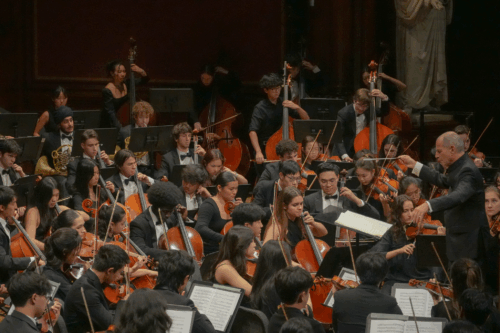
On the evening of Oct. 4, Sanders Theater was filled with tuning notes as the Harvard-Radcliffe Orchestra stepped onto the stage, welcoming the buzzing crowd of students and locals eager for their first performance of the year—notably the orchestra’s first appearance since its suspension. The orchestra was suspended for the rest of the fall semester after a college investigation into alleged hazing during its September retreat at Greenwood Music Camp.
The concert, titled “A Night of Mahler,” paired two of Gustav Mahler’s most famous works: “Rükert-Lieder, GMW 39-43” and “Symphony No. 4, GMW 37.” The performance was conducted by musical director Federico Cortese and was an introspective performance that marked the orchestra’s return to the stage.
To begin the night, Cortese first addressed the audience to explain the message behind the concert. Mahler’s “Rükert-Lieder” is a set of five songs written in 1901, but was left unordered by the composer, giving conductors the freedom to choose their own trajectory with the music as Cortese did.
“I decided to open with a song that is more about nature,” Cortese said. “Then the second and the third song have more to do with love… The second is some sort of argument; if you want to play it this way, ‘don’t look in my eye.’ And the third song is a very sweet love song, which he actually wrote for his wife…Alma Mahler. He’s probably thinking about himself: Do you love me because of my beauty? Do you love me because of my youth? Whatever the case, love me the way I love you forever.”
“These days have been very difficult for us and for the orchestra,” Cortese continued. “ I want to say that they were absolutely wonderful in their commitment and through this focus and love for music. I must say that this is an extraordinary group of musicians and human beings, and I consider myself extremely fortunate, privileged, and proud to be their conductor.”
The audience filled the hall with applause, appreciative of the vulnerability and aware that this concert was more than just a performance; it was also a gesture of resilience amid HRO’s suspension.
As the concert unfolded, “Rückert-Lieder” opened the evening with a quiet intensity. Mezzo-soprano Maire Therese Carmack, guest soloist, carried a voice that was both grounded and delicate, with her phrasing shaped by Cortese’s deliberate pacing. In “Ich atmet’ einen linden Duft,” the orchestra’s strings moved with Carmack as though sharing breath. Her words in the final song, “Ich bin gestorben dem Weltgetümmel” (“I am dead to the world’s tumult”), hovered for a moment before dissolving into silence.
Throughout the act, the harp added a soft glow beneath the voice, while the woodwinds enhanced the piece’s delicate texture. In “Um Mitternacht,” the oboe d’amore and Carmack’s voice expressed a yearning, taking the audience into a layer of darkness. The trumpets, trombones, and timpani grounded the sound with a thick, resonant base that intensified the piece’s emotional depth.
After intermission came “Symphony No. 4 in G Major.” The sleigh bells opened the first movement with nostalgic warmth, evoking a childlike innocence. The second movement introduced sharper, scarier, and rougher tones. As the program noted, “The third movement is the heart of the symphony…transporting the listener through words of pastorality, agony, elegance, hysteria, and sublimity.” The violin intensified the movement’s urgency.
The fourth and final movement unfolded beautifully; soprano Sarah Joyce Cooper, guest soloist, sang with an innocence and wistfulness that resolved into peace. Violinist John Kim ’28 described the serenity of the closing movement and its place within the concert in an interview with the Independent. “The last movement is about a child ascending into heaven. It ends very peacefully, and I think the silence is really part of the music because it sets a very reflective mood in the concert hall,” Kim said. “It was just really beautiful how the audience was also part of the music by respecting the silence of the end of the symphony.”
Contrabassoonist Madeline Zhang ’29 shared that similar feeling of emotion. “Everyone was holding their breath, waiting for the next note,” she said to the Independent. “The silence was part of the music… Sometimes it’s that extra breath right before the next note starts that adds so much more nuance to the emotional experience you’re having.”
She also spoke about Cortese’s approach to conducting. “Every little thing is intentional, and it all means something,” she said. “He told us about what the music represents… The third movement is about really highlighting the end of life.” Zhang commented further how these explanations aided the artistry of the symphony.
That sense of intention was visible throughout the performance. Cortese’s gestures were minimal but precise, his musicians responsive to every shift.
For the musicians, “A Night of Mahler” marked more than the beginning of a new concert cycle. “We worked really hard for this concert,” Kim said. “Our first cycle is always the concert with the most rehearsals. Monday, Wednesday, Friday, two and a half hours each, so we put a lot of time into our first concert every year, and this one too.”
The concert was also a product of perseverance after a month of scrutiny, and the orchestra is now restricted from hosting social gatherings or events except for rehearsals and performances.
Zhang acknowledged the tension present. “It’s important, but it’s what needs to happen so that we can comply,” she said. “It’s normal for us to have a party or a gathering after a concert as a celebration… We are not together to celebrate in any way or form.”
Nonetheless, the HRO is a strong, tight-knit community. “Coming back as a sophomore, it’s cool to see new underclassmen join the orchestra,” Kim said. “I’ve gotten close to a lot of them because we communicate and chat during break times and get to know each other. I think with this new group of underclassmen, we have more of this youthful energy and a freshness.”
Zhang echoed that warmth. “Being part of this organization is the biggest part of how music sits inside me,” she said. “Everyone is so supportive… When I sit in rehearsal, even when I’m not playing, it really hits. And it’s like, ‘Wow, this music is so amazing.’”
Mahler’s music often expresses contradiction: joy intertwined with grief, glory laced with humility. So, too, did this concert. The Harvard-Radcliffe Orchestra’s return was not triumphant in the usual sense. It was introspective, careful, and deeply human.
Katherine Chung ’29 (katherinechung@college.harvard.edu) writes Arts for the Harvard Independent.