Ponderings on Pace
Graphic by Amelie Lima

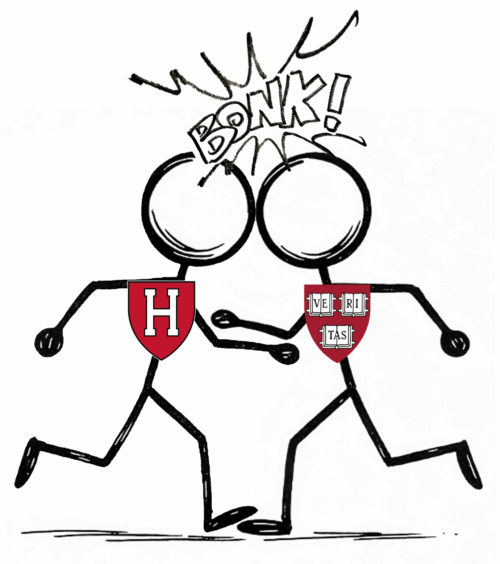
One of my closest friends recently experienced a Harvard student’s worst nightmare: a mid-semester concussion. What shocked me more than her text sharing the news was how it happened: a walking accident. My dear friend was speed-walking to class when she collided with another student, leaving her encounter with a new head injury.
While this incident wasn’t the exact catalyst that made me reconsider my walking speed, it reminded me of the dangers that this constant rushing poses to our well-being. Though I’ve long taken pride in my fast pace, this fall I’ve begun to reconsider the way I walk—and what it reveals about my broader approach to life.
This past summer, I developed something of a superiority complex about my stride. As I hurried past tourists in Times Square on the way to my internship, I relished the fact that I had important places to be, that the high value of my time warranted my brisk pace compared to people meandering from the Red Lobster to the M&M’s Store.
This opportunity cost of my time sat at the heart of that mindset. As an Applied Math concentrator, one of my favorite courses at Harvard has been APMTH 121: “Introduction to Optimization: Models and Methods.” The class taught me to build models to find a solution for any problem. Given a set of inputs—such as material costs, prices, or distances—and a few constraints, I could determine how to allocate resources to optimize output, whether that means maximizing profit or minimizing delivery time. The application areas were endless; we modeled everything from what products a business should sell, to where fire stations should be built, to what laser strength should be used in cancer treatments. Beyond equations and models, though, the class reshaped how I viewed the world: I could frame everything as an optimization problem, including life itself.
In that framework, my objective function or output became the maximization of life satisfaction, the sum of benefits I gained from what I did, subject to constraints like time and money. Optimization often works quite well on a micro-level; it’s useful for planning out your day or how to divide your work time between tasks. But on the macro-level, this overquantifying impulse can fail to capture the soft stuff: joy, or human connection.
For a long time, I believed that optimizing my life primarily meant optimizing my time. We all have 24 hours in a day, so I wanted to make the most out of every second. Speed-walking seemed the perfect solution. Whatever event I was rushing to—whether class, a meeting, or a meal with friends—surely held more value than the commute. By minimizing walking time, I could increase time spent on more enjoyable or “important” things. Each quickened step brought me closer to my goals, and the rush could be translated into a feeling of excitement and ambition for what lay ahead. Those who walk fast are often described as “walking with purpose,” an admirable title at a place like Harvard, which places particular value on hard work and having a defined meaning or passion.
But lately, I’ve started reconsidering the value of the commute itself—not just what it conveys.
A friend once told me that he rarely stopped to talk because I always seemed like I was in a rush: “I wouldn’t want to hold you up,” he said. Another person admitted they’d never approached me for the same reason—I just looked too busy. I realized that, in constantly running between campus commitments, I was sending the message that I didn’t have time for anyone. And what could be a worse use of time than missing a chance to connect with people I care about?
Since then, I’ve made a conscious effort to give myself more time to get places, adopting a more leisurely pace. I’ve started stopping for real conversations instead of tossing a quick “Hi—sorry, I have to run!” And in doing so, I’ve rediscovered something that I didn’t know I’d lost: joy in the in-between moments.
The other day, while walking down Linden Street, I noticed a new sophomore in my House across the street. Instead of waving and walking past, I purposely crossed over to say hello. We ended up chatting for a few minutes before going our separate ways, and I left with a smile and a stronger love for the Eliot community.
Slowing down has helped me cherish Harvard and its people and take pride in the four years I’ve spent here. Every person I’ve met feels like a square in the patchwork quilt of my college experience. Every conversation, no matter how brief, reinforces the stitches that hold that quilt together. When I used to rush past people, I was unknowingly letting those threads fray, and now I’ve committed to patching them back up.
In life, it’s good to have purpose and passion and all those things that make you feel like you should be rushing around to get to everything. It’s exciting to be busy, but it’s important to put your schedule in perspective. Leaving a work session three minutes early won’t make or break an assignment, but it could be just the time you need to make a new friend on your walk.
Frances Connors ’26 (maryfrancesconnors@college.harvard.edu) hopes readers will stop to say hi when they see her walking!