
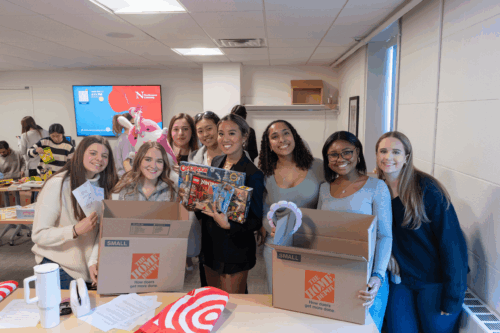
Her story started with loss.
“My situation specifically was born out of a really difficult time,” nonprofit founder Olivia Zhang ’27 explained. What started as a mere effort to memorialize her mentors—her elementary school teacher and grandfather, who Zhang lost both to cancer within two months of each other—led to the creation of Cancer Kids First, the world’s largest youth-led pediatric cancer nonprofit with over 40,000 volunteers across 80 countries.
Visiting her grandfather during chemo treatments in China, Zhang recalled observing significant gaps in quality of care, specifically for “patients in lower-income regions.”
“The [work] that stands out most to me is the work that we do in international countries,” Zhang reflected. “In low-income countries, [the childhood cancer] survival rates are less than 30%, compared to 80% in high-income countries,” a discrepancy Zhang attributed to lack of access to medicine, equipment, and care.
She recalled traveling to Indonesia and Colombia, where she met families whose children were undergoing treatment. Those moments, where she hand-delivered toys and care packages, remind Zhang of why she created CKF: not just to fill systemic gaps, but to reinvigorate patients’ and families’ dignity and joy, values typically neglected by larger institutions.
Since its founding in 2020, CKF has grown into a global force, delivering over $600,000 in resources to hospitals and organizations worldwide, and in doing so, reaching millions online through digital advocacy. This growth, Zhang admitted, was not without its own series of challenges.
“During the pandemic, we were very focused on scaling, and we lost sight of what made us special…the whole fact that we’re built by youth, for youth,” she said. “[Now], we have 111 chapters in different regions so that they could help facilitate that one-on-one interaction with patients and also volunteers.” Zhang prioritized giving local teams autonomy so each region could host its own events and fundraisers while staying connected to CKF’s larger mission.
Zhang’s latest project grew from her large social media presence, currently over 150,000 followers across TikTok and Instagram. Initially achieving viral recognition from videos related to her nonprofit work, Zhang’s social media content more accurately captures her daily life now: “I went viral mainly because of my nonprofit work, but also because I naturally post about Harvard. I was showing the life of running a nonprofit while also going to school at Harvard.”
With millions of views, followers began to ask Zhang for a “how-to guide” on starting your own organization, which, according to Zhang, began as a shared Google Doc with advice and now has over 400,000 downloads.
The public reception to the Google Doc, she laughed, was overwhelming, with thousands of people reaching out to Zhang asking for more, whether it be through one-on-one mentorship or via a podcast or book.
This demand transformed into “Youth: The Young Person’s Guide to Starting a Nonprofit,” Zhang’s debut book, set to be released in February 2026. After cold emailing over 170 literary agents, Zhang landed a publishing deal in early January 2025 and spent months editing and curating the manuscript.
“I didn’t realize how much time and effort went into the creation of a book,” Zhang admitted. Thinking back to her 14-year-old self, Zhang recalled the lack of a toolkit readily available to help her build CKF, especially as she sought answers to questions like, “How do you balance [your nonprofit] with all your AP classes? How do you fire somebody who’s the same age as you or older than you? How do you pitch yourself as a young person to get adults to trust you?”
As the resource she always wished she had, Zhang’s book is more than a how-to guide—she hopes it’s a declaration of youth empowerment. “Younger generations need to feel empowered and like they have the resources to take action and help change the world,” she said.
This zeal to usher a new generation of nonprofit leadership earned Zhang national recognition as one of L’Oréal Paris’s 2025 “Women of Worth,” an annual award honoring 10 women who uplift their communities through service. As 2025’s youngest honoree, Zhang shared how growing up, people often discredited her success. “I would hear people talk about how [I] must have been connected by somebody, or [my] parents paid ‘XYZ’ for [CKF] to grow to a scale.” This sentiment, Zhang noted, remains resonant for so many women in the leadership space, especially young women of color.
“Receiving this honor means a lot, because it’s a reminder for myself to be proud of how much I’ve accomplished, and at the same time, I hope it inspires other young women of color who maybe face similar things, that they do matter.”
As a part of the initiative, Zhang received a $25,000 grant and participated in a series of interviews in Los Angeles, alongside L’Oréal Paris Spokeswomen Helen Mirren, Eva Longoria, and Asia Naomi King.
“In December, I get to bring my mom to a red carpet,” Zhang shared, smiling. “She immigrated to the U.S. with nothing…So I’m really grateful that L’Oréal gave me the opportunity to honor the first woman who inspired me.”
That same gratitude shapes how Zhang sees her generation’s potential. Adults, she said with quiet conviction, often underestimate what Gen Z can accomplish. “But when we’re constrained, that’s when we become most creative,” she explained.
“We’re more in tune with empathy and actual experiences. So I feel because of that, we have a lot of creative solutions to problems that older people can’t necessarily think of,” Zhang said.
Zhang’s vision of leadership is not hierarchical or performative; rather, it’s human. The best solutions, she noted, come when these two worlds work together. “It’s important when it comes to any sort of issues that an old person collaborates with a young person, so you have new and old ideas that come together to address something.”
Rania Jones ’27 (rjones@college.harvard.edu) can’t wait to read Olivia Zhang’s debut book.