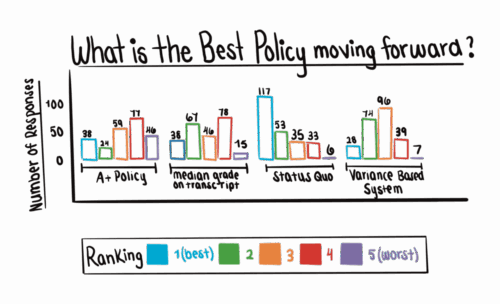
“You Admitted Us Because We Had Straight A’s”
Graphic by Katharine Weiner, Amelie Lima

On Oct. 31, undergraduate students assembled in front of Harvard’s University Hall, voicing frustration and concern. Some engaged in tense discussion, while others called out, “You admitted us because we had straight A’s,” and “We’re already dealing with so much stress.” Their words were prompted by an email sent on Oct. 27 from Dean of Undergraduate Education Amanda Claybaugh. The report, titled “An Update on Grading,” ignited widespread discussion regarding academic policy and student well-being among students and faculty.
“Our grading is too compressed and too inflated, as nearly all faculty recognize; it is also too inconsistent, as students have observed. More importantly, our grading no longer performs its primary functions and is undermining our academic mission,” the report reads. Data from the Office of Institutional Research showed that 60.2% of all College grades awarded in 2025 were As, compared to 24% in 2005.
“Students know that an ‘A’ can be awarded for anything from outstanding work to reasonably satisfactory work,” the report wrote. “It’s a farce.” The report links this upward trend in grading to factors such as faculty competition for course enrollments, high class evaluations, student anxiety about professional outcomes, and a shift from “providing critical feedback to providing emotional support”—not to improved student work.
To address these issues, Claybaugh urged a coordinated response from faculty and administrators. The report calls for instructors to review their grading patterns, reintroduce seated exams, and ensure consistency across discussion sections. The document also proposes allowing professors to assign a limited number of A-grades in each course and record median course grades on student transcripts to provide a clearer context for their relative performances.
“We owe our students grades that send clear signals,” the report continued. “We owe them an education that is meaningful as well as rigorous.”
Student reactions were mixed.
Sidechat, an anonymous online forum popular among students at the College, filled quickly with posts for and against the report. “Harvard will pride their admissions process on placing the smartest and hardest working students under one roof, and then act appalled that students work hard and get good grades,” a post with over 900 upvotes read.
“It’s definitely mixed emotions,” Marielle Howlett ’28 told the Harvard Independent. “I understand the idea of wanting to recenter academics, to really put students back into the role of wanting to learn and wanting to go to class, and I think that’s a big problem. But at the same time, over the past ten years, [Harvard] really focused on doing extracurriculars.”
Nearly every student at the College is involved in an extracurricular activity, whether through one of more than 450 student organizations or among 42 Division I intercollegiate varsity teams. These activities often involve a significant time commitment. Athletes reported spending an average of 29 hours on athletics each week. Meanwhile, many clubs require a rigorous entry process, known as “comping,” and often require similar hours to a University course. Extracurricular activities have become a cornerstone of undergraduate life at the College and are sometimes essential for post-graduate careers.
“Rather than valuing education for education’s sake, we come to see our undergraduate years as a sort of training ground for 9-to-5 office jobs, an opportunity to build a digestible resumé for corporate America,” Cade Williams ’23 reflected four years ago in an Independent editorial.
Moreover, some students fear that the grade report will make their GPA less competitive compared to those of students from other schools. “[The report] will have an even bigger negative, outstanding effect on many other groups of students, especially people who are, say, pre-med, and they need good grades to get into a good med school,” Mariia Solovi ’27 told the Independent. “They’re going to be [at] each other’s throats for the A-pluses.”
In a statement to the Independent, Claybaugh acknowledged the pressures many undergraduates face, and pointed out that students commonly measure success as they did in high school: “[A senior told me that] because they got into Harvard by earning a very high GPA and very high test scores, as well as participating in up to ten activities, they often think that they must do all of those things over again in college.”
“The paths out of Harvard are varied, and each requires something different. PhD programs, for instance, don’t care at all about extracurriculars, while certain industries care relatively little about grades. (I had a fascinating conversation with a tech recruiter, who said that the best person he ever hired had a 3.0 and the worst, a 3.9. What he cares about, he said, is that applicants show that they can teach themselves things outside of class),” she continued.
“So students shouldn’t feel that they must perform at the very highest level in all their courses and all their activities: that’s not possible, and it’s also not necessary. What they should do is figure out what matters most—both for what they want to get out of college and also what they want to do afterwards—and then prioritize those things,” Claybaugh emphasized.
Another key concern in the report was the divide between STEM and humanities/reading-intensive disciplines. “Faculty in the humanities and interpretive social sciences report that they’ve had to trim some readings and drop others entirely…Faculty in p-set disciplines report no analogous concerns,” the report read.
Students share mixed responses on this question. In a Harvard Undergraduate Association survey, nearly half of students in each year agreed that grading policy should differ by concentration.
And on Oct. 31, Dean Claybaugh held open office hours to discuss the report. Sign-ups for the sessions were full within the first hour of Claybaugh’s initial email announcing the opportunity. After group office hours, Yaroslav Davletshin ’28 was convinced of the Office of Undergraduate Education’s mission, particularly relating to the STEM versus humanities divide.
“My concentration is physics and math, so most of the classes that I have taken thus far have been…quite hard. The one Gen Ed that I took (Justice with Michael Sandel), while objectively easier than my p-set classes, was still somewhat demanding and was definitely not an ‘easy A’ class,” Davletshin wrote to the Independent. “On the other hand, the language class that I’m currently taking has extremely generous grading, and I would definitely classify it as a gem. So overall, my impression is that STEM classes are more rigorous and demanding than non-STEM ones.”
“I think it is unfair that we have two systems of grading, two sets of standards and expectations towards STEM and non-STEM students, whereby a Government concentrator, for example, can easily ‘coast’ on all A’s, while a Physics or CS major has to struggle for the same grades,” Davletshin continued.
Humanities concentrators, however, noted that the report used hours worked outside of class as a metric for academic load, which creates an unfair comparison between computational and more conceptual courses that require different skills and thus different time commitments. “A lot of STEM people are like, ‘Oh, I’m STEM, I’m working harder than you,’ but at the same time, [the] humanities is the center of compassion and understanding of other people…it’s vital to the running of our society,” Howlett said.
Claybaugh stressed that the goal of the OUE was to bring classes up to par with each other, not to disparage non-STEM concentrators: “It’s clear that there’s considerable variation across our courses, and so the goal is not to make them all ten percent more demanding or something like that. The goal is to identify the courses that are already providing a rigorous and meaningful education and then bring other courses back up to that level,” she wrote.
The report also noted that in an effort to help students transition to Harvard, the College unintentionally encouraged faculty to become too forgiving in grading.
“For the past decade or so, the College has been exhorting faculty to remember that some students arrive less prepared for college than others, that some are struggling with difficult family situations or other challenges, that many are struggling with imposter syndrome—and nearly all are suffering from stress,” the report delineated. “Unsure how best to support their students, many have simply become more lenient…Requirements were relaxed, and grades were raised, particularly in the year of remote instruction.”
Frustration abounds in students who feel as though their efforts have gone unnoticed, particularly those who identify as First-Generation/Low-Income.
“Most of us from underfunded/underrepresented areas have similar experiences where our peers back home have stellar grades at lower-ranked institutions, and we end up leaving a place like Harvard at a disadvantage despite spending hours more [working] each day,” an anonymous senior in Adams House wrote in a statement to the Independent—some students declined to provide their full name due to public ridicule surrounding recent coverage on this topic by the Harvard Crimson. “We enter a world that, confirmed by Harvard’s own recent caving, increasingly thinks A’s are given out like candy.”
Claybaugh emphasized that outside perception was not a factor in the move to recenter academics. “We began thinking about the grading in the aftermath of the pandemic, and we worked on the first grading report in spring of 2023,” she wrote. “Yes, universities are under attack right now, but it would be a grave mistake, I believe, to let those attacks drive us into paralysis or a defensive crouch. We have to continue doing what we think is right for the College, no matter what’s going on outside.”
“Critics of higher education like to blame grading trends on snowflake students and negligent faculty, but that hardly describes the faculty and students at Harvard,” the report continues. “Our grading trends are driven by other forces… Our students are as talented and capable as they’ve ever been; we’re more dedicated to our teaching than ever before.”
Grades are due from faculty members in December and are released in January; the effects of the report will be seen then. For now, the relation between Harvard’s reputation and the perceived difficulty of classes reigns for many, as a freshman in Greenough Hall stressed to the Independent: “It is an issue if people think Harvard is easy; we would rather they think we are rigorous. It makes our degrees more valuable.”
Caroline Stohrer ’28 (carolinestohrer@college.harvard.edu) writes News for the Independent.