How Much Do Harvard Students Sleep?
Graphic by Justin Ma, Amelie Lima

Around the country, higher education institutions are teeming with sleep-deprived students. Harvard is no exception: a campus culture of exceeding expectations made insomnia a sort of rite of passage. Students routinely juggle the demands of academics, extracurriculars, and social life, often at the expense of rest.
“The status quo is, are you tired and bad or tired and good?” said Summer Tan ’26 in an interview with the Independent.
These words reflect a widely researched and documented trend of insufficient sleep among college students. “Most college-aged students need 7-9 hours of sleep in order to avoid daytime drowsiness (inability to concentrate or remember and slowed reaction time), altered mood states (anxiety, irritability, and depression), weight gain, poor health, and low energy,” a Cornell Health page reads. Scientific literature also shows that sleep deprivation is a major issue for college students in particular. This manifests in a myriad of ways, from all-nighters to anxiety-induced insomnia—but the consequences are the same: burnout and exhaustion.
The Office of Undergraduate Education revealed on Oct. 27 that 69% of faculty at the College believe “Harvard students do not sufficiently prioritize their coursework.” This does not appear to align with actual college-affiliate experiences.
In a survey conducted by the Independent across all four undergraduate classes, students commented that sleep fell lower on the list of priorities—a result of a desire for academic productivity.
Survey Findings
The grade-level distribution across the 205 polled students was relatively balanced: 23.9% of those surveyed were from the Class of 2029, 45.9% from the Class of 2028, 18% from the Class of 2027, and 12.2% from the Class of 2026.
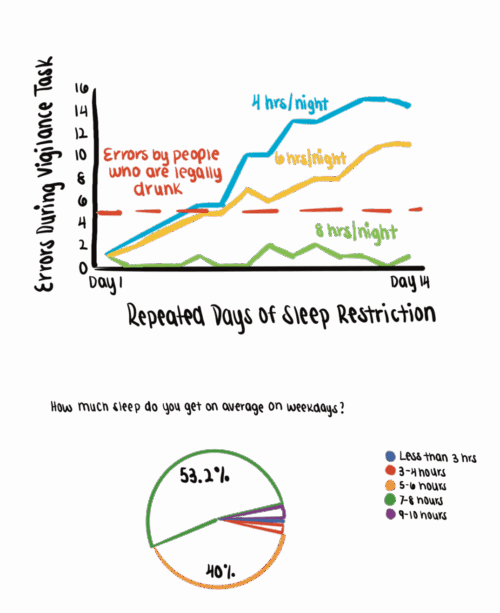
Among all surveyed Harvard undergraduates, nearly half reported getting less than six hours of sleep on a typical weeknight; the average nightly sleep duration was 6.62 hours, and 40.2% of students disclosed experiencing only five to six hours of sleep per night.
The numbers remained fairly consistent when broken down per grade level. Students in the Class of 2026 reported an average of 6.72 hours of sleep per weeknight and 7.92 hours on weekends. The Class of 2027 reported sleeping slightly more than the seniors, averaging 6.80 hours of sleep per weeknight and 8.27 hours per weekend night. Meanwhile, reporting the least amount of sleep on school days, the Class of 2028 had an average of 6.54 hours of sleep per weeknight and 7.84 hours on weekends. Finally, the Class of 2029 reported an average of 6.60 hours of sleep per weeknight and 7.70 hours on weekends.
Significantly, none of the classes had an average number of weeknight sleep hours within the recommended range for college students, suggesting that almost half of Harvard undergraduates are sleep-deprived.
The Independent observed that the weekend average across all respondents was 7.86 hours, indicating a common trend of “catch-up” sleep, a term defined by the National Institutes of Health, where students attempt to compensate for rigorous Monday through Friday schedules.
Survey comments suggested heightened sleep deprivation during midterms, with one student reporting getting only two to four hours of sleep during peak exam season, a threshold that somnologists classify as chronic sleep deprivation. This trend was primarily observed in students concentrating in STEM fields; students pursuing the humanities reported more consistent sleep patterns.
In interviews with the Independent, two students described their unique struggles in prioritizing sleep. Their experiences reflected different survey comments, pointing to the difficulty of maintaining a balanced and regular sleep schedule.
Student Profile: Summer Tan ’26
In her freshman year, Tan, a Social Anthropology and East Asian Studies concentrator, accidentally adopted what is known as a biphasic sleep pattern—essentially two naps comprising a night’s sleep. She would sleep for four hours at the beginning of the night, spend the early hours of the morning working on assignments, then sleep again for a few hours before class. “I would be awake almost every night, from 3 a.m. to 6 a.m.,” Tan explained. “I had an Apple Watch at the time. I would look at the screenshots of my sleeping time, and I would just be like, ‘this is a patchwork quilt.’”
Tan’s story seems to reflect a general campus sentiment: “I mean, look around,” she said. “Do you see the dark circles and eye bags we have?”
Through the adoption of this sleep pattern, Tan became what the National Institutes of Health deems an “irregular sleeper.” Irregular sleep patterns lead to compensatory daytime sleep. These sleep patterns also result in delayed circadian rhythms—the body’s natural clock, which runs on a 24.27-hour cycle for adolescents and young adults. Irregular daylight exposure for those awake at night and asleep for many hours of the day makes it increasingly difficult for irregular sleepers to adjust to sustainable sleeping patterns.
Tan expressed concern that the new grading policy, encouraging an evaluation of grade inflation, will further exacerbate already concerning sleep patterns. “If [it] means that people are getting three hours instead of four hours a night, that’s probably what a good amount of students are going to do until they burn out and then decide that they need to sleep for an entire year,” Tan said.
“I think, in general, it’s not going to be good for campus culture, academic culture, how people view themselves and what they owe each other in terms of self-care, and also in terms of what reasonable expectations are.”
Students across campus share Tan’s concern regarding the effects of grade deflation on sleep. “Workload is a lot, grading certainly should not become harder,” one survey respondent wrote.
At the beginning of her sophomore year, Tan developed a chronic illness, which she and her doctors believe was largely attributed to her long-term lack of sleep. “When you enter enough of a sleep deficit, everything is just in survival mode. If you’re in survival mode for a long enough time, everything gets a little messed up, because your baseline is no longer that of a healthy, normal person,” she explained.
It took a chronic illness for her to realize the true adverse effects. A drastic lifestyle change was the only option for her to get her health in order. “I was recovering and on a treatment plan for that, and I needed so much sleep, right? Like, for a baby, getting 14 hours a night and still being tired,” Tan said. “It’ll be fine if I’m more tired in my late 20s. Because right now I have a p-set that’s due. And then it came on all at once, and I was like, ‘Oh, now I can’t even do my p-set.’”
“I think there are some people who manage to have really healthy, balanced sleep schedules and still show up for their extracurriculars and have excellent attendance and submit excellent academic work, but I think it requires a level of discipline and willingness to let go of certain things that the average Harvard student is just not going to have,” Tan said.
Student Profile: Ellie Chen ’28
Not all students on campus suffer from sleep deprivation. Varsity lacrosse player Ellie Chen ’28 shared a different perspective in an interview with the Independent.
As both a varsity athlete and a Social Studies concentrator, Chen has a busy schedule yet still manages to get seven to eight hours of sleep every night, despite waking up at 6:15 a.m. for practice. Practice starts anytime between 7:30 and 8 a.m., and players are expected to be in the locker room by approximately 7 a.m. At 10 a.m., practice ends, and Ellie goes straight to her 10:30 a.m. class. On top of a day of classes and practice, she must make time for assignments and extracurriculars, while also leaving time to spend with her friends.
Chen is one of 1,200 student-athletes across 42 Division I teams at Harvard. To sustain both her mental and physical health, she, alongside her athlete peers, must remain disciplined in the face of heavily structured and often-exhausting practices.
“Last year, I sacrificed my sleep for doing my assignments and staying up, and really trying to balance everything. But this year, I made it a priority to make sure that sleep comes first,” she said.
“Scientifically, getting eight hours of sleep is just better for your health and your performance in general,” she explained. To ensure she gets her eight hours, Chen set a hard deadline for herself. “10:30 is when the lights are off and everything is done, and I’m going to bed.”
Studies have shown that sleep is directly correlated with academic performance. In his course PSY 1: “Introduction to Psychology,” Professor Daniel Gilbert presented data in his lecture showing that an individual who gets six hours of sleep for two weeks straight will perform almost twice as poorly as someone who is under the influence of alcohol. From days six to eight, they performed at around the same level as those who are legally drunk.
Chen also talked about her own experience with juggling spending time with friends and getting enough sleep.
“There are times when I struggle with it a lot, because I’m the type of person who just likes to say yes to everything. But I also really think that if you can make sure to prioritize your workload and your sport throughout the week, the weekends are really the opportunity to get into your social scene,” Chen said.
Between socializing and recuperation, she pointed to the importance of the weekend in order to maintain balance. “The weekend is also time for relaxation, like your body is tired from practicing all week, and you really have to take care of it on the weekend to prepare for the next week.”
Chen describes the key to setting aside time for socialization as devoting tiny sections of your schedule to seeing friends.
“Finding time for social life comes in kind of just little bits throughout the week, like either attending an event for like an hour or two just to see people and talk to them. It doesn’t have to be like going out and really like spending five hours at a time hanging out with people,” she explained.
…
The Independent’s 2025 Sleep Survey suggested that sleep deprivation is prevalent among undergraduate students at the College—the average amount of reported sleep per school night was 6.62 hours, which is below the minimum of 7 hours that the Centers for Disease Control and Prevention recommends for adults.
Moreover, according to the NIH, sleep has numerous benefits both to your mental and physical health. Mentally, getting enough sleep helps your brain retain information, and it improves learning and problem-solving skills. On the physical side, adequate sleep heals your body, supports growth, and boosts your body’s immune system.
The survey data points to a persistent gap between the importance of sleep and students’ ability to achieve it. And, with the new grading policy, it may become more difficult for students to find a balance between work, life, and sleep.
Pippa Lee ’28 (pippalee@college.harvard.edu) struggles with getting eight hours of sleep, while Mia Wilcox ’28’s (mwilcox@college.harvard.edu) insomnia and 9 a.m. combo gets her a solid four hours.