Thoughts from New Quincy: Hydrotrope
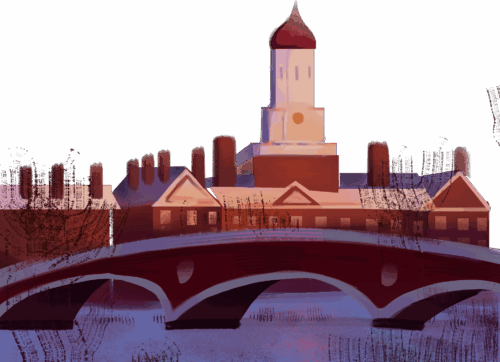
Graphic by Chau Nguyen

At the river’s edge, a single stem divides the current. Its roots grip the narrow seam between concrete and clay, where the residue of the city collects—rust, pollen, glass dust, fragments of old coins. Gnats hover above the water in small, quivering loops. A film of oil drifts past, breaking the reflection into bruised color. The mud smells mineral and sweet, like rain caught in iron. Each ripple carries silt against the roots, polishing them smooth. Beneath the surface, bottles roll against stone, their edges knocking softly like teeth.
Morning comes as a pale wash of light crawling through fog. The air is damp enough to taste. Far off, a train crosses the bridge, its rumble arriving through the ground before its sound reaches the ear. The vibration trembles through the water, through the stem itself. The light strengthens gradually—first pale gold, then white—touching every wet surface with the same indifferent hand. The stem leans toward it, slow and exact, rehearsing the same movement that has kept it alive.
The river beside is half reflection, half forgetting. On clear days, it behaves like mercury; on others, silk. What looks smooth from above is fissured beneath, filled with sediment that remembers every tide. At the meeting point of current and silt, even a small tremor stirs a leaf lifted briefly into light before sinking again.
Light moves across the surface in brief, trembling shapes of gold. Every flicker translates—sky to wave, wave to stem, stem to shadow. Beyond the river bend, the path fills with motion: the steady percussion of runners’ feet, the soft whirr of bicycle chains, the distant shimmer of a bell marking the hour. Traffic moves across the bridge in slow, even waves, its sound thinning as it falls towards the water.
Each noise reaches the water changed—thinner, slower, translated by distance into rhythm. The river listens without reply, absorbing every vibration until it becomes a single, continuous note. Nothing is kept or lost; only rewritten.
By noon, the color of the day thickens. The light no longer drifts, but presses. Heat gathers on the river’s surface until it quivers like glass in the wind. Shadows tighten around the roots, and the ground hums faintly with warmth.
On the surface, light falls through the membrane, scattering into green. Invisible apertures pulse with the air, drinking what the city exhales: carbon, oxygen, vapor—each particle caught in the choreography of need. The leaf trembles as it works, its veins pulsing with the slow arithmetic of transformation. Photosynthesis: the oldest dialogue between stillness and desire, between what reaches and what receives.
Every second, the plant converts the city’s breath into something clean.
Above, the bridge drops its shadow in precise intervals. Cyclists flash across it in colors that disappear. To them, the river is background, not body. Still, beneath their reflection, the bridge trembles. Every structure carries its ruin inside its image.
I have no seasons, only temperatures of light. The river brightens when the city does—its glow borrowed from windows, from wires, from the sky’s own reflection. Algae bloom and vanish in rhythm with this electricity, a second photosynthesis feeding what should be dark.
When rain begins, it sounds like language before meaning, each drop a percussion against the leaf and surface. The river rises slightly, greedy for more. Water slides down each vein, tracing its memory of gravity.
Evening enters by reflection, not color. The skyline liquefies into its own echo until the city and surface become one quivering plane. Artificial light moves impatiently. It can be absorbed but never kept.
For a moment, the city loses focus—buildings blur into color, glass unspooling into orange, blue, and silver light. Architecture becomes reflection, indistinct and weightless. Then the water settles, and edges return. Stillness resumes, as if composition were the river’s instinct. The air cools, and the river begins its long rehearsal for frost.
Ice crawls from the banks, sealing the current until it forgets to move. The air sharpens to a thin, colorless blue; even sound turns brittle. The wind moves in thin, splintered melodies, like glass under pressure. Even echoes freeze before they form.
The light has no warmth now, only sharpened clarity. It falls straight through the bare branches and lands on the ice in clean outlines. Frost webs the concrete, each pattern vanishing the moment it’s noticed. Beneath the surface, the stem endures—a pulse beneath glass, slow as breathing in sleep. Its roots tighten in the cold mud, sensing motion more than making it. Even frozen, it listens.
Above the frozen skin, the city quiets—the hum of traffic flattened, footsteps swallowed by snow. Steam rises where birds once moved. Light hardens into a reflective blade; ice returns it perfectly, a canvas of precision. Some mornings, the surface seals each detail in transparency. Beneath it, the current moves. Still, the water breathes.
Thaw begins with sound: ice cracks into water. The river releases its hold. Fragments drift downstream, catching light in cold flashes. Color returns without warmth—green silt, brown sediment, a strip of yellow plastic lodged in the reeds. The surface arranges itself into a collage: bottle caps, feathers, branches, wrappers, each held briefly in harmony before dispersing. Sunlight moves across them, turning waste to shimmer.
Along the bank, new shoots push through the mud. They do not wait for purity; they grow through residue, feeding on what the city leaves behind. To live here is to metabolize contamination—to turn what’s thrown away into the texture of renewal. Each leaf that opens is both inheritance and repair.
By spring, the bank gathers its debris again: plastic, paper, nylon threads, a bright array of persistence. Against the litter, new shoots push through, their color too bright for the dirt that feeds them.
The river paints over itself endlessly. Yesterday’s skyline blurs into the water; light and debris mix into a new color. Branches drag lines across the surface, breaking reflections into strokes. Each ripple redraws the edge between river and shore.
At dusk, when the city softens into its own reflection, a final warmth lingers along the water. The light bends sideways, gilding what endures. In that hour, reflection and form dissolve into one another. The difference between above and below ceases to matter. Light bends on the surface until it can’t decide which it belongs to.
Art begins in that confusion—when reflection turns real, and the river starts to paint back. The river and the plant make their own kind of work, reshaping what touches them and erasing what’s left behind.
In that quiet, what remains unseen continues: the slow circulation of breath, the invisible labor of conversion, the patience that keeps the world from collapsing. Night folds the bank into darkness, and the exchange continues—carbon into air, speed into rest, sound into silence.
Nothing concludes. The surface smooths itself, and what was once bright becomes background again.
The rhythm persists:
to slow is not to stop,
to remain is not to fade,
to breathe is to begin again.
Luke Wagner ’26 (lukewagner@college.harvard.edu) is the Managing Director of the Harvard Independent.