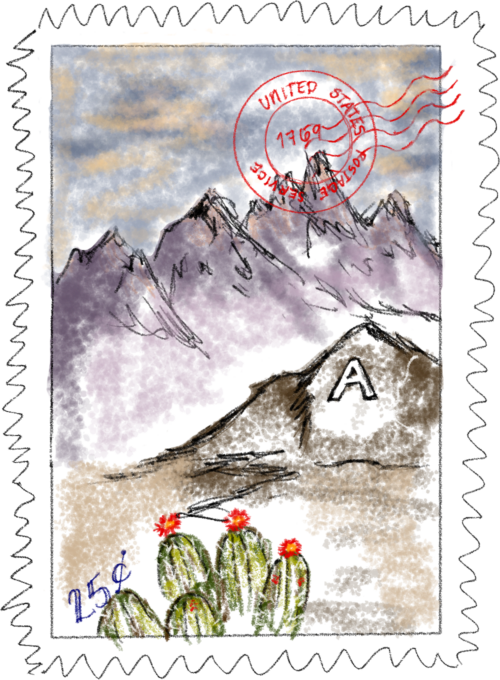
Exploring American Hometowns: Las Cruces, New Mexico
Graphic by Megan Legault

Jan. 26, 2026
I called my grandparents this morning, as I have done every Sunday since I moved away from Las Cruces, New Mexico.
The conversation flowed as it usually does. First, they ask about my academics. Secondly, we fall into a brief digression on the tribulations of the pecan tree harvest, as my Grandpa is a farmer in the Mesilla Valley. From there, the conversation can go anywhere. It could be an anecdote from American history, a story they saw on KFOX14’s nightly programming, or a printed comic strip they read somewhere and thought would offer me wisdom or amusement.
Though the topic of conversation is never identical, there is one thing I can always count on. At some point, we will discuss what has become my family’s biggest concern since my great escape to the East Coast: the cold weather.
In the months that followed my acceptance to Harvard, my house could have been easily confused for a winter clothing consignment shop. Hand-me-down coats, scarves, gloves, and boots piled up high in every corner. Aside from being the first person in my family to pursue my undergraduate degree somewhere other than New Mexico State University—a ten-minute drive from just about anywhere in the 575 area code—I was setting a precedent. I was the first to venture to the East Coast, let alone anywhere further or colder than Colorado.
After living in Las Cruces my entire life, I can say with confidence that if you ask people why they live there, you’ll get one of three answers:
Las Cruces is what we locals deem a “retirement town.” After 9 p.m., the only places open are fast food restaurants kept open by the labor of high schoolers or a Circle K. For those of retirement age, the predictability of warm weather, familiar faces almost everywhere, and the ability to push anything off until “mañana” with minimal consequence is comforting. However, as I grew up there with dreams that many people (including myself most days) thought were impossible, simply because of where I was from, these constants provided me the opposite. They felt like a trap I needed to escape.
My brother immediately enlisted in the Navy upon graduating from high school, whereas I saw Harvard as my golden ticket out. Like many young people from the area, we felt compelled to do little more than move far, far away.
This Christmas was the first time I saw my brother in over two years. It was also the first time he had ever brought a girl home. While I cannot deny that there is something mildly nauseating about seeing your sibling puppy-eyed and in love, getting to watch him introduce someone to our hometown for the very first time forced me to see it in a different light and appreciate the very area I had sought to leave for years.
Experiencing home like a tourist is something many of us have admittedly never done before; even my roommate from Manhattan has never been to the Statue of Liberty.
I never admired the fact that the White Sands National Monument was quite literally in my backyard. I didn’t see the beauty in Adobe architecture or the holiday tradition of luminaria-lined streets. I took for granted the numerous authentic, incomprehensibly delicious Mexican food restaurants where, like the Chris Young song, I have no need for a menu—especially at El Sombrero, where tacos are always 50% off on Tuesdays. I took for granted things as simple as the natural beauty of our vibrantly colored, unobstructed sunsets and non-light polluted night sky where the brightness of stars contrasts the total darkness.
Despite the rich history of Mesilla Plaza and its creation from the Treaty of Guadalupe-Hidalgo, I did not feel the chills that I did standing among the history of Harvard’s campus for the first time. The history of Las Cruces and Mesilla had been replaced, in my mind, by the history of my own life and rendered insignificant. Take, for example, the building where Billy the Kid was sentenced. To me, that is just where my grandma would take me for ice cream after spending a day catching tadpoles in the ditch banks of her farm.
I had become unaccustomed to the familiar comforts of home. I caught myself complaining numerous times about how hot it was—it was 50 degrees and sunny. The difference between wet and dry heat is noticeable, especially after adjusting from the frigid winters in Boston to the scorching 115-degree summers of Las Cruces, where you can literally cook an egg on the sidewalk. The people, too, seemed to resemble the weather: cold in Boston, warm at home.
Last week, as I received the many disappointing emails from Mary Ann Bradley announcing that class would continue after Winter Storm Fern, I was reminded of a funny parallel. During my Harvard alumni interview, I was asked an unexpected question: “What would you do if you had a snow day?” If you aren’t from Las Cruces, this question probably makes no sense. For me, though, it was a genuinely intellectual exercise—we rarely get snow. On the rare occasion we do, half an inch justifies schools and everything else being closed.
What I did not yet understand was that for my interviewer, who was also from Las Cruces and had done her four years in Cambridge, this was a hidden joke—something I didn’t realize until today.
Though it might sound silly, it took Harvard College rejecting the concept of a snow day (with snow mounds taller than my high school best friend, Sarah) for me to realize that home has become something I now run back to, not away from.
I run to the embrace of warm weather, warm food, familiar faces, and most importantly, my family, who have lived there for generations. Our state’s history, much like that of a family, is dictated by collective memories, unlike anything I have experienced anywhere else in the world. Shamefully, it took me acquiring a chronic case of homesickness, and probably frostbite, from the other side of the country for me to see the warmth of home.
As our weekly call came to a close, it was me who joked about the weather: “You know what, Grandpa? I finally had to walk uphill both ways to school in the snow today. I thought that was a joke. They weren’t kidding. This shit’s hard.”
Megan Legault ’28 (mlegault@college.harvard.edu) would sell her firstborn child for a “Christmas” (red and green chile) combination plate from her favorite local restaurant right now.