
From Mar. 6 to Aug. 2, the Harvard Art Museums is displaying “Celtic Art Across the Ages,” an exhibit curated by Susanne Ebbinghaus, Penny Coombe, Laure Marest, and Matthew Rogan with sculptures, paintings, and artifacts dating from 800 BCE to today. This exhibition is the first major showcase of Celtic art in the United States, featuring artwork spanning almost three millennia and illuminating the rich and complex history of the group.
A common misconception is that the Celtic people are exclusively from Ireland, Scotland, and the British Isles. Their history is actually significantly more complex, spanning multiple continents.
While many people today believe the Celts are from Ireland, they are actually a diverse group of people who lived throughout Europe, including what is now Ireland and Britain, starting around 1200 BCE. “Celtic” is an umbrella term that contains the sub-groups of the Gauls of mainland Western Europe, Britons of the British Isles, Galatians of Anatolia, and more. In fact, many of the objects and artifacts in Harvard’s exhibition were excavated in modern-day France, Germany, northern Italy, and even as far as Slovenia.
The etymology and history of the word “Celt” are highly debated, and it is unclear what the term used to mean. Originally, it was a Greco-Roman term used to refer to the “barbarian” tribes surrounding their empires. Today, the word “Celtic” typically refers to speakers of Celtic languages, including Irish, Gaelic, and Welsh, among others.
In pop culture, the word “Celtic” has a different definition than it does in history. Contemporary society often associates it with stereotypical images, such as the leprechaun mascot of Boston’s home basketball team.
Recognizing these common misconceptions, the gallery opens by guiding viewers through its presented artifacts. Before entering the gallery, the wall display over the entrance already begins to tell a story. Located on the left is a close-up of an ornament from 800 BCE, and on the far right is a piece of Celtic art from the 20th century. Although they appear to be similar at first glance, this subtle difference reveals that Celtic art is an ongoing form of expression for a group of people whose identity has been consistently overlooked and misrepresented.
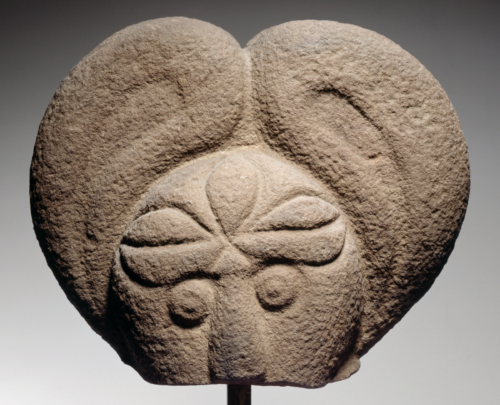
After walking through these images of Celtic ornaments, viewers are immediately brought face-to-face with the “La Tène head from Heidelberg,” a fragment of a statue cut off right below the nose. Made of sandstone, the statue once stood taller than the average person, and was placed outside a Celtic burial mound from 450 to 380 BCE. The figure depicted is thought to be a warrior or druid, wearing a crown of leaves dubbed “Mickey-Mouse ears” due to its resemblance to the contemporary rodent character. Unlike Greek art of the same period, the Celtic statue is abstract instead of hyperrealistic—the face has a “palm-tree” motif on its forehead, perfectly circular eyes, and stylized hair detailing on the reverse side.
The next room of the gallery is filled with bronzes and various decorative items, such as jewelry or burial items. It is important to note that, unlike more stable metals such as gold, bronze decays and turns green over time. This means that many of the objects have lost their original luster. To honor their original states, the museum collaborated with an expert at the Massachusetts Institute of Technology to recreate the “Bracelet or Anklet Fragment” from the fourth to third century BCE. Next to the dull and green-tinged original is the gleaming reconstruction, allowing viewers to imagine how stunning these pieces of jewelry would have been when they were worn.
The exhibit also displays the stunning and intricate bronzework of Celtic metalworkers. The “‘Dome with Dragons,’ from a chariot burial at Roissy-en-France (Val d’Oise),” initially seems like two concentric circles with a vine or leaf motif. However, if viewers look closely at the shapes, they may notice the almond-shaped eyes representing the heads of seahorse-like creatures.
Art historians are unsure what Celtic artists called these figures; the modern approximation is “dragon.” Like an optical illusion, it is initially difficult to make out the bodies of these creatures, but once someone does, they cannot “unsee” them. As the dragons swirl in and out of the rings, viewers are left marveling at how the artist created such fluid movements out of bronze.
Because of the famous artwork by Greek and Roman artists of the same period, Celtic art is often overlooked or less studied. The style was distinct from the others: more abstract. However, a case of coins in the exhibition illustrates that this did not ring true for all works. Curated by Marest, who is an expert on ancient coins, the installation proves that the Celts were capable of imitating this realism—they simply were not interested in it.
The first set of Celtic coins was minted in the 4th century BCE in Greece by Alexander the Great’s father, Philip II, and depicts his side profile wearing a crown of leaves. Next to it, the Gallic imitation of these coins is remarkably similar, depicting Philip II with slightly more detailed facial features. However, by the second century BCE, the Gauls had abandoned the serious realism of the Greeks, minting a coin depicting a side profile with luscious, flowing curls, the face taking up only a small portion of the space. The last coin in the installation is even more abstract; the only recognizable part is a chevron-like pattern, representing the laurel wreath in the original coin.
As you enter the final room of the exhibit, the curators follow the development of Celtic art beyond the ancient and medieval periods. The conquest of Celtic Gaul (modern-day France) by the Roman Empire under Caesar’s reign in the first century BCE significantly changed Celtic culture. The gallery displays a 19th-century plaster cast of the Roman-era statue “Dying Gaul,” depicting a wounded Celtic man in a realistic style. It serves as a reminder of the conquest of the Celtic people, evoking feelings of shame as the figure stares at the ground in defeat. The man has unkempt hair and a torc, a type of Celtic necklace, perhaps conveying the Romans’ view of the Gauls as “barbaric.”
The rest of the exhibit emphasizes the continuation of Celtic art into the 20th century and beyond. A case of silver objects from more contemporary Celtic silversmiths concludes the gallery. It includes the “Freedom of the City of Edinburgh Chest,” which was owned by Joseph Patrick Kennedy Sr. (John F. Kennedy’s father), illustrating that Celtic culture lives on through the lives of Irish-Americans.
The exhibit does more than educate its viewers on the complexity and beauty of a forgotten cultural group—it also tells a story. It tells the narrative of how a people: their conquest, their incorporation into a dominant culture, and their reemergence in the modern era.
“Those people that Greeks and Romans considered barbarians actually made this really elaborate, technically, highly skilled art,” Ebbinghaus said in an interview with the “Independent.”
“Celtic Art Across the Ages” is an unprecedented project—and it’s right in our backyard. Many of the objects are on loan from collections all over Europe, such as the British Museum, the National Library of France, the National Museum of Ireland, and more. In fact, the “Stater of the Arverni,” a gold coin depicting the Gallic chieftain Vercingetorix, is one of the few remaining coins of its kind. The particular coin on display is extremely rare because the imprinted text is still fully legible.
“This is the first major exhibition in the U.S. on this topic. So, many of the things are on view for the very first time,” Ebbinghaus said. “And I think that’s also what made our colleagues at the lending institution so excited that they really sent us some of their star objects, because they felt almost a missionary zeal to make this art known here in this country.”
The Harvard Art Museums is located on 32 Quincy Street and open Tuesday to Sunday, 10 a.m. to 5 p.m. “Celtic Art Across the Ages” is located in the Special Exhibitions Gallery on the third floor. The exhibit also features an interactive, family-friendly activity and frequent performances, which you can learn more about on their website.
Kalvin Frank ’28 (kfrank@college.harvard.edu) and Ellie Guo ’29 (eguo@college.harvard.edu) are the Arts Editors for the “Independent.”
Head, 450–380 BCE. Sandstone; height: 29 cm, width: 36 cm, depth: 13.5 cm. From Bergheim, Heidelberg, Germany. Badisches Landesmuseum, Karlsruhe, C6828. Photo:© Badisches Landesmuseum, Karlsruhe; Thomas Goldschmidt.