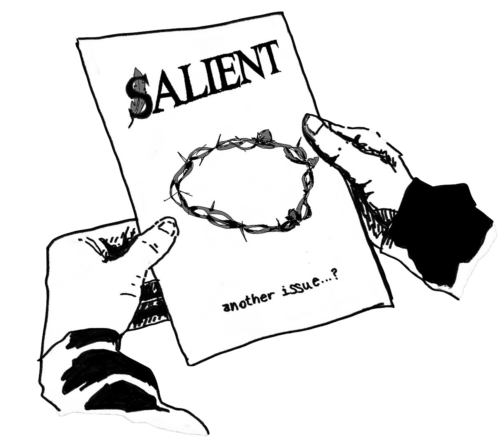
Students Respond to the “Salient” Revival
Graphic by Sage Willey

“Neo-Nazis at Harvard? Not surprised,” Aaron Thompson ’27 said.
“They’re just very ‘red pill,’ irritating men, you know? Just terrible,” an anonymous sophomore in Mather House added.
“I think the revamp is a scam,” another sophomore in Cabot House commented.
In the wake of a leadership shakeup at the “Salient” due to past publication of antisemitic, sexist, and racist material, the conservative student magazine publicly relaunched on Feb. 27 with new interim president Keri Collins ’29 and revised editorial guardrails. But despite internal restructuring, many Harvard undergraduates say the publication’s effort feels less like a reset and more like an unwelcome return. Some students chose to remain anonymous, given the severity of the rhetoric discussed.
The collapse of the “Salient” began publicly in late Oct. 2025, when its board of directors announced it would suspend the publication after article drafts surfaced that the publication’s graduate board of directors called “reprehensible, abusive, and demeaning.” This came alongside “credible complaints” about the organization’s broader culture. The most widely circulated flashpoint was a Sept. 2025 draft article by David Army ’28 that included lines closely mirroring rhetoric from Adolf Hitler’s 1939 Reichstag speech.
Army’s piece urged a return to values “rooted in blood, soil, language, and love of one’s own,” explicitly invoking “blood and soil,” a Nazi slogan historically used to tie ethnic purity to land and justify exclusionary nationalism and territorial expansion.
By Dec. 2025, internal documents and message logs tied to a student complaint involved members’ casual use of racial slurs in group chats, draft materials containing swastikas and Nazi slogans, and an unpublished issue described as featuring a call for mass executions.
After months of turmoil and resignations, the “Salient” is now trying to rebuild under interim student leadership, including a pledge to abandon pseudonyms and restructure editorial oversight.
That promised reset has not impressed some undergraduates, who said the relaunch feels disconnected from the magnitude of what happened. “I don’t necessarily know if there’s a need for it,” Thompson said. “This whole revival campaign feels more gimmicky than anything.”
“It’s kind of like, coffin buried. You’re six feet under. Stay there.”
For the sophomore in Mather, the pattern was familiar: “I would hear about something that they had written, and I would then go back and read it and just be disgusted,” the student said. “I never respected them just based off of the things that they choose to write about and say,” the student added.
“I don’t understand how they’re still allowed to operate on this campus after the whole N-word scandal,” the sophomore from Cabot said.
Before their “scandal,” the “Salient” was recently revived in 2021. This followed a surge in right-wing ideology amongst college-age men. The publication door-drops its issues to all upperclassmen houses and freshman dorms. This led some houses to add black mailboxes last year in response to management concerns about fire hazards from door drops, combined with the “Salient’s” concerns that their issues were being trampled.
According to the “Salient” website, it has distributed over 117,000 issues and maintains 3,700 substack subscribers—though student sentiment does not always agree with such readership statistics.
“I never really took the ‘Salient’ seriously in the first place,” Thompson said.
“I had never heard of the ‘Salient’ before the scandal,” Steven Miall ’29 said.
The scandal arose around the same time President Alan Garber ’76 responded to the Trump Administration’s concerns that the University marginalized conservative perspectives. University administrators have since reaffirmed the need for “intellectual vitality” on campus.
“If Harvard is the place for diversity of thought, you can have that. You don’t have to agree with opinions,” Thompson stated. “In instances where you channel, cite, are inspired by, or allude to things that I don’t consider controversial but more dehumanizing … that’s where you draw the line.”
“If it’s known it’ll incite a lot of backlash … you’re starting something that doesn’t need to be started,” Miall commented.
A month before the Trump Administration called for Harvard to become less politically liberal, a “Salient” article published in September encouraged Harvard to consider reinstating the pre-Radcliffe merger, which separated the men’s and women’s colleges. The article emphasized the distracting nature of female students on-campus.
“People who like Hawaiian pizza—that’s a controversial opinion, if you say you like it,” the Mather sophomore said. “But to say something that’s hateful towards a specific group isn’t a controversial opinion. That’s just straight-up disrespectful and discriminatory.”
“It does make me think about the group as a whole,” Miall said. He elaborated on his belief that when students choose to identify with an organization, outsiders often assume that the organization’s published positions reflect the organization’s collective beliefs. “The stuff they’re saying, it usually tends to mirror what the group is thinking,” he said.
The challenges facing the “Salient” also spilled beyond Cambridge, becoming another headline in the ongoing national debate about Harvard. Students said that scrutiny comes with the institution’s brand. “The New York Times” reported on the suspension in Oct. 2025, featuring the controversy around the “Salient’s” use of Hitler-adjacent rhetoric and the board’s decision to halt operations.
“The name of Harvard sensationalizes everything. So I think that kind of comes with the territory,” Thompson said. “[Outside] publications are publishing things that may not reflect the full truth or don’t necessarily center a student’s narrative.”
The anonymous Cabot student agreed that scrutiny scales with prestige: “I think any school with the status that Harvard has will be scrutinized to a higher degree,” the student said. “People just need to remember that things can be extremely sensationalized by the media,” the student added.
“I think if you really want to know what’s happening on Harvard campus, you just got to talk to normal students,” they concluded.
Courtney Hines ’28 (courtneyhines@college.harvard.edu)is the News Editor for the “Independent.”