
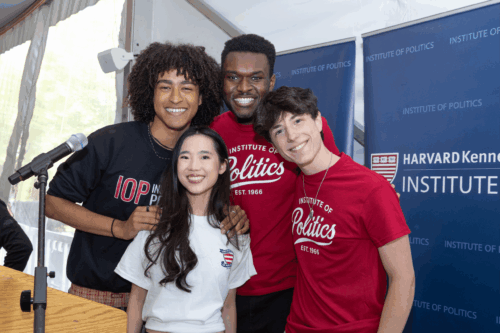
The Harvard Kennedy School’s Institute of Politics closed its fall 2025 Common Application on Sept. 12. Since then, its 18 student programs and four coalitions have welcomed a new cohort of undergraduates committed to civic engagement. Following a politically turbulent summer, the IOP reported one of its most engaged application periods in a non-election year on organization record.
“We are so grateful to our fellow students for their passion and interest in pursuing public service,” IOP Vice President Summer Tan ’26 wrote in a statement to the Independent.
“The scale of enthusiasm and excitement—from all corners of our campus, but especially freshmen—is like nothing we’ve ever seen,” Communications Director Lorenzo Ruiz ’27 wrote.
Since its founding in 1966, the IOP has stood as one of Harvard’s core centers for public service and leadership. Its outreach to University-affiliated undergraduates and graduate students alongside global political leaders drives strong engagement every semester. This fall was no different, with the organization receiving 1,506 applications—an approximate 191% increase from their spring semester numbers.
“This semester’s cohort is big, but more importantly, it is rich and reflective of the diverse backgrounds, interests, and aspirations of Harvard students,” Ruiz continued.
Across the 1,258 unique applicants, a few IOP programs saw especially significant growth in interest.
The Fellows and Study Groups program forges a network between students and leaders in politics, government, journalism, and activism. The IOP announced the FSG’s fall 2025 resident and visiting cohort on Aug. 25: Ambassador Mari Carmen Aponte; New York Times chief White House correspondent Peter Baker; former-U.S. Secretary of Education Dr. Miguel Cardona; New Yorker staff writer Susan Glasser ’90; Indiana Governor Eric Holcomb; former senior advisor at the National Republican Senatorial Committee Brock Lowrance; former senior State Department and Central Intelligence Agency official Ned Price; Ambassador Katherine Tai, and former Senator Pat Toomey ’84 (R-PA).
Over their fellowship terms, the eight residents will host seven weekly off-the-record study groups and special events in formats ranging from Q&A sessions to open dialogue between each expert and attendees, while visiting fellow Toomey will host programming during the window he visits campus.
On Aug. 25, Harvard undergraduates were invited to apply to serve as liaisons for any one of the fellows, a member of the Fellows Search Committee, or a member of the larger FSG Leadership Team. Six liaisons are chosen per fellow to assist in study group planning through weekly meetings. The FSG program aims to foster both a personal and professional relationship between liaisons and their designated fellow over the next few months.
This semester, the FSG received 321 applicants, marking the highest program turnout in its history. For comparison, spring 2025 saw 284 distinct applications.
“We were able to more than double the number of students accepted into our program, a direct result of our efforts to broaden access and open our doors to more students than ever before,” FSG co-chairs William Smialek ’27 and Zoe Yu ’27 said in a statement to the Independent. “We’re incredibly excited to welcome this outstanding class of students, our remarkable cohort of fellows, and the meaningful conversations that lie ahead.”
Alongside FSG, the IOP’s John F. Kennedy Jr. Forum brings in speakers for non-partisan speeches, panel discussions, and debates over politically relevant topics. Past guests have included heads of state, as well as leaders in business, arts, and media. On Sept. 25, journalist Maggie Haberman will take the Forum stage. On Sept. 30, former Vice President Mike Pence will speak on the future of American conservatism. The full Forum schedule is available on the IOP’s website.
The forums conclude with a Q&A session between audience members and panelists.
Undergraduates can apply to serve on the JFK Jr. Forum Committee, where they will be responsible for assisting Forum staff with event production, working on strategy, outreach, campus engagement, receptions, and social media. These students will also have the chance to help moderate the Forums themselves.
Similar to the FSG, the JFK Forum received the most program applicants in its history, coming in at 267.
Founded in 1969, three years after the FSG and Forum, the Harvard Political Review welcomed over 200 members following an application process that featured skill-building in policy, politics, and culture reporting. The HPR encourages students of all specialities to apply and join, regardless of prior journalism experience.
Beyond its long-standing programs, the IOP has launched a few new initiatives over the past few years to account for expanding curiosities and international reach.
“One and a half years after we first discussed building a space exclusively for global affairs at the IOP, we are proud to have reached official program status,” Global Affairs Program co-chairs Erik Dalaker ’27 and Sarp Nalbantoglu ’27 wrote to the Independent.
GAP is the first and only group within the IOP dedicated to international diplomacy and relations. Members organize speaker events and Socratic-style seminars centered around international governance. Launched as a pilot program in the spring of 2025, the program attracted a record-breaking 200 applications, leaving Dalaker and Nalbantoglu optimistic about the program’s future.
“We have now selected a talented group of 45 students from 25 different countries and are very excited about the semester ahead!” Dalaker and Nalbantoglu said.
Following in the GAP’s footsteps, the Program for Environmental Politics is the IOP’s newest addition. Originally the Coalition for Environmental Action, the revamped PER will serve as a forum for its 21 members interested in the intersections of environmental science, activism, and governance.
Alongside these policy-oriented offerings, the IOP also saw an increase in direct service opportunity engagement. For instance, the Citizenship Tutoring program—which pairs student tutors with Harvard affiliates in guiding them through the American citizenship test and application process—accepted over 100 members.
With recent University engagement with the Trump administration leaving Harvard’s politics in flux, the IOP’s nonpartisan future and civic engagement goals remain unknown. However, the executive board emphasizes their commitment to the space for both current and prospective members.
“As our members settle into our 18 programs and four coalitions, we remain committed to making the IOP a home for every student interested in public service, regardless of beliefs or background,” Tan concluded.
Sara Kumar ’27 (sjkumar@college.harvard.edu) is the News Editor of the Harvard Independent.