A New Normal for Taiwan
Graphic by Neshama Ryman

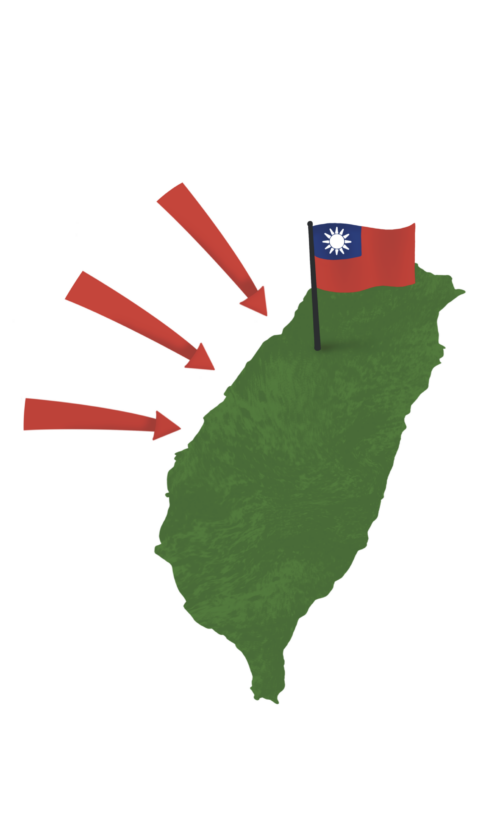
On Dec. 30, 2025, the People’s Liberation Army launched what it called “Justice Mission 2025”—a two-day operation during which PLA artillery units fired 27 rockets into the waters surrounding Taiwan while Chinese ships and aircraft reportedly practiced repelling an approaching enemy force. The operation marked a sharp escalation in a long-standing trend of aggression from Beijing toward Taiwan, raising questions about President Xi Jinping’s intentions in a period of heightened geopolitical uncertainty.
“December of 2025 not only constituted the largest air and maritime presence around Taiwan ever, but attempted to normalize that presence as a new peacetime baseline,” Asia security expert Dr. Mira Rapp-Hooper told the House Select Committee on the Chinese Communist Party in early February. This comes in the months leading up to President Donald Trump’s summit with Xi, which will occur in China at the start of April.
For some, exercises like “Justice Mission 2025” demonstrate Xi’s resolve to take Taiwan by force. “Beijing’s aggressive maneuvers around Taiwan are not just exercises—they are dress rehearsals for forced unification,” Admiral Samuel Paparo, who heads the U.S. Indo-Pacific Command, reported to the House Armed Services Committee last spring. An invasion would test the resolve of key Taiwanese allies like Japan and the United States, whose current war with Iran could disrupt Washington’s ability to send forces to the Indo-Pacific.
Another possibility is a Chinese blockade of Taiwan. During Justice Mission 2025, eight of the 19 Chinese ships that entered Taiwan’s contiguous zone—the area within which the country’s laws can be enforced—belonged to the Chinese Coast Guard. Their presence could be indicative of a larger role to come; enforcing a blockade would mean relying heavily on CCG ships to carry out “inspections” of merchant vessels. Such inspections could worry the underwriters who insure commercial cargo ships, potentially severing Taiwan’s energy and supply lifelines.
In the past, China has also leveraged economic and diplomatic pressure. Ahead of the 2024 Taiwanese presidential election, Chinese officials met with Kuomintang (KMT)—the Chinese Nationalist Party—leadership and temporarily imposed embargoes on the import and export of several important Taiwanese goods, like pineapples. They hoped that voters, feeling economic strain, would support the KMT, which was more willing to negotiate with Beijing than the Democratic Progressive Party is. Despite these measures, the DPP’s William Lai prevailed.
To understand the path forward, the “Independent” spoke with Professor Rana Mitter, the S.T. Lee Professor of U.S.-Asia relations at the Harvard Kennedy School. He emphasized the importance of recent turnover in the Central Military Commission, referring to the fact that in January, CMC generals Zhang Youxia and Liu Zhenli were placed under investigation for “serious violations of discipline and law.”
In removing them, Xi effectively completed a purge in military leadership that had been ongoing for the duration of his time in power. Mitter believes that these changes make an imminent confrontation unlikely. “We have to assume there is serious turmoil within the CMC, which makes it less likely there is an immediate plan for a military confrontation over Taiwan,” he said. “An attack on Taiwan would involve a very complex amphibious operation.”
Charles Horner, an expert on U.S.-China policy, also said an attack is unlikely in the short term. Horner served as the Deputy Assistant Secretary of State under Presidents Reagan and Bush and is the co-author of “Hiding a Dagger Behind a Smile: The Coming Era of U.S.-China Relations.” He works as a senior fellow at the Hudson Institute, a Washington-based foreign policy and national security think tank. “Military leaders tend to be cautious about the use of military force,” Horner said in an interview with the “Independent.” “And the prospect of a thoroughly rearmed Japan has got to be very unsettling—the Japanese are an enormously capable people.”
Horner emphasized that the CCP has other priorities. “The CCP struggles every day to maintain its monopoly on political power in a country of 1.4 billion people,” he said. “That is a daunting task.” According to Horner, in light of this struggle, Chinese leaders are likely to avoid a potentially costly invasion of Taiwan.
Their concerns are heightened because China relies on trade amid broader economic uncertainty. With new home sales at a 15-year low and apartment prices plummeting, exports are crucial for maintaining growth. For this reason, Horner thinks that a blockade is unlikely. “The People’s Republic of China may have the ability to blockade Taiwan, but its own links to the world can be severed easily,” he said. “The CCP’s leaders know that about 90 percent of China’s oil comes in by sea.”
Mitter described a similar effect: “If there were a conflict over Taiwan, it would mean huge amounts of physical destruction and air and shipping routes would be disrupted, not least because insurers would be cautious about protecting vessels in the area.”
In light of these potential disruptions, China may opt for other short-of-war strategies, like attempting to influence Taiwan’s 2028 elections using “information warfare.” The 2024 Annual Report to Congress, produced by the U.S.-China Economic and Security Review Commission, reported that “the CCP’s Propaganda Department and a PLC psychological warfare unit would conduct election influence campaigns through news outlets and social media.”
As a result, social media has been flooded with propaganda, much of it AI-generated. One such fake news clip accused President Lai of corruption. Other videos, some even depicting U.S. leaders, intend to push the narrative that Taiwan is on its own and should negotiate with China.
Horner suggested that Beijing views non-kinetic tactics like those as the safest path forward. “The CCP’s leaders believe they can undermine Taiwan’s will to resist with a variety of political, economic, and psychological pressures,” he noted. “They also believe that key foreign countries can eventually be intimidated into abandoning Taiwan. So why bet the future of the regime on one throw of the dice?”
With Japan’s decision to deploy missiles to an island near Taiwan and Trump’s looming summit with Xi Jinping, tensions remain high. But for now, Beijing seems resolved to play the long game.
Morgan Jay ’29 (mjay@college.harvard.edu)writes News for the “Independent.”