A Review of “Merrily We Roll Along”
Graphic by Crystal Manyloun

When I first saw the title “Merrily We Roll Along,” I mistakenly assumed that it would be carefree and joyous, like the nursery rhyme it references. However, within the first minute of the musical, I was thrown into a story in which no one is merry. In fact, the “rolling along” captures the twists and turns of life that can easily throw us onto the wrong path.
“Merrily We Roll Along,” Stephen Sondheim’s adaptation of the 1934 play, is a story of ambition and friendships told in reverse chronological order. The musical begins at the end of the story in 1977 with a party hosted by Franklin Shepard (Kaylor Toronto ’27). Ben Arthurs ’27, the director of the show, describes Franklin as a “jaded sellout, a producer of mediocre Hollywood blockbusters” in an interview with the Harvard Independent. As the party unfolds, it’s clear his friendships and romances are in shambles—his second wife spurns him for having an affair, and his ex-friend screams at him in disapproval of his materialism. Though he has a luxurious and high-profile life, he is merely a husk of the passionate young composer he used to be.
As we progress backward in time, we learn that Franklin had a messy and public falling-out with his co-writer and best friend Charley Kringas (Bernardo Sequeira ’26). Along with drama critic Mary Flynn (Grace Hawkins ’28), they once formed an inseparable trio. In his romances, Franklin’s marriage to his first wife, Beth Spencer (Carolyn Yujie Hao ’26), ends in divorce after he has an affair with Gussie Carnegie (Gabrielle Greene ’27), a flamboyant Broadway star.
The songs that take us through the story are in the style of Broadway show tunes, paralleling Franklin and Charley’s work in musical theater. They encompass a wide range of numbers—from energetic showstoppers to delicate ballads. The actors encapsulate the hopes and dreams of each character with every movement, word, and note.
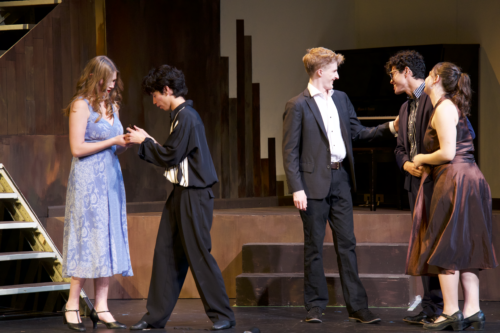
Ida Chen ’27, the scenic designer for the show, transports us to a luxury apartment, a cruise ship, and a dingy nightclub—without major alterations to the set. The spiral staircase and platform transform seamlessly into these settings with the help of lighting, designed by Jocelyn Shek ’27. An upright piano stands in the heart of the stage, reminding us of Franklin’s humble roots, driven by a passion for music.
The musical ends in 1957 with the moment when the three friends first met. Knowing what will become of them—Franklin loses everything in pursuit of money, Charley’s creative visions never come to fruition, and Mary descends into alcoholism—we are left to mourn the optimism and innocence that the characters once held.
Arthurs described the plot as a series of Franklin’s bad decisions. “You’re really rooting for him to make the right choice, and then he doesn’t, every time,” Toronto told the Independent. “I think he often has trouble with prioritizing what really matters, because he sees the big, amazing things in front of him, and that’s always where he goes.”
I experienced the tragedy of Franklin’s story in cycles of anticipation and disappointment. Each time he faces a choice, he allows his ambition for fame and fortune to take over at the expense of his relationships.
For example, in the scene in which Charley and Franklin have their first hit show, Charley records the audience’s applause on a tape recorder. However, Charley’s wife is in labor, and he has to rush to the hospital. Franklin is alone on stage while he listens again to the audience’s cheers. He clutches the tape recorder to his chest, shaking it gently. The gears seem to turn in Franklin’s head as he reckons with his potential to make it big—a temptation he fails to resist, as he ends up abandoning Charley’s satirical political play for a commercial musical.
The complexity of Franklin’s character shines through Toronto’s portrayal, inviting the audience to sympathize with him. His subtle actions—a clench of the fist, a voice that gets softer and less overwhelmingly confident when he is alone—constantly remind us that Franklin is human, too. Drawing attention to Franklin’s humanity is crucial for the audience to experience the full scope of disappointment and desperation that comes with watching a tragedy.
This tragic, dramatic irony pervaded every character’s portrayal as the cast worked together to constantly remind us of how Franklin’s life deteriorated.
For example, Beth first sings “Not a Day Goes By” when she is divorcing Franklin. Hao conveyed the tiredness and resignation of a mother with a broken spirit in each note. But in the reprise, when Beth is singing her vows to Franklin during their wedding, Hao’s singing carried across the theater in a gentle and pure voice—reminding me of the tragic irony of her character’s fate.
Sequeira conveyed how Charley’s bitter resentment of Franklin at the beginning was once an innocent ambition to succeed in the show business with his best friend. In “Franklin Shepard, Inc.,” a number at the beginning of the show, Charley publicly expresses his anger at Franklin’s financial motivations on live television, leading to the end of the friendship. Sequeira oscillates between bursts of outrage and begrudging politeness. Though he is sitting on a couch with Franklin, he maintains a forced distance between them, physically showing the strain on their friendship.
This is contrasted with the genuine, almost endearing, nervousness Sequeira portrays in younger versions of Charley, who is tense and fidgety. During “Good Thing Going,” Franklin and Charley perform one of their original songs for an audience for the first time. Sequeira relaxes during sustained notes in the number, highlighting the deep-seated passion for music that Charley and Franklin once shared.
Franklin’s own development can be traced through how Toronto “de-ages” the character as time travels backward. In the opening party scene, Franklin is unwaveringly confident—shoulders back with his hands in his pockets, commanding the room. As the story moves to the past, Toronto gradually incorporates hesitation and naivety while Franklin gets younger. His voice is shaky during tense conversations with Charley, and his smile seems more genuine.
I was especially impressed by the final scene. The three best friends meet for the first time under a starlit sky, clad in their pajamas. They express their amazement at their unlimited potential to succeed, and join pinkies together in a secret handshake. Franklin hesitates, a directing choice by Arthurs which Toronto interprets when “the oldest version of [him] jumps into this younger body.” As Franklin realizes what is going on in the scene in front of him, the light becomes harsher, and shadows on his face grow sharper, making him appear physically older on stage.
The costumes, designed by Giselle Paulson ’27, also immersed the audience in the reverse chronology. The three friends’ clothing gets progressively less refined and neat throughout the play. Franklin’s tuxedo, immaculate in the first scene, devolves into a creased and wrinkled suit, showing his journey from a penniless composer to a rich sellout.
Beth’s costuming represents her heartbreak as well. When we first see her, she is wearing a starkly contrasting white blouse and black skirt, representing the clear-cut divide between spouses as she divorces Franklin. But later in the play, she is dressed in light pinks and rosy reds, representing her love for her family.
What struck me most was the thematic message of the play, perfectly placed in its context as a performance by and for Harvard students. We are similarly filled with potential to succeed, constantly facing the tension between the sincere passions that brought us opportunity and the desire for financial security. In this critical period of our lives that bridges childhood and career, “Merrily” invites us to think introspectively about the choices we make every day. Are we, like Franklin, saying “yes” to things when we should be saying “no”?
As Arthurs wrote in the program, “a story like this one strikes at the core of both our dreams and our doubts. As one cast member summed up after a first sing-through, ‘Merrily’ is difficult to perform ‘because this could happen to me.’”
The show is ultimately a cautionary tale. Arthurs added that “as the show goes backward, we see more and more of how easy it is to go down these dark roads in the chase for success and lose sight of what’s important.”
I left “Merrily We Roll Along” feeling catharsis, which Aristotle defines as a critical part of a tragedy.
The Harvard-Radcliffe Dramatic Club will be showing “Merrily We Roll Along” Loeb Drama Center from Oct. 22 to 25. Tickets can be purchased at the Harvard Box Office website.
Ellie Guo ’29 (eguo@college.harvard.edu) did not expect to be put on an emotional rollercoaster on a Monday evening.