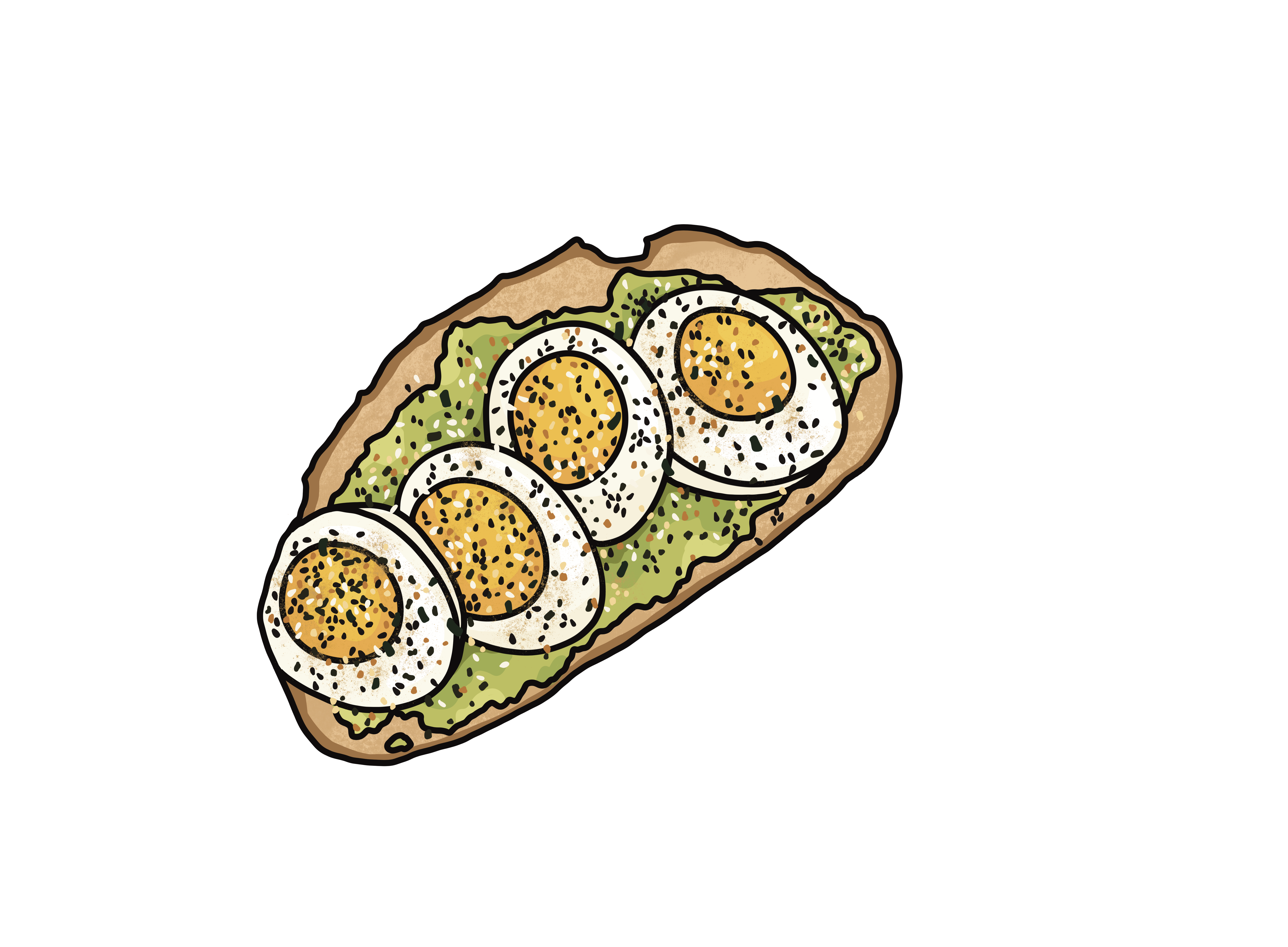
A Satirical College Essay: Furikake on my Avocado Toast
Graphic by Linden McCarl

Harvard values building a diverse student population and asks applicants to reflect on their roots and how their backgrounds shape them as students today. In exactly 893 words, describe your roots and their impact on your personal growth.
I am a vessel of my ancestors during the most unexpected of times.
They do not visit me in dreams or make their presence known as I roam the streets of Taiwan, photographing signs for Google Translate. They do not bless me with forgotten knowledge during my Advanced Placement European History unit exam on the Victorian era. No, my ancestors are far too selective for that. They intervene only in moments of dire consequence.
It’s in the grill parties on warm summer nights in California, surrounded by friends and family, when I stand at the condiment table and confront the binary that begs me to identify my existence: Kewpie Japanese mayo or Hellmann’s mayo on my sandwich?
I am Wasian, a child of two proud citizens of the Republic of Wasia, founded in the late twentieth century after the two provinces finally put the Green Tea Feud of 1979 behind them. My mother comes from the Eastern Province and my father from the West. While the two sides officially reconciled after the Treaty of Tea (commonly known as the TreaTea), historians agree that lingering tensions persist. I am a melting pot of traditions and geopolitics, serving as a symbol of Wasia’s interprovincial reconciliation. From afar, I am a symbol of peace. But inside my head, a constant war rages over how to represent my nation, especially from across the ocean.
I can often feel my East-Wasian ancestors on my left shoulder and my Western ancestors on my right—my great-grandmother Pam-Mei of the East at war with my great-grandfather Ignacy of the West, locked in a heated argument across my collarbones. While it may seem like a trivial choice, one that should be determined by flavor preference, my condiment preference is a choice between which province of Wasia to publicly favor. Until Hellmann’s drops their own Kewpie mayo, I must choose between my regional identities, at least momentarily.
“This,” my ancestors murmur in my ear, “is why we endured. Why we fought. For your strength, for your decision, for your being.” Whose struggle for power do I honor through this sandwich?
Perhaps their intervention comes at odd times. I do know this—it is something I’ve grappled with my whole life. When I most desire them, their voices disappear. My ancestors are not impressed by accolades or awards. I heard no whispers of congratulations when I founded a nonprofit that provided clean drinking water to 1,000,000 underserved communities at the age of ten. They were silent when I rescued one of the Queen’s swans from drowning in a pond at Hyde Park, and I was given the Queen’s Award for Voluntary Service.
But my East-Wasian ancestors seem to speak for me when someone asks where to find Lao Gan Ma chili crisp at H-Mart, and my Western delegation chimes in to locate Cadbury chocolate fingers at the Waitrose off Gloucester Road. During these times, I feel the full weight of my lineage lean forward in their chairs behind me, infusing me with wisdom, knowledge, and the strength to walk down aisle three.
In this struggle, I have come to see the discourse of my ancestors as no longer an argument to tune out, but a (not so) gentle reminder of their presence.
“You are Eastern,” Pam-Mei insists. “You love scallion pancakes and don’t digest dairy properly.”
“Ignore her, Audrey,” Ignacy replies. “Once you take Lactaid, you are Western. Join us for some croissants and tea this morning.”
I remain torn, but in the struggle, I find some comfort. Without their disagreements in my ear, there would be no discussion. And without discussion, would Wasia even exist?
Harvard asks me to describe my roots, and I will not offer a miraculous reconciliation or outlet in how I choose to identify myself. It’s not something I think I can ever resolve, unlike my work at the latest Davos Conference, where I streamlined the creation of a five-century plan for environmentally conscious AI initiatives. But to Harvard, I offer myself as a curious individual eager to come to campus and open this often-overlooked discussion.
At Harvard, I hope to pursue a degree in the rigorous interdisciplinary field of Wasian History Studies with a secondary in Psychology. I want to spend my next four years diving deeper into courses such as WSNS 102: “The White-Washing of Matcha,” and WSNS 1067: “Keanu Reeves, Alyssa Liu, and Olivia Rodrigo: Role-Model Wasians.” I am also greatly interested in contributing to Professor Walton-Shi’s research on the “Wasian Check” TikTok trend and its geopolitical implications. I am eager to immerse myself in a discipline that sits close to my heart, and more importantly, my shoulders.
But for now, I will continue to live my embodied experience as a Wasian, listening to my ancestors’ thoughts and learning to define my identity on my own. Perhaps, this is what Harvard is really asking—the willingness to keep sitting with the question, even when both provinces insist they have the answer. I’ll put Kewpie on one half of my sandwich and Hellmann’s on the other. It’s no longer just a sandwich; now, it is a representation of me.
Audrey Adam ’27 (audreyadam@college.harvard.edu) is planning a girls’ trip to Wasia this summer.