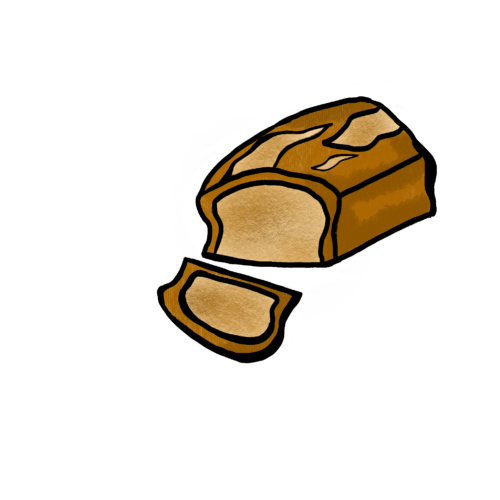
At My Khala’s House, We Eat Banana Bread
Graphic by Christiana Zembrowski

Tuesday, Feb. 6, 2024
I hear a rustle from outside our college dorm door, and I know that my roommates, Ella and Mia, are back from class. Together, they burst in, throw down their bags, and sprawl themselves on the couch. Ella complains about her upcoming sociology paper, and Mia gets started on her next Organic Chemistry problem set.
From my desk chair in the next room over, I hold in my hands the one thing I know they need most: my Khala’s banana bread. Quietly taking the loaf out of the Ziploc bag, I walk into our common room, beginning to peel back the layers of the foil.
“Girls, guess what I have…”
In unison, they shriek in the way only 20-something-year-old girls can: “THANK GOD FOR YOUR AUNT!”
For three years now, the loaves of banana bread have come one at a time, roughly every three weeks. It’s become a ritual. I collect the bread from the mail room, while my roommates arrange crumpled paper towels on the floor to catch the crumbs. By the time I carry it upstairs, they are gathered and expectant.
The loaves are always wrapped in layers of miscut, fraying tinfoil, and I can see the corners of the bread poking out through the tears. Together, we fight over the extra-baked corners of the bread, and our room becomes a cacophony of affectionate arguing. We nibble using chopsticks and other assorted pieces of plastic cutlery. Each loaf is gone in just a day or two, leaving us anticipating the arrival of the next.
Sunday, April 5, 2013
“Ranno, I’m about to put the bread in, and it should be ready in around an hour. Capeesh?”
Sitting across the kitchen island from my Khala, my brother and I twist and spin on our barstool chairs. The chipping black leather from the barstool seats clings to the back of our sticky arms and legs. We laugh and sip our Shirley Temples, intently focused on our Khala’s mixing and folding. I hear the clatter of her metal spoons, the rustle of flour and sugar bags, and the oven door shutting with a certain finality. My Khala’s lip gloss cracks along the plastic rim of my cup as she steals sips of my drink.
I am eight, but I don’t feel that way. She makes me feel like a real adult, slipping me her “Princess Number One” bites of banana bread batter from a plastic spoon for approval.
In her kitchen, I know where everything lives: the chipped Miami Ohio mug on the second shelf, the drawer under the sink with the good scissors, and the pan on her stove that sticks no matter how much oil she uses. There’s something deeply intimate in knowing where a person keeps their pots.
I swing my legs back and forth from the stool. And my brother, beside me, copies.
***
My Khala has always been my ally. She took me to the malls my parents wouldn’t and read me the books they never had the patience for. But when my mom passed away three years ago, the foundation of our relationship fundamentally altered. It lost its sort of gritty innocence—the plastic raincoats, the Shirley Temples, the brittle laughter. My feet could touch the floor from her barstools, and she no longer lived down the block, but across the country, and had for eight years.
Distance drew a gap between how we each experienced our grief, though I imagine it took a similar shape. After all, the mother-daughter relationship isn’t so different from the big sister-little sister relationship. They were each other’s compass throughout life, just as my mother was mine.
***
It was at my Khala’s house that I first learned how to crack an egg and turn on a stove. She was the one who showed me that vanilla extract doesn’t actually taste as good as it smells and that too many chocolate chips can, in fact, be a bad thing for a batch of cookies. We frosted cupcakes on her kitchen island and drew smiley faces on each other’s cheeks with the excess flour. She picked me up so I could look at the microwave to watch the butter melt and sat on the hardwood floor beside me while we waited in front of the oven for the cookies to rise. It was these moments that I missed most when she moved to California in 2014.
***
My phone buzzes roughly every three weeks at school with a message along the lines of: Ranno, I went to the grocery yesterday and bought overripe bananas for bread this weekend. I’m old and like to bake you bread.
Since my freshman year, just a year after my mother’s passing, week by week, the loaves arrive from across the country—California to Cambridge. It’s a unique form of warmth to open homemade banana bread in the mail room of a college dorm building.
Banana bread is what you make when fruit goes soft—when time has turned, and you can’t stop it. It’s a salvaging of sorts. I’m unsettled with what it tells me about survival, though: that we will always be expected to make do with what is left. I did not think compromise would taste like banana and nuts and half-melted chocolate chips.
To lose a mother is to lose the principles of care. My Khala, my mother’s sister, has been teaching me a new language. I eat banana bread because it is part of how my Khala and I communicate now. It’s how she communicates her care. “Have I told you lately how proud I am of you? I feel so lucky to be your Khala. You are an amazing human, Ranno.” And how I respond back. “I’ll be okay, I promise.” Those same hands that once painted my nails over ripped newspaper clippings now hold space for my grief. My aunt, in so many ways, is what is left of my mother, just as the bread is what is left of the banana.
I’ll spend the rest of my life tiptoeing around the jagged hole my mother’s death left. But my Khala is stitching it back together. Thread by thread, loaf by loaf. We’re still figuring out what this should look like together. And as we do, the bread remains. It’s a ritual, a form of care. It’s the impossible manifestation of carrying on.
To knead, to wait, to rise again.
Rania Jones ’27 (rjones@college.harvard.edu) needs to learn how to make banana bread.