Avoid the Building with My Family’s Name
Graphic by Miranda Chao Hwang

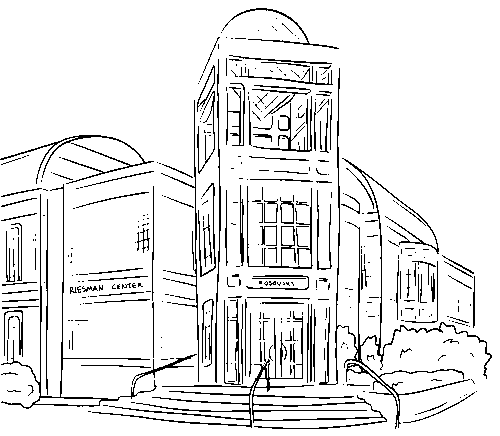
The Riesman Center for Harvard Hillel was once my refuge.
As a struggling undergraduate, I found comfort there, and not because my family’s name was chiseled into its edifice. I was welcomed at its dinners, warmed by its community, and guided by leaders who seemed to genuinely care about a better Jewish future. But today, the Riesman Center for Harvard Hillel, the building that bears my family’s name, has lost its way. That is why I must urge you: do not attend or affiliate with it.
I write only for myself, but I utterly condemn the organization’s refusal to put up any kind of fight against the tidal wave of genocidal racism and violent authoritarianism that has engulfed the campus, the country, and Jewish institutions around the world. Although the Riesman Center’s actions and sins of inaction feel like a personal betrayal and a betrayal of my family legacy, none of that matters. The important thing is that Hillel is not protecting Jewish students. It is not protecting any students. By going along with the Trump agenda, the Riesman Center for Harvard Hillel is setting Harvard students up to be targets.
Harvard’s Muslim students, international students, immigrant students, and students of color are already at dire threat. The presidential administration wants every one of these groups off of campuses; indeed, they want many of them deported or perhaps even sent to one of America’s newly constructed concentration camps. By going along with a state of affairs where Jews are the one minority it’s ostensibly ‘not okay’ to discriminate against (while open Nazis and Nazi sympathizers staff the halls of the executive branch), Harvard Hillel is making Jewish students into cogs in the machine of Trumpist oppression, whether they like it or not.
However, it wasn’t always like this. My first journey to Israel/Palestine was organized through Harvard Hillel, back in the summer of 2005, and it was led by the organization’s then-director Bernie Steinberg. Just a few weeks before his death and years after retiring, Bernie published an op-ed in the Harvard Crimson denouncing the way right-wing forces weaponize the word “antisemitism” to attack Palestinians.
“Let me speak plainly: It is not antisemitic to demand justice for all Palestinians living in their ancestral lands,” he wrote. “It is very telling that some of Israel’s own supporters instead go to extraordinary lengths to utterly silence the other side. Smearing one’s opponents is rarely a tactic employed by those confident that justice is on their side.”
But now, Bernie is gone, and the picture on campus has changed.
Despite an early stance of resistance, Harvard’s administration is now showing signs it will capitulate to the Trump administration. Hillel on campus has stayed silent and aligned with parent organization Hillel International’s agenda of suppressing Palestine solidarity and uncritically supporting Israel, even as that nation-state commits internationally recognized genocide against Palestinians.
Here in the U.S., as students from non-Jewish minority groups face threats and detentions by Trumpist forces, Hillel International’s CEO has offered only a tepid statement that he and his organization “understand those concerns.” When Donald Trump says he’s committed to taking “forceful and unprecedented steps to marshal all Federal resources to combat the explosion of antisemitism on our campuses,” Hillel International believes him—or at least is happy to go along with him. Meanwhile, Rabbi Jason Rubenstein, the current director of the Riesman Center, has said nothing publicly about the recent abductions of students. He has other priorities for his days.
Just weeks ago, Rubenstein privately announced to Hillel affiliates that the Riesman Center would host an emissary from the Jewish Agency for Israel this school year. This organization aims to bridge the gap “between American Judaism and Israeli Judaism, and of humanizing the latter against the dehumanizing misrepresentations.” More troubling, Rubenstein in the internal email proudly identified this emissary as “an alumnus of the elite 8200 intelligence team in the IDF”—the same unit that is currently providing intelligence data for targeted killings in Gaza and coordinating with Microsoft to surveil Palestinians.
This is only the most recent moral disaster within the organization.
When a Hillel-affiliated student posted flyers depicting the genocide in Gaza alongside words from Jewish liturgy, Rubenstein called the police instead of engaging with the substance. In his public response, the word “Palestinian” appeared exactly once. The words “genocide” and “war crime” didn’t appear at all.
When Harvard, under Trump’s pressure, closed its DEI offices, gutted the Center for Middle Eastern Studies, and ended the Israel/Palestine dialogue program, Hillel said nothing. When Harvard pulled funding for race-based affinity groups’ graduation celebrations, Hillel again said nothing, silently validating the Trumpist lie that all of this is being done in the name of protecting Jews. For shame, Rabbi Rubenstein.
This silence contrasts sharply with my grandfather’s example. Robert A. Riesman, Sr. ’40, matriculated as a Harvard undergraduate in 1936, when Jewish quotas were still enforced. A Christian friend vouched for him in his application by writing, “He has little or none of the appearance of being a Jew.”
When German Jewish lives and property were ripped asunder in November of 1938 during the Nazi-sponsored night of antisemitic terror known as Kristallnacht, my grandfather was in his junior year. He leapt into action, forming a student organization called the Harvard Committee for Tolerance, demanding the University hire German Jewish academics so they could escape Europe. Harvard refused, of course.
The Harvard-Radcliffe Hillel was formed in 1944, while my grandfather was serving in army intelligence and helping to plan D-Day. The Hillel was created as a direct response to the discrimination that Jewish students had faced: exclusion from clubs and societies, derisive comments from fellow students, and a lack of facilities for Jewish religious practice. Although Jews may not have been as visually distinct from WASPs as, say, Black people, surnames and rumors could tip antisemites off that a student was Jewish, and hatred could follow. My grandfather wanted none of that, so after the war, he became a fervent supporter of Harvard Hillel, donating heavily to ensure Jewish students would never face the bigotry he had endured.
Today, Jewish students don’t face quotas or phrenology. But Hillel’s posture leaves Jews dependent on temporary special privileges granted by an authoritarian regime. My people are deemed useful as an excuse for cracking down on other groups. For now. Being made into a pet minority is never a good long-term solution for my people; indeed, that status is often followed by final solutions. When the white supremacists in power decide to leave us hanging in the wind, we will be hated by the Nazis for our very nature, and treated as scapegoats by the anti-fascists because we were given a privileged position in the regime. It’s a grim future to imagine, but one we are rapidly careening toward.
The Riesman Center for Harvard Hillel seems content to forsake my grandfather’s legacy of fighting for a Jewish future free of the fascist grip. Alas, I understand why.
They’re doing it for the same reason my grandfather sacrificed much of his own legacy: Jewish nationalism.
As long as Trump supports Israel’s endless war, no officially sanctioned Hillel is going to break with the party line and condemn fascism in Israel and the United States. Perhaps they will tepidly ask for more aid to be sent to starving Gazans, as other Jewish institutions have begun to do, but that’s about it. Many of my fellow Jews are willing to learn the wrong lesson from millennia of oppression and genocide: “Never again to us,” rather than “Never again to anyone.”
The Riesman Center, like my fervently Zionist grandfather, lost its way by deciding that Israel’s future must be built on the bones of the Palestinians. By putting Jewish fears in the forefront and utterly ignoring Jewish power and Israeli war crimes, the organization’s implicit argument is that, if Israelis need to kill tens of thousands of Palestinians in order to feel safe, so be it.
But I say: enough. I know Orthodox Jewish students face challenges for religious observance outside of Hillel, but new institutions must be built. For those who are not religiously observant, there is no excuse for affiliating with Hillel while it refuses to condemn, let alone do anything about, an active genocide. Like so many other American institutions that have failed—from churches and synagogues to courts and universities—I sincerely doubt that the Riesman Center for Harvard Hillel can be changed from within.
If we are fortunate, one day—to paraphrase the title of Omar El Akkad’s new book—everyone will have “always been against” the fascist upheaval in Israel and the United States. Maybe not “everyone,” but many more people will recognize the horror of the Gaza genocide and America’s authoritarian turn. And everyone will see that the Riesman Center was on the wrong side of history. Unless it undergoes radical transformation, the institution must be avoided.
Hillel is, in fact, placing Jewish students in danger by not loudly and vehemently opposing the Trump administration’s disgusting attempts to “protect” those students. As matters get worse in the United States and Israel/Palestine—and worsen they will—a silent Hillel will be a complicit Hillel. And a complicit Hillel will lead to a perception that Jews on campus are by and large fine with the Trump agenda. This will not provide such students with safety. It will very much do the opposite.
I place my hope in the campus movement for Palestinian justice, including the many Jewish students protesting the Riesman Center for Harvard Hillel—as well they should. I support them in that effort. Absent rapid and radical changes right now, before it’s too late, I fear Grandpa’s beloved institution will become just another tool of homegrown fascism.
I urge the Jews of Harvard to remember the words of Bernie Steinberg in that final op-ed: “Be boldly critical of Israel—not despite being Jewish, but because you are.” Be just as critical of Hillel and the University. Never again to anyone.
Take it from a Riesman: don’t be fooled by promises of “protection” that come at the expense of your peers. Such promises are as cruel as they are temporary. Stand up for yourself. Build alternatives. If we do not revolutionize Judaism and Jewishness, they will become nightmares from which we may never wake.
Josephine Riesman ’08 (josie@josie.zone) is a journalist and the New York Times-bestelling author of Ringmaster and True Believer.