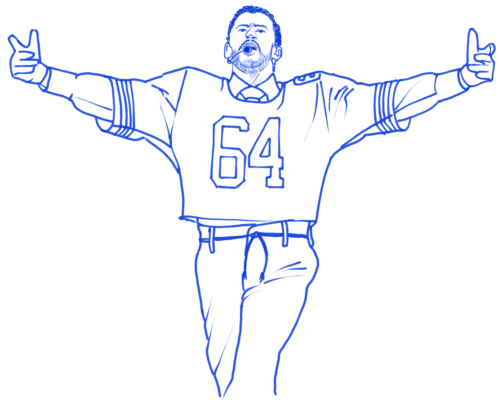
Bad Bunny’s Unforgettable Dance: The 60th Super Bowl Halftime Show
Graphic by Emma Crago

“The only thing more powerful than hate is love.”
Bad Bunny’s final message for over 130 million viewers at Levi’s Stadium in Santa Clara, California, was simple.
On Feb. 8, Benito Antonio Martínez Ocasio, known to the world as Bad Bunny, headlined the 60th Super Bowl Halftime Show. The Puerto Rican King of Reggaeton made football history as the first Super Bowl headliner to perform almost entirely in Spanish, defying critics who questioned whether a predominantly English-speaking audience would embrace it.
As the camera panned across the field, viewers were first transported to Puerto Rico, following Bad Bunny’s walk past sugarcane workers and street vendors. He opened with one of his most popular hits, “Tití Me Preguntó,” while holding a football with the words “Together, We Are America.”
The symbolism was hard to miss: at one of the most quintessentially American events, and at a time when immigrant belonging is under scrutiny, Bad Bunny delivered this message unmistakably. The message appeared to be that, in his eyes, the values of inclusion and acceptance are at the heart of what it means to be American.
After strolling through the streets of Puerto Rico, Bad Bunny appeared on the roof of a pink house singing “Yo Perreo Sola” as dancers filled the field below. Modeled after a real home in Humacao, La Casita’s porch embodied the communal core of Puerto Rican culture. The guests on this porch illustrated diversity and pride in Latin American representation by featuring Cardi B, Jessica Alba, Pedro Pascal, and Karol G.
Bad Bunny then fell through the living room roof and literally intruded on the model American family. In shock, viewers watched as Bad Bunny brushed himself off and got back up to dance. In that moment, he embraced his role as an agent of reggaeton—aware that millions of Americans remain unfamiliar with the genre’s roots, yet asserting his music as central to American pop culture.
For the next scene, he took his place on top of a “Bumpside” Ford pickup, where he sang a cover of “Gasolina” by Daddy Yankee, a fellow Puerto Rican singer. On a large screen above the field was an endangered Puerto Rican crested-toad, also featured in the DeBÍ TiRAR MáS FOToS short film. The toad is thought to symbolize memory loss due to gentrification and the departure of locals from the island.
At this point, the singer introduced himself, saying, “Hoy estoy aquí en el Super Bowl 60, y es porque nunca dejé de creer en mí. Tú también deberías de creer en ti” (Today I am here in the 60th Super Bowl, and it is because I never stopped believing in myself. You must also believe in yourself). Paired with this dialogue, the image of the toad marked a transition from popular old hits to his newest album, “DeBÍ TiRAR MáS FOToS.”
He goes on to say, “Dime, esto es lo que tú querías,” which could be interpreted as “Tell me, is this what you wanted?” The relevance of this phrase was not immediately apparent as the camera panned to Thomas Wolter and Eleisa Aparicio’s wedding in a courtyard on the field. The couple initially invited Bad Bunny to perform at their wedding, and he instead invited them to be part of one of the most widely watched performances in history. The legal ceremony served as another reminder to enjoy the thrill of life and love.
The couple then stepped aside, revealing Lady Gaga performing “Die with a Smile” alongside Los Sobrinos, a Puerto Rican salsa band with whom Bad Bunny has collaborated several times. Bad Bunny likely directed his initial question (“Is this what you wanted?”) to the portion of the audience that preferred the Super Bowl headliner to be a white, English-speaking popstar.
Many people missed this subtle critique, spurring continued confusion over Lady Gaga’s role in the show, especially since record-breaking Latina artists Cardi B and Karol G were left partying in the back. Nonetheless, Bad Bunny created an image of merging cultures as well as a celebration of American diversity. The lines “If the world was ending, I’d want to be next to you” were fitting for the wedding context, but also addressed the importance of standing together amidst panic and division in the United States today.
As Bad Bunny took Lady Gaga’s hand, he said, “Mientras uno está vivo, uno debe amar lo mas que pueda” (While one is alive, one should love as much as they can). Then they partied to “BAILE INoLVIDABLE” (Unforgettable Dance), a sweet yet vibrant song of nostalgia and appreciation.
Among the softest and most treasured moments of the performance was when Bad Bunny gave his Grammy to a young boy representing his younger self. Airing on a box TV in the living room set is one of his acceptance speeches from the week prior. He tells the little boy, “Cree siempre en ti” (Always believe in yourself).
The next scene included Puerto Rican star Ricky Martin sitting on a white plastic lawn chair singing an acoustic cover of “LO QUE LE PASÓ A HAWAii.” Common on the streets of Puerto Rico, these chairs appear empty on the “DeBÍ TiRAR MáS FOToS” album cover to symbolize the emigration of locals to the mainland. The lyrics further underscored the United States’ legacy of colonialization.
Bad Bunny then emerged from behind the grass with a Puerto Rican Independence flag (denoted by the lighter color of the blue), singing “El Apagón” (The Outage). The track was depicted clearly with electric poles spitting out sparks. Through the chorus, he described the experience of Puerto Rican citizens enduring frequent power outages and their frustration with government neglect of the issue. What’s striking is that “El Apagón” is a track from the album “Un Verano Sin Ti,” which came out in 2022. Four years later, Puerto Rico is still fighting the same battles.
The cameras then panned to bring viewers back to the party with “CAFé CON RON,” a song that invites neighbors to come out on their balconies for a shared “coffee in the morning” and “rum in the afternoon.” As runners weaved through the dancers waving flags from nearly every country and territory in the Americas, he is undeniably calling everyone to join the party.
Bad Bunny then shouted, “God Bless America!” and named each flag one by one. The U.S. and Puerto Rican territorial flags led the parade side by side— a proud testament to his own identity.
The party resumed with “DtMF,” his current No. 1 track on the Billboard Global 200. The dancers, musicians, and runners shouted only a short phrase from the chorus: “Debí tirar más fotos de cuando te tuve. Debí darte más besos y abrazos las veces que pude. Ojalá que los míos nunca se muden” (I should’ve taken more pictures when I had you. I should’ve given you more kisses and hugs whenever I could. I hope my people never move away.) The beloved track is both a sweetly nostalgic love song and a reminder of the challenges of migration and change, memories that many Americans share in one way or another.
Bad Bunny’s performance strikes at an urgent moment in American history. While not explicitly condemning ICE raids as he did at the Grammys, he nonetheless took a stance against exclusionary efforts by the current presidential administration. “We need to be different. If we fight, we have to do it with love,” he expressed the week before. This celebration is proof that pride in one’s culture and undying faith in unity are what define the people of America.
His final words of the halftime performance were “Seguimos aquí” (We are still here). The statement could be in defiance of recent exclusionary measures against Latin Americans, yet throughout the performance, Bad Bunny referred broadly to all Continental Americans. Together, we are still here for one another.
Olivia Le ’29 (oliviale@college.harvard.edu)is taking photos while there’s still time.