Bavaria: Barker-Style
Graphic by Amelie Lima

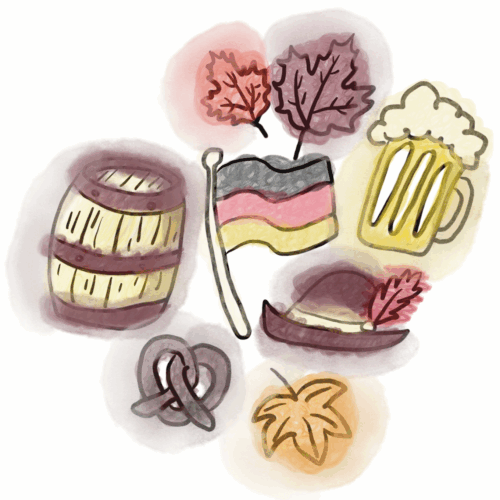
“O’zapft is” echoes out every September as the first beer barrel is tapped at the Schottenhamel Festhalle to open Oktoberfest. Hosted in Munich, Germany, the Oktoberfest dates back to 1810 as a celebration of the nuptials between Crown Prince Ludwig of Bavaria and Princess Therese of Saxe-Hildburghausen. Today, Oktoberfest is a celebration of German and Bavarian culture, attracting tourists from all over the world who want a taste of Germanic food, music, attire, and more.
Around 3,870 miles away from Munich at Harvard, students can immerse themselves in German culture at the Department of Germanic Languages and Literatures through language study and culturally relevant community events.
“Our goal is to provide students with the enriching experience of studying languages, literatures, and cultures of German- and Nordic-speaking Europe across the ages,” the undergraduate page on the department website reads.
The department offers classes in the German language at all levels. To pursue a concentration in German studies, students must take nine courses in the department. This includes both core language requirements and cultural requirements. Offering the Harvard Vienna Berlin Program to earn credits, the department strongly encourages students to study abroad.
With an average class size of five to 15 students, the department offers an intimate learning environment. Germanic Languages and Literatures Department faculty member Professor Daniel Carranza explained the benefits of belonging to such a tight-knit community: “It can be an advantage being a small department, because you have small class sizes that challenge students to speak, but you also have very direct and immediate access to faculty,” he said in an interview with the Harvard Independent.
“It makes the kind of intellectual engagement also a bit more intense, because neither students nor faculty can hide in the crowd,” Carranza continued. “It actually creates many spaces where those kinds of more intimate interactions can happen.”
Interested undergraduates have the opportunity to pursue a concentration or a secondary in the department through classes such as German 10 and German 100.
Outside of the classroom, the department provides opportunities for the German language community to connect. One example is Kaffeestunde, a weekly conversation hour open to all German language students. Literally meaning “coffee hour,” Kaffeestunde features community, coffee, and cake in Harvard’s Barker Center.
“It’s a very casual, low-stakes atmosphere for catching up with people practicing German and interacting as human beings, not just as students to teachers,” said Carranza.
Kafeeestunde is not the only event that fosters belonging for German-speaking students and those of German heritage. Weekly Sunday brunches organized by the Harvard Undergraduate Austrian German Association, dinners in Harvard Square planned by German students for other German students, and annual New York trips allow the community to connect over their shared appreciation for German culture and language.
“I’d say our German community is pretty strong. They always organize stuff. We have lots of group chats. I think I know all the German first-years,” Nadjela Wepiwe ’29 from Frankfurt, Germany said in an interview with the Independent.
External organizations also aid in the connection between German students across campus. Many of the first-year German students met during the First-Year International Program, a pre-orientation program for freshmen meant to help international students adjust to living in the United States. For these students, FIP helped ease their transition to Harvard and laid the foundation of friendships that carry over into the community’s offerings and activities.
Meanwhile, the Harvard College German Club offers another space for students to cultivate community. The student-run organization hosts dinners in the Square, where students try different restaurants while getting to know their peers. During these dinners, students speak to each other primarily in German, creating an environment to socialize while practicing their German speaking skills.
The cultural exchange provides ample opportunities for connection, from celebrating traditions to clarifying misperceptions.
Fitting for the season, Wepiwe was recently able to address some common misconceptions about the festival. “Oktoberfest is Bavarian culture. It’s a little bit like states. Every region has its own culture. For example, Baden-Württemberg and Bavaria, they’re really close together. They have a similar culture, while the East has a completely different culture than the West, and Bavaria is in the South.”
She added that the festival’s soundtrack is a type of music called Volksmusik, traditional folk music that can be heard in ski resorts in Austria, Switzerland, or Germany. When she experienced Oktoberfest, she explained that she felt some culture shock. “The music they listen to at Oktoberfest is really Bavarian music. And that is 100% not the music I feel connected to.”
Beyond Oktoberfest, students can look forward to a variety of upcoming events hosted by the department, such as the lecture “The Use and Value of Language Skills in the Workplace” on Oct. 2.
Claire Chung ’29 (clairechung@college.harvard.edu) and Audrey Wu ’29 (audreywu@college.harvard.edu) write News for the Harvard Independent.