Before the Binge
Graphic by Trischelle Afihene

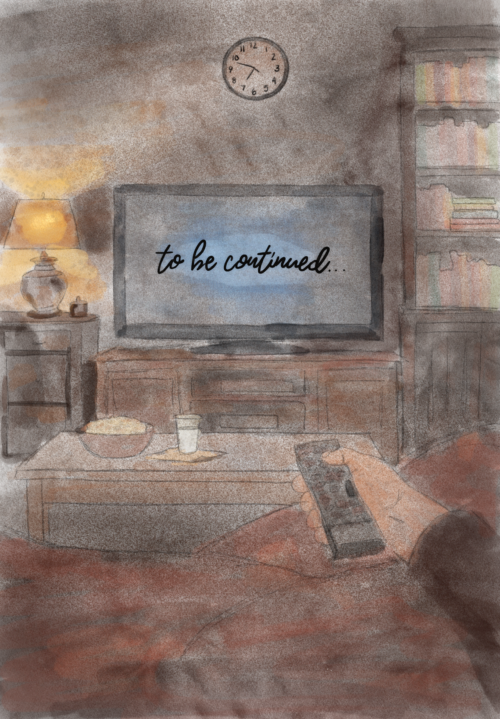
For as long as I can remember, my family would gather in the living room for dinner and tune in to the newest episode of “Survivor.” Unfortunately, this only happened every Wednesday, so on non-“Survivor” nights we’d trade cable for streaming and browse for something new, or an old favorite. My top pick quickly became “Downton Abbey,” but our watchlist did not stop there. While we cycled through various shows, “Survivor” remained a constant—to this day, my parents still watch it at home (now without me). Though this routine isn’t exactly your conventional dinner-table debrief, it was our Wednesday night ritual.
In an age driven by binge-watching and algorithms, television has lost its ritual—and with it, the shared excitement that once made it communal.
Because of the way we organized our evenings, we never watched more than one episode—well, maybe two if there was a cliffhanger. But that quickly changed. Once I got an iPad as a preteen, I fell in love with the practice of binging—my Netflix kids account hated to see me coming.
Presently, shortened attention spans have been exacerbated by the rise of short-form media like TikTok, Instagram Reels, and even YouTube Shorts. Impatience thrives on the hunger for the next newest thing, a wealth of options at our fingertips. We’re practically skimming through all the media we digest. Abundance hasn’t deepened our engagement with short-form media; it has diluted it.
It seems that with the push for immediacy, the once ubiquitous serial format of television shows has taken a hit. Shows like “Bridgerton” now release their seasons in halves, while HBO’s “The Knight of the Seven Kingdoms” has cut back its standard eight-to-ten-episode model of the “Game of Thrones” franchise. However, these reductions are accompanied by production delays, including years between seasons. What may be intended to build suspense ends up leaving a dying fandom disappointed by the assumption that such delays would surely yield something extraordinary.
For decades, most shows were structured around thirty-minute or hour-long cable time slots. However, to compensate for those shorter instalments, seasons were longer. But, as streaming replaced cable, the balance was lost. Now, productions have boosted their run times per episode to nearly an hour, each functioning like a mini movie, resulting in fewer episodes per season. With more cinematic productions, longer timelines for filming and editing have also created wider gaps between seasons. When seasons shrink from twenty episodes to eight and years divide installments, the shared cultural enchantment diminishes with them.
One of the most poignant examples is “Stranger Things.” Star actress Millie Bobby Brown (now Bonjovi) was 11 years old when production started, but by the time the final season aired, she was 21, married, and a mother. Despite all of this, her character, Eleven, aged only four years. Characters stay trapped within fictional timelines that child actors cannot, and believability falters. But what’s worse is that the audience then feels aged. When “Stranger Things” first came out, the characters were about my age. What should have felt like growing up alongside the series instead felt like revisiting something I had already outgrown. I wasn’t even aware when the final season was released, and to my surprise, I didn’t care. I couldn’t imagine telling my preteen self that news.
The compression of television’s release cycle isn’t just diminishing storytelling; it’s stripping it of its ritual.
Perhaps production companies are trying to appeal to audiences’ shortened attention spans by offering shorter series; however, if anything, audiences are left wanting more. The times when nearly everyone watched the same finale at the same time now seem scarce. The second a show is released, so too are references and commentary, making it difficult to wait without encountering spoilers. Even viewers who may want to pace themselves are pushed toward immediacy just to have a seat at the table. Clips flood social media feeds, and trailers appear in targeted ads rather than communal commercial breaks—fractured by algorithms and availability.
Growing up, my family was just one of many within the “Survivor” fanbase. Every Wednesday evening during swim practice, my coach would proclaim it was “Survivor” night; on Thursdays, he would offer his opinion on the episode. Weekly reality TV creates space for that community. I am by no means saying that reality TV is dead; in fact, the popularity of shows like “Love Island” disproves that. But it proves my point that audiences are drawn to anticipation when it’s shared and paced, like a weekly treat.
Some series have mimicked reality TV with great success, but with a script, using fictional time to transport viewers away from a weekly schedule. For example, “The Pitt” follows a weekly release schedule, a format that mirrors time—each episode is one hour long, reflecting one hour of a work shift—extending time outside of reality. This serial format builds excitement that people can share in online communities without fear of spoilers, unlike when a series is released all at once.
The weekly format feels exciting, knowing you can see an episode as soon as it’s available and feel the suspense build throughout the day. It also comes with the reassurance that you don’t have to tiptoe around social media if you can’t watch an entire season on release day. When episodes are spoiled or re-run, they can feel stale and as though you’ve missed out on the group camaraderie that comes from fresh enjoyment. Weekly releases may not restore the long seasons of network TV, but they at least reintroduce tempo and shared anticipation into a compressed viewing culture.
When episodes are spaced out, we’re forced to sit and wonder, predict, and let them settle without the ability to hit “play next” for immediate gratification. While I’m a fan of a late-night marathon, it rarely actually benefits me. Some nights, I’ve instituted a ritual structure to some of my favorite weekly shows: on Sunday nights, “A Knight of the Seven Kingdoms,” and on Thursday nights, “The Pitt.”
These nights feel familiar; I can nearly smell dinner freshly ready. I stretch across the living room couch instead of curling up in my college bed. My laptop glow feels distant, like the soft, room-filling glow of my TV. When the credits roll, I feel ready to plead for just one more episode. Moments like those remind me that the magic was never in the binging, but in the waiting.
Sophia Gonzalez ’28 (sophiagonzalez@college.harvard.edu) is looking for new weekly recommendations.