Channeling Capone
Graphic by Wallace Selph, Sasha Cavell

In third grade, I strutted through hallways and across the playground on the most exciting day of the school year, dressed in a pinstripe suit, bowler hat, and sunglasses —finished off with a bright red lip. In my full ensemble, I was more than ready for the Halloween parade as 1920s gangster Al Capone.
My fascination with Capone, and with gangsters in general, had begun that year during our “Chicago history” unit, designed to help us connect with our city’s past. Though my teacher had brushed past the gangsters in a single day, preferring to linger on the World’s Fair, the stories and photographs of their crimes remained vivid in my mind. I was mesmerized by their boldness, their heists, and most of all, their dress. The fedoras, sharp suits, and gleaming accessories seemed iconic to my younger self, who lived in Justice hoodies and sweatpants.
I would pretend to be them in my room, tipping my imaginary hat as I struck deals and sent my enemies to “sleep with the fishies.” I checked out books from the library and memorized mob members’ names, a skill that might have been useful had I been a private eye, but was mostly mildly aggravating to everyone around me. Halloween was an opportunity for me to showcase my newest obsession and, without realizing it, the version of my identity in that moment.
That day, I was met with confusion from classmates and amusement from parents, but I embraced it. Every time someone asked me, “What are you?” I proudly replied, “Al Capone.”
Throughout elementary school, my love for unusual costumes persisted. Anything I was obsessed with—dementors, mimes, Sypro (the purple dragon from “Skylanders”)—I decided to become for Halloween.
By fifth grade, I had ditched the video game characters for group costumes. Once you hit 10, solo costumes suddenly indicate outcast status; group costumes become social currency. “What are you being for Halloween?” turned into “What are you guys being?” The shift was jarring and sudden, like a new set of rules had been written overnight. From that point on, my friends and I chose more “normal” themes—The Wizard of Oz, superheroes, fairies, and more. Even though my costumes were no longer as personal (or as odd), I was still obsessed with dressing up.
Halloween became an excuse for us to spend hours scouring Pinterest, online shopping, or thrifting—pulling together pieces we’d never otherwise wear. I loved the hunt and the rush of stumbling upon the perfect accessory to complete my outfit. Halloween was the one time of year when, if people said you were too much, maybe they simply weren’t enough.
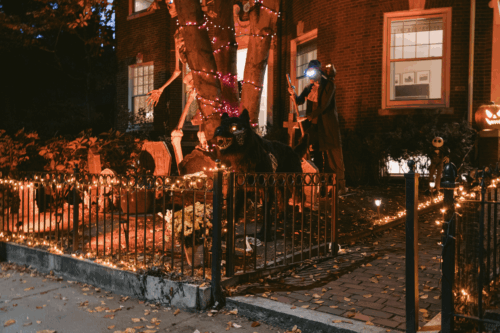
Now, as my first college Halloween approaches, the holiday carries nostalgia and a taste of home. Though Cambridge is nothing like the Chicago suburbs, the decorated houses just beyond campus and the bright autumnal colors are familiar sights. They remind me of trick-or-treating, pumpkin carving, and trading candy late into the night.
That nostalgia extends beyond Halloween scenes. In my first year of college, independence feels newly exciting—both in everyday life and on Halloween. It’s the kind of creative freedom that brings me back to childhood wonder, letting me rediscover who I am in a new environment. Without the comfort of old friends to lean on, I’ve had to start over again from scratch. There’s no longer history to rely on. Because of this, solo costumes are back, an exhilarating yet daunting reminder that I’ve come full circle. Choosing a costume on my own again feels like a return to the confidence and emboldened curiosity I had as a kid, when dressing up meant showing what I love, not who I was friends with.
Still, that doesn’t mean I’ve lost my love for group costumes. I still adore planning, coordinating, and matching with a good group of friends. Whether solo or in a group, I love Halloween for the escape it offers—for one day (or, let’s be honest, a whole weekend) you can become whoever you want to be.
Maybe that’s the real lesson this year: the divide between individual and group costumes was never as significant as I thought. What once felt like a choice between conformity and self-expression isn’t serious at all. Whether alone or with friends, Halloween has always been about the same thing since I was Al Capone—a chance to revel in pretending, dressing up, and being “too much.” A fedora that’s a little too tacky. A lip that’s a little too red. A costume that’s a little too weird. That’s what makes it special.
Claire Chung ’29 (clairechung@college.harvard.edu) can’t wait to dress up for Halloween.