
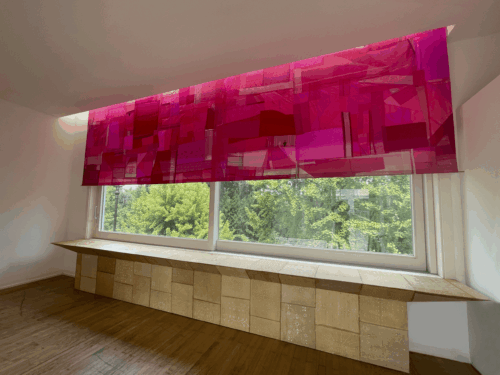
On Sept. 24, the East Asian Studies Department hosted Christina Kim, designer and founder of dosa, to guest lecture for EASTD 154: “Threads: Histories and Theories of Clothing and Fashion.” Kim is known for transforming clothing scraps that are often cast aside as waste into garments and art installations. Through this medium, she draws attention to what she calls “reparative thinking and doing,” a pedagogy central to her design process that highlights the human interaction involved in the process as well.
Kim’s inspiration comes from memories of her childhood in Korea, where she first watched her grandmother mend clothing. This fascination with her grandmother’s process kick-started her interest in design at a young age; soon after in 1971, she came to the United States.
Living in New York City as a young adult, Kim reminisced on her days immersed in the downtown arts scene of the 1980s. Somewhat of a club rat, she described her nights out on the town, for which she would make her own garments to stand out in the crowd. As her work attracted attention from both friends and strangers, she began taking commissions and creating unique designs; her materials were often repurposed—leftover scraps from previous projects, thrifted items, as well as old clothes—sewn together to create a new vision. This, along with recognition from brand names like Henri Bendel and the support of her mother, enabled Kim to begin the dosa brand in 1984. Her primary goal for her design process was to “make clothing for other people to feel like they are who they are.”
In an interview with the Harvard Independent following the guest lecture, Kim explained her love for the action of clothing-making as a sensorial and meditative process: “The patchwork, or any kind of sewing, it’s like a topography, because you’re moving with the curve of the fabric. And it really feels good because you’re feeling in so many layers—you’re feeling with your hand, you’re controlling with your feet the speed of it, and you hear the sound.”
“Reparative thinking and doing” lies at the core of her design process, extending both to materiality and human interaction:
“In the late 80s, I started really thinking about environment. That was the beginning of my thinking about organic versus non-organic. It started with the food movement, and I heard about Alice Waters, and the way she was talking about local organic.” She also pointed to the emergence of the brand Patagonia in the 70s, and its focus on impact-conscious consumerism as an inspiration. “I really liked these ideas. They seem much more rooted in grassroots and very much part of the earth.”
This environmental awareness was also deeply rooted in her personal experiences. As a member in one of the first classes of Brownie Girl Scouts in Korea, Kim learned at a young age to care for and connect with nature and the environment. Both outlooks became central to her design process, leading her to travel to Oaxaca in 1992 and study the city’s specialized organic dying traditions.
“I realized the bolt of fabric that you see takes so much time, like the growing of cotton takes so much effort. Harvesting cotton takes time, spinning… All that takes so many hands and skills. So by the time you have a bolt of fabric, you’ve really gone through history of time—human time,” Kim said.
Kim’s fascination with color, texture, and culture began with early interpersonal interactions; before her own travels as an adult, her family would host resident professors in Korea, exposing her to different cultures. She remembers a professor from Nigeria and another from India who would arrive in their country’s traditional garb.
It was through her travels to Mexico, China, India, Colombia, and many other places that she demonstrated the effort of clothing-making processes. “In order for me to respect the hands of these people, I try to use as much as possible. And that’s when I really thought about how to design with people’s effort in mind.” Kim began saving every scrap left over from her designs, patching them together and giving them a new life of their own.
She would remember not only the visitors from her childhood, but also those she passed on the street or met at the club—and wonder about their clothes. She began seeking out the origins of the designs and techniques that caught her eye on her travels, learning from artisans and craftspeople the traditions embedded in cultural garments. She visited workshops where garments were made and, sitting alongside makers, practiced the techniques that went into each piece.
“I sit and start doing my design, and [the artisans] get so frustrated because they are so much faster. So then they go, ‘Oh, let me do this.’ And then they take over, or I will sit and do it with them, and we kind of create the design together,” she explained. “Then it becomes sort of like a community project, and they feel certain ownership because they were part of developing an idea.”
A byproduct of Kim’s curiosity and these cultural exchanges was empowerment and authority for the craftspeople. In a society of mass consumerism and fast fashion, the work of individuals becomes overlooked, yet here, they are recognized, appreciated, and accredited for their efforts.
“My aspiration isn’t the aspiration of those who are in the industry.” Kim explained that in the fashion economy, she does not look to directly combat a culture of consumerism and societal impatience, but rather aims to highlight the beauty of process and time in garment production.
“The fact that she [artisan] got such pleasure with me sitting there, watching her, I think that’s a really beautiful human exchange, and that is the reward for me. I’m allowed to go into Muslim quarters and be with men. I don’t have to cover myself. I can be who I am without being uncomfortable. And I think that’s luxury… I think that luxury is much more important than the concerns of the industry.”
Kim is now working toward her next project, an exhibition at LACMA in which she will honor the artists that inspired her—Ed Ruscha, Simon Rodio, and Gloria Stewart—during her first years in the U.S. In the meantime, dosa will remain rooted in the ethos of crafting clothing that values story, hands, and time. Her brand and studio will remain living archives of her travels and collaborations. Kim plans to continue her daily practice: using reparative thinking to make choices that have a positive impact on the environment and on humanity, and sewing with her team every day, allowing patchwork to be her meditation.
Mia Wilcox ’28 (mwilcox@college.harvard.edu) is Columns Editor of the Harvard Independent.