
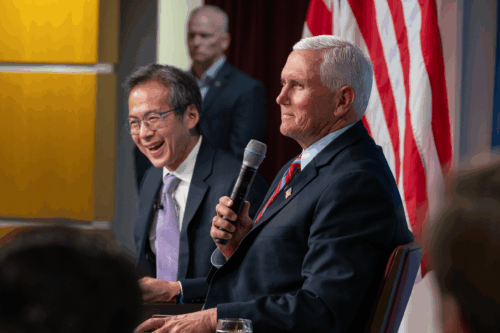
“Christian, conservative, Republican—in that order.”
On Sept. 30, former Vice President Mike Pence described himself with these words as he took the John F. Kennedy Jr. Forum stage for a conversation entitled “The Future of Conservatism and American Democracy.” The discussion was moderated by Professor Archon Fung, Director of the Ash Center for Democratic Governance and Innovation at Harvard Kennedy School.
Pence’s career in public service has spanned across various forms of government and elected positions. Before becoming Vice President, Pence represented Indiana’s 2nd congressional district in the House of Representatives from 2001-2013 and was the governor of Indiana from 2013-2017. Prior to the Forum event, Pence joined Governor Eric Holcomb, who succeeded Pence as governor of Indiana and currently serves as one of the Institute of Politics’ Fall 2025 residential fellows, for an off-the-record study group session.
At the beginning of his panel, Pence reflected on how his Christian faith shapes his political choices, referencing his response to losing the 2020 election and his decision to respect the outcome in the wake of the Capitol insurrection.
“I’ll always believe it was by God’s grace that I did my duty that day. The Bible says he keeps his oath even when it hurts,” Pence explained.
“What was a day of tragedy…became a triumph of freedom, because as the world watched, our Congress reconvened the very same day and completed our work in a peaceful transfer of power.”
Pence received sharp criticism from President Donald Trump during the Jan. 6, 2021 Capitol attack for refusing to block certification of the 2020 election results.
As rioters stormed the Capitol, some roamed the halls of Congress chanting “hang Mike Pence.” Pence later received the JFK Profile in Courage Award for protecting the will of voters despite personal risk.
Pence then reflected on the differences between the 2020 Trump administration and his observations of the current White House, with a particular focus on trade policy.
“In our administration, we use tariffs and the threat of tariffs to lower trade barriers, to negotiate the opening up of markets,” Pence said. “I was speaking to some agricultural leaders yesterday out in the heartland, and our farmers are hurting right now—really hurting—and the bailouts that are being talked about in Washington, D.C. will be a pittance of the losses that family farmers are facing because of the tariffs and restrictions on trade and exports.”
According to Pence, Trump’s heavy reliance on tariffs is triggering global retaliation, driving up costs for American consumers, and hurting small businesses.
“Our administration in our four years embraced America’s role as the leader of the free world… We negotiated the largest trade deals in American history—we expanded trade and exports in the country,” he said. “What drew me into my brief but memorable campaign back in ’23 was that I saw my old running mate and many in our party departing from those core ideals and principles.”
The conversation then turned to concerns about the current state and future of democracy. Fung described his “nightmare scenario” in which Democratic winners in the upcoming 2026 midterm elections are prevented from taking their earned seats in the House due to Republican opposition. He pointed to early warning signs of such democratic erosion already unfolding—redistricting battles, federal requests for voter data, and disputes over the integrity of voting machines and mail-in ballots.
Pence offered reassurance by pointing to the “resilience” and “strength of our institutions,” arguing that the right and the left have historically been capable of upholding democracy, even in times of immense unrest. “I have confidence in the days ahead that Republicans and Democrats will hew to those roots into that duty,” Pence said.
This harmony brought Pence back to Christianity and a recent essay he co-authored with Heritage Foundation co-founder Ed Feulner: “Rediscovering Order in an Age of Populism.” In the essay, Pence calls for preserving America’s founding ideals—what he terms the “American experiment”—and urges the conservative movement to reclaim those principles while moving away from the current climate of division and right-wing populism.
“Our founding generation believed we were endowed by our Creator with certain unalienable rights,” he said at the Forum. “That is the beginning of being a conservative who seeks to conserve and preserve what’s best to this nation.”
Fung then opened up the Forum to the audience, with students asking Pence questions about party politics and the global political landscape.
“Where do you think the future of conservatism is going to take us? Do you think that the Republican Party will ever revert back to traditional views? Or do you think this new age of Trump politics is going to continue into 2026, 2028, and beyond?” asked Caitlin Saxinger ’29.
“They’ve changed the agenda—but I don’t think they’ve changed the Republican Party,” Pence said. “I have people come up to me all the time and say, ‘I agree with your philosophy: fiscal responsibility, limited government, pro-growth, American leadership in the world.’ So, I tend to think that anybody who ever considers voting Republican still holds those same common sense, traditional conservative views, and that when the next presidential election comes along, there’ll be a fulsome debate.”
Looking ahead, Pence voiced concern about the global rise of strongmen, pointing to Chinese President Xi Jinping and Russian President Vladimir Putin as key threats.
“I think we’re living in a very perilous time where America needs to be strong,” Pence said, responding to a different student question on what his perspective has changed on during his political career. “We got a shot at a peaceful future. Failing that, I think the second half of the 21st century could look a whole lot more like the first half of the 20th century.”
At the same time as the Forum, Trump broke the news to reporters at an Oval Office event that his administration is reaching a $500 million deal with Harvard, alongside other agreements.
“As a South Korean citizen, a research assistant here at the Kennedy School, and an undergraduate, this does affect me in three ways and so many other people in this room,” Hyunsoo Lee ’28 said, who asked Pence for his reaction to the breaking news regarding the potential Harvard-Trump deal.
“There can be no tolerance in America for antisemitism on our campuses or in our public squares, and I appreciate the fact that Harvard conceded that there was an issue they had to deal with,” Pence replied.
However, Pence also emphasized the importance of preserving higher education institutions.
“We rely on our research universities, whether it’s in Indiana or storied institutions like Harvard and others, for an enormously important part of our national life,” he said. “My hope is that there can be substantive and principled agreement reached so that we can move forward with the kind of support that will continue to underwrite the vital work of research universities.”
Both Pence and Fung stressed how critical conversations like the one at the Forum are—dialogues that cross party lines and bring people together. “In these divided times, it’s maybe more obvious to more Americans that we all got to start listening to each other a little bit better,” Pence said.
“I really deeply believe that unless we get better at exercising those muscles as a country, as Americans, but perhaps all over the world, that is the first, best, and perhaps most important source of our democratic flourishing,” Fung added.
In the end, Pence voiced confidence that, even amid political turmoil and polarization, the American people will ultimately sustain the strength of democracy. He paraphrased former United Kingdom prime minister Winston Churchill: “A careful study of American history shows that after they’ve exhausted every other possibility, the American people always do the right thing.”
Layla Chaaraoui ’26 (laylachaaraoui@college.harvard.edu) is the Editor-in-Chief of the Harvard Independent.