Elite Universities Weigh the Costs of Settlement With the Trump Administration
Graphic by Amelie Lima

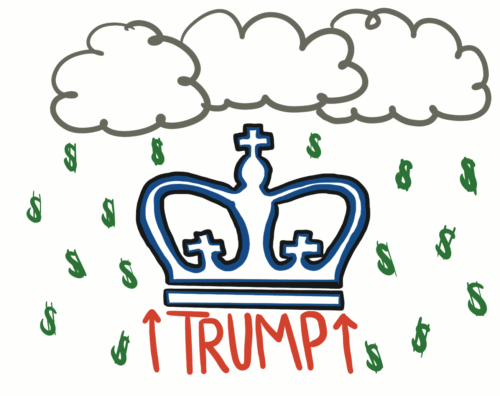
After months of resistance against the federal government, Harvard University may soon reach a settlement with the Trump administration. Reports of these deliberations come just weeks after Brown University and Columbia University agreed to settlements to restore withheld federal funding.
Persistent funding cuts to post-secondary academic institutions nationwide now total between $6.9 and $8.2 billion. These cuts have raised concerns about the future of academic research and the role of college administrations, with institutional autonomy seemingly at odds with government oversight.
“It is a travesty,” wrote David R. Walt, Hansjörg Wyss Professor of Bioinspired Engineering at Harvard Medical School and Professor of Pathology at Brigham and Women’s Hospital, in a statement to the Independent regarding the funding cuts.
“Many of these advances take years to decades to accomplish, so shutting down projects wastes an enormous investment already paid for by taxpayers. It is beyond my comprehension why any leader would want to compromise the crown jewel of its educational and research ecosystem,” Walt added.
According to Harvard, federal funding halts come after 75 years of research partnerships with academic institutions. These partnerships have produced significant breakthroughs that help maintain the United States’ position as a global leader in research. Rescinding this funding, Harvard warns, will harm progress in fields including life-saving medical research on tuberculosis, chemotherapy, pandemic preparedness, Parkinson’s disease, and Alzheimer’s disease.
“Cutting funding to Harvard and other academic institutions will delay our ability to deliver and scale these innovations, which will result in unnecessary delays in diagnosing and curing these and many other diseases, and will result in unnecessary suffering and many deaths,” Walt said.
Tensions between elite American universities and the executive branch escalated after President Donald Trump took office in January. On March 10, Trump’s administration sent letters to 60 universities, including Harvard, regarding investigations into antisemitism and Title IX violations. Since then, alleged diversity infractions have spurred funding cuts and grant rescissions on a national scale.
Minority-serving institutions are at particular risk under current circumstances. According to the Center for American Progress, more than two-thirds of all land-grant universities and nearly half of all historically Black colleges and universities are facing funding cuts under the current administration.
Additionally, changes to federal funding have impacted the 1,100 community colleges that provide education for over 6 million students nationwide, as well as tribal colleges, which rely almost entirely on federal funding. Without robust endowments needed for self sustainment, these institutions have less flexibility when it comes to settlements.
Among the throng of academic institutions affected, American Ivy League schools have become limelight cases—most notably seen via Harvard being one of the primary institutions to take legal action against the federal government, and Columbia being one of the first universities the federal government targeted.
On July 1, the University of Pennsylvania became the first Ivy League institution to reach a settlement deal. Unlike Brown and Columbia, Penn did not pay a fine to the federal government. Investigations focused largely on the University’s compliance with Title IX, specifically regarding women’s athletics and the controversial participation of transgender swimmer Lia Thomas.
On July 24, Columbia paid a $221 million settlement—an unprecedented concession to the Trump administration.
“Today, President Donald J. Trump secured a historic settlement with Columbia University to address violations of federal civil rights laws and to restore fairness, merit, and safety in higher education,” a statement released from the White House reads.
“By securing this settlement, the Trump Administration is ensuring that Columbia upholds merit-based standards, complies with federal law, and fosters an environment of academic excellence and safety for all students,” the statement continues.
“Before the agreement, Columbia’s entire research operation was at risk,” Howard Worman, Professor of Medicine and Pathology and Cell Biology, and University Senator at Columbia, wrote in a statement to the Independent. “If [Columbia] didn’t come to an agreement with the government and continued to be cut off from federal funding, it could have triggered an exodus of promising faculty, especially from the medical school.”
On July 30, Brown University agreed to a $50 million settlement. While similar in scope, Brown’s settlement was set on different terms than that of Columbia.
Both Brown President Christina H. Paxson and Columbia Acting President Claire Shipman issued university-wide statements following the settlement decisions, outlining the terms and promising certain institutional protections.
“At its core, the agreement preserves the integrity of Brown’s academic foundation, and it enables us as a community to move forward after a period of considerable uncertainty in a way that ensures Brown will continue to be the Brown that our students, faculty, staff, alumni, parents and friends have known for generations,” Paxson wrote.
Similarly, Shipman wrote: “We understand that members of our community will hold different views about this decision. We made it with care, with seriousness, and with an unwavering commitment to the mission, values, and future of Columbia University.”
Settlements have faced substantial pushback and concern from current and former students, faculty, and higher education communities at large.
“This settlement subverts our democracy and capitulates to the Trump plan to target the pillars of our democracy: the judiciary, the free press, and our education systems,” American Association of University Professors President Todd Wolfson wrote in an AAUP statement in response to Columbia’s administrative decision.
As Harvard’s legal battle with the Trump administration continues, many are pointing to the settlement cases at Brown and Columbia University to urge their administration not to follow suit. Just last month, hundreds of Harvard College students co-signed an open letter opposing a harmful settlement circulated by Harvard Students for Freedom.
“Any deal with the White House must not involve banning any aspect of the curriculum that President Trump dislikes, firing professors, or punishing students for peaceful free speech. And it certainly must not involve turning over disciplinary records of international students, risking ideological deportation. Doing so would set a dangerous precedent for the entire country,” the statement reads.
Previously applauded for standing up to the federal government, an agreement between Harvard and the federal government may be seen as a substantial setback in the fight against government impositions on higher education. Amidst the uncertainty, the University has released several statements affirming its commitment to academic freedom and institutional integrity.
“We stand behind our thousands of outstanding faculty, postdoctoral, staff, and student researchers,” assured Harvard President Alan Garber ’76 in a University-wide issued statement on May 14. “It is crucial for this country, the economy, and humankind that this work continues.”
University affiliates have not been afraid to express public opinions regarding the funding situation and a possible settlement. In an op-ed for the New York Times titled “Harvard Derangement Syndrome,” Johnstone Family Professor of Psychology Steven Pinker provides commentary on how the renowned nature of Harvard naturally attracts criticism. Despite this tendency—derangement syndrome—to criticize the University, Pinker argues that current funding cuts and a potentially coerced settlement take the form of an unconstitutional punishment toward the University.
“I’m hardly an apologist for my employer when I say that the incentive now being aimed at Harvard has become unhinged,” Pinker wrote.
“I don’t think that these punishments are a consequence of negative attitudes toward Harvard,” Pinker added in a statement to the Independent.“The Trump administration is attempting to cripple elite universities, starting with Harvard, for the same reason they are bullying law firms, media companies, and cultural institutions: they are seen as sources of opposition to Trump.”
“Only totalitarian regimes try to manipulate private institutions to conform to their wishes,” Pinker continued. “In the case of federal funding of research (and other provisions that the Trump administration is using to punish Harvard), there are certain violations of Title VI of the Civil Rights Act that entitle the government to withhold grants, but the government has to stipulate exactly what the violations are, allow the institution to reply and rectify them, and withhold funding only from the offending programs.”
In the meantime, the White House recently released a larger statement regarding federal funding on Aug. 7. “Going forward, President Trump’s appointees will review funding opportunity announcements and grant awards to verify that each grant dollar benefits Americans instead of lining grantees’ pocketbooks or furthering causes that damage America,” the top of the page reads.
Part of the announcement outlines the system of merit, which the administration hopes to rely on for college admissions and grant distribution. “President Trump signed a Presidential Memorandum to ensure funding to Nongovernmental Organizations (NGOs) advances U.S. interests and multiple Executive Orders to prevent taxpayer dollars from funding radical ideologies such as DEI, gender ideology, and the green new scam,” the page continued. “The Trump Administration has already terminated thousands of contracts, saving American taxpayers billions of dollars.”
“The Trump Administration will ensure that meritocracy and excellence once again characterize American higher education.” U.S. Secretary of Education Linda McMahon added in a statement to Politico.
As the Fall 2025 semester rapidly approaches, a potential resolution between Harvard and the White House is at the forefront of the minds of University affiliates and international onlookers.
Affiliates of the University remain hopeful as faculty report conversations with President Garber denying the proposed $500 million settlement, favoring a legal resolution.
Megan Legault ’28 (mlegault@college.harvard.edu) is a Copy Editor for the Harvard Independent.