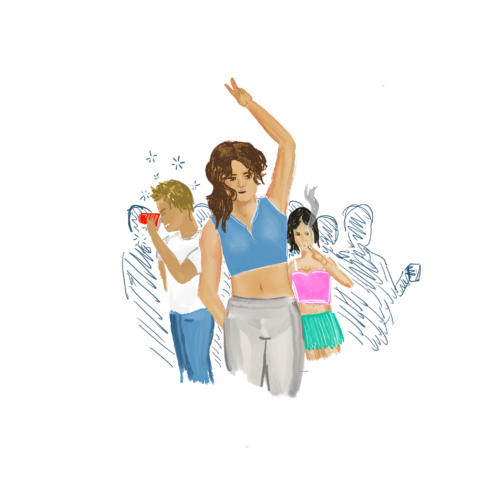
Emma Gray and the “Sober Party Girl”
Graphic by Caleb Boyce

“I’ll come out, but I’m not going to drink tonight” has become an increasingly familiar refrain as I find many of those around me falling in line with reported generational decreases in alcohol intake. While these words are not quite a commitment to full-fledged sober living, the physical and mental benefits of decreased drinking are certainly present.
In January, Lauren Mechling of “The New York Times” published “The Sober Party Girl Revolution,” exploring how Gen-Z influencers have given sobriety a hot-girl makeover. It cites the emergence of dry members’ clubs like The Maze NYC alongside a growing community of young, chic, abstaining influencers as revelatory of a new era of partying.
The marked decrease in alcohol consumption in young adults is attributed to a variety of factors. A 2025 “Time” article pointed to increased usage and accessibility of other substances like marijuana, as well as increasing awareness of the adverse health effects of alcohol—previously held beliefs like the so-called health benefits of moderately consuming red wine are being debunked.
To learn more about this cultural shift, I spoke with Harvard alumna Emma Willoughby Gray ’19, author of the Substack channel “Uncurated Chaos,” who trademarked the term “Sober Party Girl.”
For me, influencers like Gray are the clearest indicator of this generational shift: a growing emphasis on mental and physical fitness over peer pressure and a move away from a Baby Boomer culture that framed alcohol consumption as a means of relaxation.
Gray described her personal journey, beginning as an undergraduate at Harvard College in 2012, then taking a two-year leave of absence after struggling with addiction through her freshman year. After facing family intervention, trying various rehab facilities, and overcoming relapses, Gray finally saw the light of sobriety, giving her the resources and confidence to return and graduate from the College.
“I think I was perpetually 16, and when I was using and drinking, my behaviors were very much the same of this 16-year-old Emma. So it’s definitely like a rebirth when you get sober and try and figure out who you are again,” she explained. “It was amazing and terrible all at the same time: there was a lot of loss and heartbreak … So much of my identity was substances.”
After working in corporate finance for six years post-grad, Gray decided to change career course last summer, delving into her interest in fashion and social media influencing. When I first came across her platform—without realizing our similar New York upbringings or her connection to Harvard—I was struck by her embrace of sober living as simply an element of her youthful, adventurous lifestyle. I found it a refreshingly true-to-life style of influencing that feels rare these days. Her content, a conglomerate of hot Real-Real finds, storytimes, parties, and AA sayings, reads to me as both fun and lighthearted and also truly down-to-earth.
It is from this truthful expression of her identity that “Sober Party Girl” arose: “I never had an intention of making ‘Sober Party Girl’ a brand, or doing anything like that with it, but I always wear my sobriety on my sleeve,” she related. “I tried to not do that [but] for me, it was too similar to lying, or too similar to hiding such a big part of my identity that it never made me feel good.” In embracing this identity, Gray still enjoys all the facets of an active social and party life, choosing only to forgo the drinking.
She explained that in the height of her addiction, substance use was deeply intertwined with her deteriorating mental health. “It felt like everyone I was around was really heavy, and I was heavy, like, I was dark and depressed and heavy,” Gray said. “Now it’s like, everything I do is light and everyone’s silly and there’s so much whimsy. It’s not that heaviness anymore.”
Gray’s story is reflective of many who suffer from addiction, turning to substances as a coping mechanism for emotional pain and social stressors. The National Institute on Drug Abuse highlights the wide variety of causes: “People use drugs for many reasons: they want to feel good, stop feeling bad, or perform better in school or at work, or they are curious because others are doing it and they want to fit in.” The latter rings especially true for young people, particularly college students, who often feel peer pressure to conform, as the fear of stepping off the beaten path can be powerful enough to keep them in line.
For Gray, the combined effects of anxiety and being surrounded by other users became fuel for her addiction. “The problem with using any substance for anxiety is that it’s a really good solution. It really does help. But what you don’t realize is that it only helps when you’re doing it, and it makes it worse at any other time,” she explained. “There’s never going to be a world in which I am never anxious,” she said. “It’s really about how I tolerate anxiety, and how you can sit in the discomfort, and how you best calm your nervous system. Sometimes it’s dumb … sometimes it’s reality TV, and that’s how I do it.”
In finding sobriety, Gray returned to Harvard, finished her degree, and built a life she felt happy and proud of. “Harvard in general—at least my experience—was that it was incredibly accepting around this. There weren’t a lot of sober people, I’m not gonna lie, but people were really, really supportive of it, and that was really amazing,” she said.
She described the confidence Harvard’s acceptance gave her in continuing her journey post-grad: “When I came back to New York and started to create a social life for myself here, I already knew that I could do it,” she said.
Through her journey, Gray also found friendship and community. “They say connection is the opposite of addiction for a reason, like addiction is really, really isolating,” she explained. “I think once you find your people, you don’t feel any pressure to do anything. You just can all exist together as you want to be.”
The concept of the Sober Party Girl seems antithetical at first glance, but Gray, along with other influencers in the sober community, is redefining the conditions of “partying” and what makes life fun. Sober partying may not be everyone’s cup of tea—or glass of wine—but that’s the point.
For those quick to criticize Gen Z for skipping the bar-crawl blackout, I ask: what exactly is the problem with going out and having two drinks instead of ten? Or none at all? Partying does not have to be a monolith. If anything, what defines this cultural shift is not abstinence but intentionality and destigmatization. It offers the freedom to decide what kind of night and what kind of life feels good to you.
In Gray’s words, “I think it’s an incredible direction that we’re going in. And I think that the more normalized it becomes, the better.”
Mia Wilcox (mwilcox@college.harvard.edu) will see you at the next “Indy”rager.