Harvard’s Haunted House
Graphic by Mia Stewart

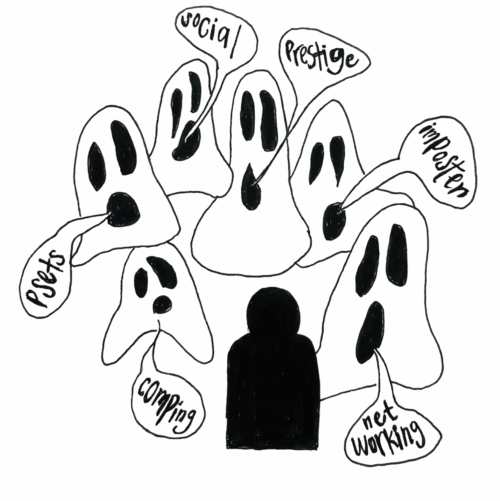
At Harvard, you don’t need ghosts to make the place feel haunted—stress is enough to fill the halls with the unease of ambition that never sleeps. It’s hiding within busy comp schedules and crowded day-to-day schedules, breathing through the walls of dorms that never quite feel “homey” enough, and slipping into the quiet. It’s a kind of unease that doesn’t appear terrifying. The pressure Harvard students feel has a low and steady hum, a reminder that behind the put-together look of students at the College, the real haunting is made of ambition, pressure, and an expectation to thrive.
For first-year college students, September and October are marked not just by new classes and the enduring freshman flu that arrives by week two of school, but by the emergence of a newfound feeling of competition. It starts innocently enough: visit the club fair, attend a few comp meetings, send in a few applications. But soon, the whisper begins: You’re not doing enough. The thought lingers between p-sets and Brain Break, whispering louder each time you take a moment to rest. Someone out there, you’re sure, is comping three more clubs, joining five different publications, or launching a startup or two before breakfast.
Comps start to feel less like a way to join extracurriculars and more like a campus-wide ritual sacrifice. A typical afternoon schedule for an ambitious first-year may include a Crim Biz mixer, CBE social, and an IOP interview, all within two hours. As they make their way to Lamont to complete tasks or fill out countless applications, the library’s fluorescent lights illuminate their anxiety and enthusiasm, adding events to their color-coded GCals like they’re warding off bad spirits.
From the comp culture brings rise to certain absurd hierarchies. There are a few club names we all know, and being closely associated with them is its own level of honor and prestige, such as finance and consulting groups. The ambition and success of these clubs are not to be undermined, but at a certain point, the honor of them becomes their own ghost, haunting you to “be better.” In Harvard’s great haunted house, the scariest thing might just be the silence that creeps in when the rush of the day finally stops. Is imposter syndrome a monster you can ever outrun?
Not all Harvard horror stories unfold in lecture halls or on spreadsheets. They don’t only live in club applications and resume lines. Some live closer—in the spaces we return to every night. At Harvard, the haunted house isn’t just a metaphor. Sometimes, it’s your actual dorm room. Freshmen are thrown together with strangers: different sleep schedules, hygiene habits, and definitions of “clean.” Yes, it’s part of the college experience to coexist, but sometimes, living feels like survival.
“Coexistence,” you’re told, means “you don’t have to be best friends with your roommates, you just have to learn to coexist with them.” But no one really teaches you how to coexist. It might mean learning to breathe through someone else’s mess or pretending you don’t hear the door repeatedly slamming open and shut. Coexistence is a compromise, but sometimes it becomes a surrender in the haunted house you live in.
Maybe the real terror all along is the mountain of trash growing beneath your roommate’s desk, now sentient. Or, the discovery that your family heirloom necklace has migrated into someone else’s drawer. Unlocking your dorm after three back-to-back classes, being hit by a wave of mold, stale air, and seeing the flickering and buzzing of harsh lighting: Welcome home. The room feels heavy due to the uncanny quiet before confrontation, but only if you work up the courage.
This haunted house is a shared space. Worse still: the roommate who’s not just disorganized, but self-appointed in charge. I’ve heard stories, friends with “dorm moms” who enforce bedtimes and deliver lectures on alcohol consumption. In every haunted house, someone sets the rules. In this one, they live a few feet away, are your age, and share the same sickly glow of the ceiling light.
These small everyday horrors build quietly, like creaks in the floorboards. At one point, the pressure doesn’t stay quiet. It breaks through the surface, it’s sudden and impossible to ignore. Last weekend, someone hurled a brick through a window and down a hallway in the freshman dorm Canaday Hall B. The incident drew a police response and a wave of uneasy chatter across campus. A flying brick is big news. Just another story with too many unexplained parts, it’s one of Harvard’s specialties. Although Canaday has never lacked horror stories, between its carpeted floors and rat problem, the dorm has added another misadventure to its legend.
Canaday has always had its own series of unfortunate events and urban legends, just as every other freshman dorm does. The dorm’s latest is just one manifestation of the madness beneath the surface of the student housing complex. Perhaps this utter madness is a symbol of pressure breaking through the glossy Harvard image. Just in time for the end of October, Harvard has written yet another chapter in its ever-growing anthology of campus horror. Maybe it’s about the pressure simmering underneath everything, the competition, the whispered reminders that everyone’s doing more. The roommate tension that builds and builds until even silence feels loud.
But what makes it even scarier isn’t just the power dynamic—it’s what it reveals. Harvard’s haunted house isn’t just haunted by creaky floors or flickering lights and scary roommates. It’s haunted by ambition—behind the glossy facade, pressure, competitions, and the expectations we bring in with our suitcase, mishaps in the haunted house may be inevitable.
Forget the ghost stories. The real horror is already home.
Abby Li ’29 (abbyli@college.harvard.edu) is excited for her first Halloween in the haunted house.