Harvard’s International Students Navigate Immigration Updates
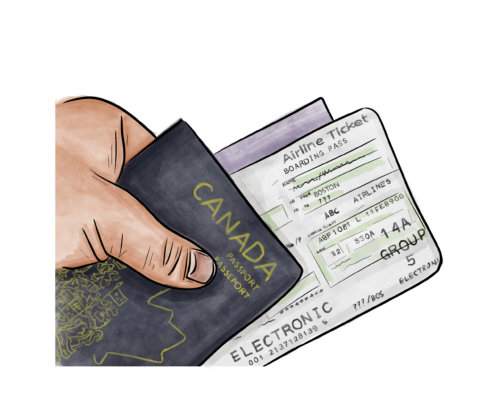
Graphic by Miranda Chao Hwang

Harvard College’s 2025-2026 Winter Recess spurred feelings of uncertainty and caution for its international student population. Averaging around 27% of each undergraduate class, the College’s international students had to navigate whether to remain on campus or travel abroad during the four-week intermission between semesters, as the Trump Administration continues to pursue actions directed toward international students at the University.
“There’s always some uncertainty about the visa situation because of how the general immigration situation has been over the past half a year or more,” said Adnan Bin Alamgir ’29, an international student from Bangladesh. “But given that I did not face too much of an issue while coming here for the first time, I think the concerns were lower than what they were back in September or August.”
In May 2025, the Department of Homeland Security moved to revoke Harvard University’s certification under the Student and Exchange Visitor Program, a federal authorization that allows universities to enroll international students on F-, M-, and J-visas. The Department alleged that Harvard had failed to comply with repeated requests for detailed student records, including disciplinary and protest-related information, and accused the university of insufficient oversight of its international student population.
These are claims that Harvard has strongly disputed, though the College has since distributed unspecified information on international students to the Department of Homeland Security. “Let this serve as a warning to all universities and academic institutions across the country,” Homeland Security Secretary Kristi Noem said on X.
A week later, on June 4, President Donald J. Trump issued Proclamation 10948, titled “Enhancing National Security by Addressing Risks at Harvard University,” suspending the entry of foreign nationals seeking to study or participate in exchange programs at Harvard. “Admission into the United States to attend, conduct research, or teach at our Nation’s institutions of higher education is a privilege granted by our Government, not a guarantee,” the proclamation stated.
The federal action triggered immediate legal pushback. Harvard filed suit, and a federal judge issued a temporary restraining order blocking the government from enforcing the proclamation’s visa restrictions while the matter continues through the appellate courts. In the judge’s ruling, the conflict was framed as involving fundamental constitutional rights, including freedom of speech and expression.
The administration’s actions were part of a broader escalation in rhetoric and policy toward international students that extends beyond Harvard. In 2025, the U.S. government revoked thousands of international student visas and green cards, with hundreds of cases specifically targeting participants in pro-Palestinian and anti-war protests.
Federal immigration and security officials have additionally enhanced social media screening and vetting requirements at U.S. consulates for potential visitors to the U.S. since mid-Dec..
Against this backdrop, international students made highly individualized winter break decisions, balancing academic goals, family obligations, and personal assessments of risk.
For Anderson Dy ’28, an international student from the Niagara region of Canada, winter break meant returning home after nearly a year away; he last went home the previous winter session. Dy noted that his last return to the U.S. had gone smoothly. “I generally felt more comfortable,” he said.
“I personally exercise an abundance of caution, and this is a personal decision,” Dy continued, explaining his rationale for his choice to visit home this year. That caution shaped Dy’s choices earlier in the year. Over the summer, he remained on campus to conduct research at Massachusetts General Hospital rather than traveling home, a decision he said was partly motivated by concern for minimizing unnecessary travel risks.
Dy emphasized that international students’ comfort levels vary widely. “To be fair, it depends on which country you’re from,” he said.
The Trump administration’s travel ban has indefinitely frozen immigrant visa processing for nationals of roughly 75 countries, including Iran, Brazil, Egypt, Russia, and Somalia. In other words, some international students face far stricter travel restrictions or paperwork delays than peers from countries not on the list, complicating decisions about whether to return home or stay at Harvard during the break.
He also acknowledged the difficulty of speaking openly about travel. “Given the circumstances, I feel as if my responses are rather limited,” Dy explained.
Other students found that remaining on campus offered both stability and academic opportunity. Bin Alamgir stayed in the Harvard dorms for most of the winter break, using the quieter period to conduct research.
“It was my first winter,” Bin Alamgir said. “I wanted to see what kind of opportunities they may have.”
Shortly after finals, Bin Alamgir reached out to professors and secured a position in a physics lab, where he completed extensive training during the break. He is now a full-time member of the research group and plans to continue his work throughout the spring semester.
While immigration uncertainty factored into his thinking, Bin Alamgir stated it was not the primary driver of his decision. “There’s always some uncertainty about the visa situation because of how just the general immigration situation has been over the past half a year or more,” he explained. “But given that I did not face too much of an issue while coming here for the first time, I think [my] concerns were lower than what they were back in September or August.”
Bin Alamgir also pointed to institutional support as a stabilizing factor. Harvard guaranteed winter housing for all international students who applied, which reassured him. “Other than that, there were a lot of winter programs and everything to make sure that we don’t get bored to death during the winter break. So that was also nice.”
Despite an emptier campus, students who stayed described an unexpected sense of connection. Undergraduates from different class years and Houses shared meals and routines. “There was only one dining hall open,” Bin Alamgir said. “It was all first-years, sophomores—all the students, all undergrads eating at the same place.”
Bin Alamgir described winter break as fostering an environment that allowed students to meet peers they might not otherwise encounter during the semester. “Because we’re all sort of in the same situation, on an almost empty campus, it was a different sort of community,” he said.
While many students emphasized that their Winter Session experience was defined more by resilience than by fear, conflict between Harvard and the Trump Administration continues to escalate. On Feb. 2, President Trump demanded a $1 billion fine from Harvard on Truth Social. This comes just one week after he privately told negotiators he was willing to drop his demand for a $200 million payment from the University.
“This should be a Criminal, not Civil, event, and Harvard will have to live with the consequences of their wrongdoings,” President Trump wrote.
Though prior safe returns to the United States and informal networks of support within the Harvard community helped temper anxieties, future decisions from the Trump administration remain unpredictable.
Courtney Hines (courtneyhines@college.harvard.edu)is the News Editor for the Independent.