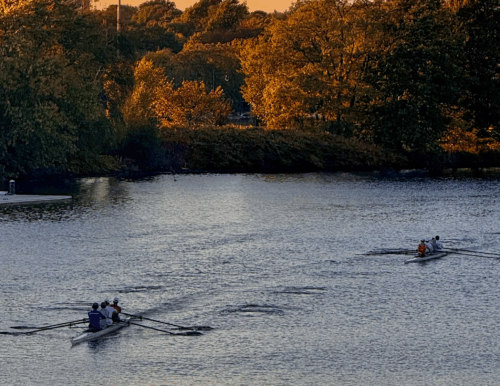
Head of the Charles: A Preview of the 60th Anniversary of the Regatta
Graphic by Giulia Viacava

This weekend, Oct. 17-19, marks the 60th anniversary of the Head of the Charles Regatta. Founded in 1965 by the Cambridge Boat Club, the event has grown from a local experiment into a global showcase of athleticism, tradition, and community. Each fall, the regatta draws thousands of athletes and spectators to the Charles River. Harvard men’s and women’s heavyweight and lightweight rowing teams will compete against other collegiate programs, alongside rowers of all ages from around the world.
The regatta was founded by D’Arcy MacMahon, Howard McIntyre, and Jack Vincent of the Cambridge Boat Club, after Harvard sculling instructor Ernest Arlett proposed a “head of the river” race similar to those held in England. The inaugural race took place on Oct. 16, 1965, drawing local crews to the Charles River. The regatta offered rowers something to train for and compete in, at a time when not many rowing races were held in the United States. As a result, the event quickly grew into a large-scale spectacle, now featuring more than 12,000 athletes across 74 races and thousands of spectators lining the bridges and banks of the Charles.
“It’s really phenomenal energy—you get a lot of friends and family, old Harvard alumni that flood the Newell Boathouse dock,” Harvard men’s heavyweight rower Ben Scott ’26 said in an interview with the Harvard Independent. “It’s great to see old Harvard alumni from decades and decades of Harvard rowing that still turn up for the event, clap us out as we’re going on the water, and are there when we’re racing.”
During the 1970s and 1980s, however, the regatta became more of a social event than a competitive one. College students turned the weekend into a party, passing alcohol to rowers and burying kegs along the riverbanks. After several years, the Metropolitan District Police imposed stricter regulations, and by the mid-1990s, the event had evolved into a respected, world-class competition. The Head of the Charles is now known not just for its atmosphere, but for the demanding course that challenges even the most experienced rowers.
Among the thousands of competitors returning to Boston for the 60th Head of the Charles is Philip Price (parent of Sarah Price ’29), a former collegiate rower at Brown University who first raced the Charles in the early 1990s. This year, he will compete in the Men’s Grand Master Eights [50+] event alongside friends he has rowed with since his college days.
“It was a ton of fun,” Philip Price said, recalling his first race. “I was rowing with some of my best friends…and it was absolute chaos… The shell itself weighs about 200 pounds, and you put eight people in it, each weighing about 200 pounds. So, you have a ton moving down the course, and the Charles is winding. So you have multiple boats, and I just remember sharp turns in the course and oars clashing.”
For Philip Price, the Head of the Charles stands apart from other regattas because of its unique course and competitive density. “The Charles is narrower and more windy, and everybody wants to row in it. So, you have more competitors in a narrow, winding river.”
Now, decades later, the regatta remains more about camaraderie than competition. “I’m expecting to do a lot of laughing with my old friends,” Philip Price said. “These are guys that I’ve known since I was a teenager… More than anything, it’s a chance to see people I care about.”
From seasoned rowers returning to the Charles to students racing it for the first time, the regatta unites generations through a shared river.
In an interview with the Independent, Harvard women’s heavyweight rower Erin Hanrahan ’26 recalled the first time watching the Head of the Charles as a high school novice, speaking to the excitement of competing at such a young age at the same regatta as professionals. “I just remember thinking it was such a big deal,” Hanrahan shared. “You already knew the meaning of the Charles from a novice who had just joined the program–that it was something special.”
Hanrahan competed in the regatta for the first time as a high school junior. “It was actually the most surreal thing ever. Rowing it’s not a very spectator sport, and not a lot of people come out to watch it, but it was absolutely crazy to see how many people were there… It being in Boston was crazy,” Hanrahan said.
This fall, the Harvard-Radcliffe heavyweight rowing team has been preparing through a weekly series known as the Radcliffe Rumble, where rowers train in smaller four-person boats and race timed segments of the course. “You learn a lot just because you’re 25% of the crew, you learn how you impact the crew…We are kind of ranked like that, and ultimately, the Charles lineups are…based on this Radcliffe Rumble,” Hanrahan added. The team practices directly on the Charles every Saturday and tests on indoor rowing machines each Friday.
“It’s so exciting… I feel like all of my old high school friends are here with their college teams. So much family comes and so many people watch on the live streams… It’s really fun to have everyone here supporting you,” Hanrahan shared. “I think, obviously, it’s so hard—you’re still racing and you kind of need to make sure you don’t get too overwhelmed with everything that’s going on. But… I’m excited for it.”
Scott will row his final Head of the Charles this year as a collegiate student. Originally from Perth, Australia, Scott first learned of the regatta long before coming to Harvard. “The Head of the Charles is the biggest spectator rowing event in the world,” Scott said. “People fly in from all over the world. Australia, the UK, Europe, and yeah, you get a whole bunch of different colleges and even national teams that turn up.”
The men’s heavyweight rowing team won the collegiate event last year, earning the title of fastest college crew on the river. “We beat Yale in 2024 for the first time in ten years…. Now we’re not just looking to beat other colleges but also international crews like Cambridge and the U.S. national team,” he said.
Training for the regatta begins in early September, with the summer devoted to international competitions. Several Harvard rowers competed in the World Rowing Under-23 Championships in Poland, representing Great Britain and Australia. Once the full team returned to campus, practices focused on synchronization and technical precision. “At this point, it’s not about getting fitter,” Scott said. “It’s about refining technique and getting used to the course.”
Through all of its changes over the years, the Head of the Charles has stayed true to its original purpose: to give rowers the chance to test themselves on a challenging course and, above all, enjoy the race. Its impact on both the rowing world and greater Boston community continues to be felt, uniting athletes and spectators in a shared excitement each October. See what the excitement is all about and head down to the river this weekend.
Katherine Chung ’29 (katherinechung@college.harvard.edu) writes Sports for the Independent.