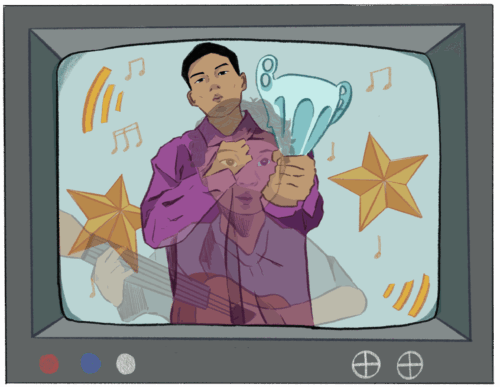
Hungry for More: Dexter Suhn’s Ascent into Music
Graphic by Kayla Le

Dexter Griffin ’27 took a lingering pause when I opened our interview by asking him to describe himself in three words. While I could have answered the question for him—creative, artist, visionary—he chose instead to revisit the question at the end of our conversation, offering me only one:
“Hungry,” he said when I asked him again. “I want to be a killer.”
…
Griffin performs under the artist name Dexter Suhn. His father, a musician and composer, immersed him in music from an early age. By preschool, he was already playing the ukulele, strumming Beatles tunes or the blues for his Berkeley, California community. “I didn’t really have much of a choice in terms of music being a part of my life,” he told me. “I think it’s always just been there.”
Suhn describes music as his “home base” for everything, explaining how the way he “experiences life is very much colored by music and driven by music.” His passion developed quickly: he learned jazz guitar through middle and high school, branched into music production with friends, and began songwriting in seventh grade. By his freshman year of high school, he was releasing music publicly, though none of those early tracks remain online. “I think it is not representative of the music I’m really trying to make,” he reflected on his original work. “In high school, at 16, 17, I’m trying to figure out what I want to say and, musically, what kind of world I want to build.”
Since then, that world has taken remarkable shape. While in high school, Suhn attended a UC Berkeley talk where he met producer ThankGod4Cody, a long time collaborator of American singer-songwriter SZA. In February 2025, Suhn was a producer, composer, and lyricist on “Take You Down,” a track from SZA’s 2025 album “SOS Deluxe: Lana.”
“I’m just grateful that it actually brings joy to people’s lives,” he said, referring to the song, which has over two million views across SZA’s official YouTube channel. “When it’s at a level of mass consumption like that, it can actually make a million people’s day better, which is amazing.”
“Breaking into music is hard, and for one of the first people I’ve come across in the industry to be someone like [Cody]—willing to share, willing to be that generous, really believe in me whole heartedly—I always have to be so grateful,” Suhn said.
That recognition was not misplaced. Put Suhn in a room, and he says he can make a beat out of thin air—a rare, on-demand skill that showcases both his technical ability and undeniable talent. Songwriting, however, especially for his own work, is a more meticulous process—one he finds comes most naturally in solitude.
“My thesis with a lot of my artist projects that I’m working on right now is to be hyper-intimate, and for emotion to be the guiding thing,” he said. “I really need to figure out what I’m saying and say things out loud—I sometimes just need to stumble through the words, and they find you.”
With the support of his family and community, Suhn has not only deepened his love for creative expression but has also found ways to give back. One of his achievements is founding Berkeley Electronic Arts & Technology Scholars, a free after-school program for BIPOC elementary students. Suhn was inspired to form this initiative after noticing that his school district’s music program both lacked students of color and suffered from resource limitations. “If you don’t have representation in the staff necessarily, then kids don’t see themselves there,” he said. “It’s just another barrier to entry to being in those spaces.”
Suhn’s ultimate goal was to offer mentorship to the students in the program. “How can I make these kids feel cared about?” he recalled asking himself. “That an older student that understands them and is young enough to relate to them, and also comes from a background of understanding and is willing to meet them where they’re at, and give that extra siblinghood and support?” Teachers and parents began to notice the program’s impact extending beyond music: students showed greater excitement for learning and improved classroom performance, which Suhn called a “win.”
Suhn’s passion for music also extends into his extracurricular life at Harvard, where he serves as director of publicity for The Kuumba Singers of Harvard College—a choir founded in 1970 to bring Black students together through music and spirituality during a time of alienation.
Suhn first saw Kuumba perform at his first-year convocation and was immediately drawn to the group. He explained that he had been looking for Black spaces to join at Harvard—places where he could feel a sense of community while also pushing himself musically. “It has been one of the most gratifying things I’ve done here. It’s one of the most special things on campus.”
Suhn also serves as development chair for the Harvard Undergraduate Music Business Association, a newly formed student group dedicated to connecting Harvard students with the music industry and related careers. “There was undeniably a big gap between Harvard undergrads and careers and entertainment, specifically in music,” Suhn said. “I’m glad that we’re able to bridge that gap a little bit, and provide some of that network and resources.”
While he loves music, Suhn emphasized he’s “not just music” and notes how his academic interests have strengthened his creative ones as a psychology concentrator. “Part of the reason why I’m addicted to making music myself is you really get to handle emotions at some of its purest level. Sometimes it’s pure, raw emotion and memory and thoughts—the human experience.”
“Psychology is very much: How does your mind work and how does your mind trick you? How can you trick your mind? I’m just really attracted to that.”
…
This past summer, Suhn split his time between New York, where he worked at a fashion company, and Los Angeles, where he focused on music production—including a dedicated week of sessions for himself. Now, he’s ready to make his first true statement as an artist, starting with a few singles followed by a larger project. “It’s a piece of me. I’m really excited to see that go out to the world,” he said. “I want to come out swinging—it’s so near and dear to my heart. I feel like I have something to say.”
For Suhn, this is only the beginning. With a hit record alongside one of the world’s top artists and new projects already underway, he’s carving out his name as both an artist and a producer—a “50/50” balance he’s grateful to be pursuing. Gratitude, a theme that surfaced throughout our conversation, continues to shape not only his approach to music but also the high standards he sets for himself. “I want to achieve my fullest potential. I don’t want to look back and be like, ‘I could have done this and that.’ I want to work hard and make myself and my family proud.”
It’s fitting that the one word he ultimately chose to describe himself was “hungry.” He’s eager for what comes next—and so are we.
Layla Chaaraoui ’26 (laylachaaraoui@college.harvard.edu) is the Editor-in-Chief of the Harvard Independent.