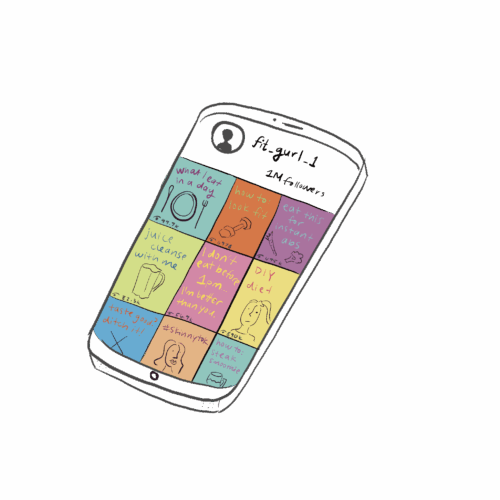
“I Don’t Eat Before 1 p.m. Because I’m Better Than You”
Graphic by Clara Lake

“I don’t eat before 1 p.m. because I’m better than you. Eat 300 grams of protein, sleep 8 hours, drink 8 glasses of water, reduce stress, get 10,000 steps, lift heavy, and remain in a calorie deficit. For a high-protein afternoon shake, put a large steak and matcha powder into a blender.”
Over the past few weeks, every time I’ve opened Instagram, I have been attacked by AI fitness junkies and influencers preaching protein maxing and biohacking—each short more extreme than the last. Their satire rings uncomfortably close to the reality of what diet culture now looks like online.
Yes, our generation has made strides toward body positivity. But with the rise of trends like #SkinnyTok and influencers such as Liv Schmidt promoting a hyper-specific “skinny aesthetic,” it feels as though we are regressing back to the 2000s, an era that idolized thinness often at the expense of physical health. However, social media has changed the landscape of diet culture, with content existing in an instantaneous and unavoidable format, wherein individuals with no verifiable knowledge have a platform to spread misinformation and toxic standards.
This shift coincides with the growing accessibility of GLP-1s—drugs like Ozempic that regulate blood sugar and insulin release. Once reserved for patients of diabetes or chronic illnesses—and for celebrities who could access them—GLP-1s are now available to friends, neighbors, and even parents, repurposed from medical treatment into a tool for aesthetics. This availability has rendered weight loss an instantly accessible commodity for those who can afford the often steep treatment plans, making the pursuit of the ‘ideal’ body feel closer than ever.
As Vanessa Friedman noted in her June New York Times article “Extremely Small and Incredibly Tight: The Bandage Dress Makes a Comeback,” the resurgence of the skinny aesthetic is “wrapped up in the Ozempic-inspired rise of a new form of body consciousness and diet culture.” The return of the Hervé Léger bandage dress, infamous for its unforgiving fit, is a visual marker of this shift. At its peak, Friedman reminds us, the dress was “a way to differentiate your body from the bodies that couldn’t get into [it].”
Influencers like Liv Schmidt, founder of “Skinni Société,” push restrictive ideals under the guise of health. The result is a repackaging of Kate Moss’s infamous 2009 mantra, “Nothing tastes as good as skinny feels.” Companies like “Skinni Société” make fitting a highly restrictive “ideal” feel like an exclusive club, where eating only one bite of brownie is the admission price.
The resurgence of that style alone is a stark signifier of where we are currently standing with regard to diet culture.
The problem isn’t wanting to eat well or train hard. It’s when health becomes a commodity and disordered habits are rebranded as empowerment, allowing companies and individuals to profit from perpetuating insecurity. #SkinnyTok primarily targets a vulnerable audience of young women online; it is especially troubling to see girls as young as 12 years old engaging with this content in the comments. Even if the impact is not immediate, it plants seeds of doubt.
As one student explained in an anonymous interview, “Just yesterday, I was looking for fun recipes to make, and every single video, without fail, had to incorporate the number of calories that it had in it and the amount of protein it had, and this obsession with numerical value in what we’re consuming.”
“It’s masked with the idea that it’s very healthy for you and makes you strong,” they explained, referring to the restrictive ‘one-bite’ diets she has been seeing on social media.
She’s right. Recipes online increasingly sound like AI parodies: “Put cottage cheese into a blender with cottage cheese, bake it, and spread cottage cheese on it, giving you delicious, high-protein cottage cheese.”
Personally, I’d rather enjoy a cinnamon roll made with flour, butter, and sugar than its “high-protein” substitute, leaving me genuinely satisfied both physically and mentally, instead of fixating on what I denied myself.
This constant stream of “wellness” content doesn’t just shape our momentary choices, but rewires how we think about food and health. By commodifying nutrition, influencers create a feedback loop of guilt and anxiety. “Come with me to burn 10,000 calories at the gym”—creates a persistent sense of inadequacy that outlasts the trends themselves.
“Health” has become inextricably linked with productivity; if I didn’t eat 400 grams of protein and burn 10,000 calories at the gym today, I’m a couch potato with no discipline. All there is time for in the day is a hustle of work and “wellness.” This mindset takes away from so much of what wellness has been about—self-care, meditation, downtime—other than working out and eating well.
And beyond this, diet culture on social media is riddled with inaccuracies.
Dr. Deirdre Tobias, nutritional epidemiologist and assistant professor at Harvard Medical School and Brigham and Women’s Hospital, stressed the need for evidence-based guidance in an interview with the Independent. “Claims that we have some sort of issue with getting enough protein are actually not very accurate for most Americans,” she said.
“The more you over consume in any one category, even if it’s relatively neutral on its own, can have those unintended consequences of displacing foods that you know provide additional nutrients and fiber.”
Yet products like the David Bar, boasting “28 grams of protein in only 150 calories,” continue to sell. Behind the shiny gold wrapper and sleek branding lies an ultra-processed, chemical-heavy snack. The allure of “high protein” trumps the value of whole, natural ingredients we actually need.
And that’s not to say you shouldn’t eat what you want, just don’t be fooled by the glossy packaging and claims of ‘health’ and ‘wellness.’
Dr. Tobias also warned about the lack of oversight online. “There’s no requirement or even social accountability for something like a social media post to actually be reflecting truth, right? And the regulation of that is almost non-existent.”
This exists in stark contrast to the world of academic research, which is built upon decades of research and evidence. But in the influencer economy, credibility loses out to marketability. “There’s no money to be made off of telling people to eat from the produce section,” Tobias said.
So what’s the takeaway? Both your diet and your media diet are personal choices, not dictated by algorithms or influencers. Goals and aesthetics are fine, but remember to take online “wellness” with more than a grain of salt. Balance matters more than protein counts or step totals. It is essential, and what we should all be doing is listening to our bodies to prioritize our health, instead of spending time keeping track of every calorie and gram of protein.
For my part, I won’t be choking down cottage cheese brownies, but I also don’t plan to eat a pint of ice cream at every meal. And I certainly won’t be freezing affirmations into ice cubes to blend into my protein shakes for “subconscious gains.”
Ultimately, for me, balance will beat biohack any time. Maybe the real hack is just eating what leaves you satisfied and feeling good.
Mia Wilcox ’28 (mwilcox@college.harvard.edu) is going to finish every bite of her brownie.