Keep Us Out of the Media
Graphic by Amelie Lima

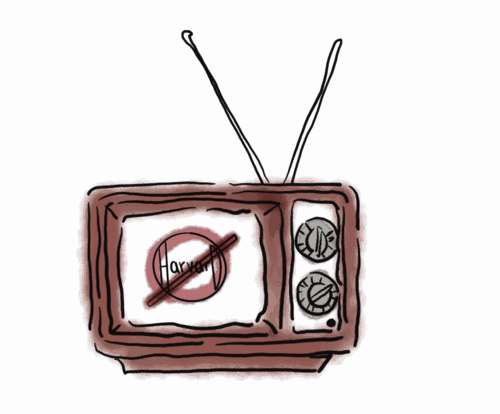
If you believe everything you read in the news, Harvard students are either future billionaires, political masterminds, or villains in a culture war. This narrative is making Harvard, a pinnacle of higher education, seem as if it’s plotting to undermine the country from within.
The truth is, as always, less dramatic: most of us are just trying to make it through p-sets, balance clubs and classes, and figure out what comes next. Yet every time our campus trends online or appears on the news, we’re reminded that being a “Harvard student” is not just a description, it’s a caricature. Maybe the best press we could get is no press at all.
Reporters descend on Harvard as if it were a stage set for the entire nation. We are seen as symbols instead of students, cast into stories that have already been written. When the news wants to talk about wealth, ambition, or politics, Harvard becomes the perfect headline bait. News such as “‘Remedial’ math at Harvard” or “Harvard refuses to condemn political violence” continues to gain national attention. Stories like this capture attention because, regardless of truth, they tap into politically charged themes in the media: elitism, hypocrisy, and degradation of standards. Although most of us are too stressed to attend a protest, and despite the “old money” stereotype applying to very few, the narrative sticks. We’re still painted as the spark for everything supposedly “wrong” with America’s elite.
There’s certain logic to this claim: with 41 Fortune 500 CEOs among its alumni, Harvard produces some of the brightest and most influential minds every year. But it isn’t Harvard that determines their path; it’s the drive and intellect that got them here in the first place.
In my three short months here, I’ve seen enough to be wary every time an influencer appears in the Yard: They ask loaded questions with no right answers, framing Harvard as an ideological hive mind. Seeing a video of one of my fellow first-years being asked their thoughts on Charlie Kirk’s death made me realize how fragile our public image is. What if I were the next one interviewed and said the “wrong” thing, becoming the subject of national outrage? As my father likes to say, “If you ask the smartest person a bad question, you can make them seem dumb.”
This media narrative is nearly impossible to debunk from within. Most people’s only experience with Harvard students comes through what they hear secondhand. From the New York Times talking about how, at Harvard, “many of its students skip class and fail to do the reading,” to social media interviews conducted by people asking leading questions, fitting Harvard students into a preconceived narrative, few ever speak with us directly. And so we’re reduced to tropes, seen not as individuals, but through a media portal.
Of course, Harvard should be held to a higher standard, maintaining academic rigor and producing excellent students, but that standard should be about education, not ideology. The strength of this University isn’t in a political leaning but in the investment it makes in its students. In my short time here, I’ve met people who have challenged my worldview through shared experience and genuine
conversation—not by the political “brainwashing” some imagine happens at Harvard.
If the media truly cared about what happens here, it would focus less on culture wars and more on how universities like Harvard can nurture the next generation of thinkers, leaders, and changemakers. Media consumers, too, can be more conscious of what they are reading. Instead of falling into the trap of a “Harvard” headline, they may ask themselves who really benefits from this caricature, and whether they are hearing a story about a student or just a story about power.
There’s also something we as students can do. Rather than running away from media attention, we can choose to interact on our own terms. Writing and speaking beyond campus allows us to reclaim our own narrative, displaying to the public that we exist beyond our media portrayals. Maybe the best solution to this caricature isn’t silence, but authenticity. It seems unreasonable, but we must defend the identity of Harvard through our own actions, disproving the unjust media perception of ourselves.
What the world should understand is that Harvard isn’t a singular entity. It’s a collection of thousands of voices, each with its own story. There’s irony in the fact that the place most famous for producing voices that shape the world rarely gets to speak for itself.
Aidan Gallagher ’29 (aidangallagher@college.harvard.edu) is from Wyoming and comping the Independent.