Kitchen Sink No. 1
Graphic by el richards

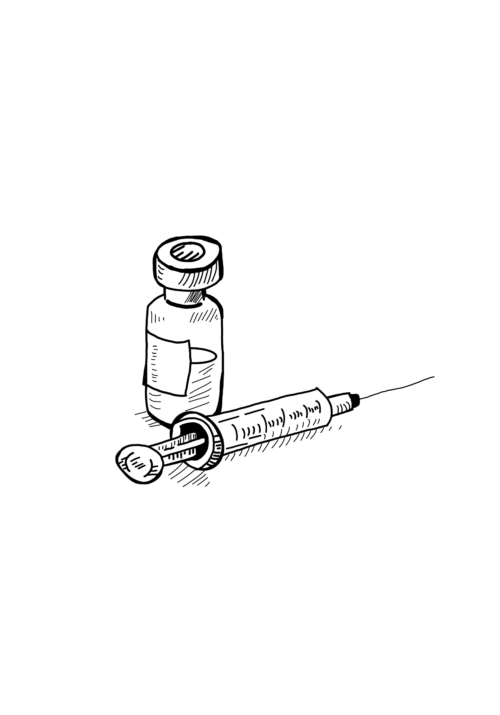
I woke up, and my shoulder was sore. Not sore—throbbing. A deep ache in the muscle where they’d injected the medication yesterday. Or was it this morning? Time moves strangely here. Above me, I could hear Thomas breathing. He was already awake. He’s always awake before me, which he mentions constantly, as if being awake first proves something, as if consciousness were a moral achievement. The room smelled of carbolic soap and boiled cabbage and something else underneath—sweat, fear, the particular staleness of air that’s been recycled too many times—the asylum smell.
I should get up. There’s a routine here, and if you break it, they notice, they write things down, everything is evidence here. Everything means something. The nurses prefer you punctual.
Thomas climbed down from his bunk already dressed, his jacket buttoned correctly, his hair combed back in neat rows. He’s meticulous about these things. He believes presentation matters, that if he maintains the proper appearance, then eventually someone will realize there’s been a mistake, that he doesn’t belong here, which is absurd because we all belong here, or none of us do. What’s the difference really? He told me I’d been talking in my sleep again, saying something about the library. But I don’t remember. I imagined driving him back between the bunks, breaking that precise composure piece by piece until there was nothing left of him but something blocking my way.
The attendant came with breakfast. Two tin trays. Porridge, grey and lukewarm. Thomas thanked him. The attendant grunted and left. Attendants rarely look at patients directly. They move through the ward with the same routines, the same hours, the same locked doors, only on the other side of the keys. Maybe they’re the crazy ones. We ate in silence. Thomas ate the way he dressed: methodically, chewing each bite exactly twelve times. Twelve times. Every time. I wanted to ask him why, what he thought twelve chews would accomplish that eleven couldn’t, but I didn’t because I knew he’d have an answer. Thomas always has answers, reasonable-sounding ones that make me feel like I’m the one who doesn’t understand basic principles of existence.
Thomas mentioned that Dr. Whitmore wants to see me today. He said the doctor told him yesterday, during his session. This bothers me. The idea of them discussing me, of Thomas knowing my schedule. But everything here is public. I asked what he’d told the doctor about me. Thomas set down his spoon and looked at me with that expression—patient, condescending, amused. He said the doctor only asked if I was sleeping well, and he’d mentioned I talk in my sleep sometimes. Of course I do. When I sleep, no one is listening to write it down. Or maybe they are. Maybe that’s when they listen most carefully.
After breakfast was exercise period. The courtyard is small. Thirty paces long, twenty wide. High stone walls. A few scraggly trees that seemed to have never fully grown. Thomas walked ahead. He always walks ahead. Quick, purposeful strides, as if there’s anywhere to go. The air was cold. October air. Or November? I can’t remember what month it is. Time here doesn’t follow normal rules. Days last forever. Weeks vanish.
Oxbridge feels very far away. But also very close. Sometimes I can barely remember it. Other times it presses in on me with such clarity I can smell the must of old books, hear the chapel bells. Had it been autumn when I arrived? Or spring? I’d arrived in October, I’m certain of that, October 1910, but which October? The first one or the second one? The chronology keeps shifting, refusing to stay fixed, and maybe that’s the real problem, not that I can’t remember but that I remember too many versions and they’re all equal and equally alike.
There was a bird on one of the branches. Small, brown, ordinary. It flew away. Over the wall. Gone. The bird could leave! Just like that! But where would I go even if I could leave? Back to Oxbridge? Impossible. Home? I barely remember home. London is a blur of streets and noise and my father’s disappointed face. There’s nowhere to go. Which means being trapped here is the same as being free, really, if you think about it, though Thomas would say that’s exactly the kind of reasoning that proves I belong here.
Thomas called out that they were going back inside. I hadn’t heard the bell. But others were filing inside, so it must be time. It’s always time for something here; never time for nothing.
…
The office was warmer than the rest of the building. A fire in the grate. Bookshelves. A desk with papers arranged in neat stacks. Dr. Whitmore sat behind the desk, writing something. He’s about fifty, clean-shaven, with iron-grey hair and spectacles.
He told me to sit without looking up. I sat while he finished writing. When he was done, he set down his pen and studied me. Assessing. Clinical. Like I’m a specimen under glass. He asked how I was feeling today, and I said fine because what else was I supposed to say? That my arm hurt from yesterday’s injection? That Thomas won’t stop watching me? That I can’t remember what month it is? So I said fine, and he repeated it back to me. Fine. No complaints? No complaints, I said. Dr. Whitmore made a note.
He mentioned the sleep-talking. Of course he had reported me. I thought back to our conversation. Thomas reports everything. He observes and catalogues and reports, always trying to build his case that he’s the reliable one, the sane one. I told the doctor I don’t remember talking in my sleep, and he said that’s the nature of sleep-talking; you rarely remember.
Then how do you know it happened? I asked. Because Thomas heard you. Thomas says a lot of things, I said, which is true. Thomas says so many things. Endless things. Most of them are about me. Most of them are wrong, or warped, or twisted to make him look better.
Dr. Whitmore leaned back in his chair and told me I don’t trust Thomas. Would you? I asked. Would you trust someone who reports everything you do? He’s concerned about you, the doctor said. No, I said. He’s concerned about himself. He wants to make himself look better by making me look worse.
That’s an interesting interpretation, Dr. Whitmore said. It’s the truth, I said. But he just made another note. Another mark in his little book. Every statement is evidence. Every word is data for their theories about what’s wrong with you, why you’re here, whether you’re improving or deteriorating.
Then, he said, let’s talk about Oxbridge, and my chest tightened. I didn’t want to talk about Oxbridge. Talking about Oxbridge means remembering, and I’ve worked very hard to stop remembering, to push it all down into some sealed chamber in my mind where it can’t hurt me. He asked what I studied there, and I told him Greek tragedy. Sophocles primarily. Oedipus Rex. Medea. Did I enjoy it? What a strange word. Enjoy. Had I enjoyed it? I’d been good at it. I’d understood the texts in a way the other students didn’t. I could see the patterns, the parallels, the inevitability of fate—but had I enjoyed it? That’s a different question entirely. It was challenging, I said. Which seemed safe. Noncommittal.
Thomas studied the same subject, he said. You were in the same lectures. You must have known each other well. Not really, I said, which was true. Or partially true. We’d known each other but not well. We’d been aware of each other. There had been some kind of competition or rivalry, though it’s hard to remember exactly. The timeline keeps shifting. Sometimes I remember meeting Thomas in the first week. Sometimes I remember not meeting him until December. Sometimes I can’t remember meeting him at all. Only suddenly becoming aware of his presence.
Thomas says you were friends, Dr. Whitmore said. Thomas is mistaken, I told him. Or you are. I didn’t answer. There was no good answer. Either I admitted my memory is faulty, or I accused Thomas of lying. Either way, Dr. Whitmore would make a note. Add it to his file. Use it as evidence of something.
Did something happen at Oxbridge? he asked. Something that upset you? Everything happened at Oxbridge. Nothing happened at Oxbridge. It had been the best time of my life. It had been unbearable. I’d been happy there. I’d been miserable. All of these things are true simultaneously, which makes none of them true, which makes the whole question meaningless. I don’t know what you mean, I said.
The reason you’re here, he said. Do you remember why you’re here? Of course I remember. I’d been brought here after—after—. There had been something. An incident. A misunderstanding. Something to do with the library? Or the rooms? Or someone had said something, and I’d responded, and somehow it had all gone wrong. Spiraled out of control. There was a misunderstanding, I said. What kind of misunderstanding? I don’t remember exactly. Try. But I couldn’t. The harder I tried to remember, the more it receded, like trying to grab smoke.
There had been accusations. Questions. Men in uniforms. Someone in authority was asking me things that I’d tried to explain, but the words came out wrong. Nonsensical even to my own ears. I was upset, I said finally. I said things I shouldn’t have said. What things? I don’t remember.
Dr. Whitmore was quiet for a long moment. Then he said very gently: Do you remember the girl? The girl. Something lurched in my chest. Fear. Guilt. Grief. All of them at once, crushing the air from my lungs. What girl? I said blankly. The girl from the library. I don’t know what you’re talking about. Thomas says—Thomas is a liar. The words came out too loudly. Too sharp. Dr. Whitmore’s expression didn’t change, but I saw him glance toward the door. Calculating whether he needed to call for assistance.
I forced myself to breathe. To calm down. To present the appearance of rationality, even though everything inside me was screaming. I’m sorry, I said. Thomas says a lot of things that aren’t true. He confuses things. I can’t be held responsible for his delusions. His delusions, the doctor repeated. Yes. Another note. Damn him. Damn his notes and his gentle voice and his spectacles and his warm fire while the rest of us freeze in our stone cells. I think that’s enough for today, he said.
I stood up too quickly. The room tilted. I had to grip the back of the chair to steady myself. He asked if I was alright. Fine, I said. Just stood up too fast. The medication can cause dizziness. Make sure you’re drinking enough water, he said. I nodded and left.
In the hallway, Thomas was waiting. He’d been waiting outside the entire time. Listening probably. He asked how my session went. Fine, I said. He asked about Oxbridge, didn’t he? That’s none of your business. He asked me about it, too. Yesterday. He wanted to know about the girl. There was no girl. There was. You know there was. I didn’t answer. We walked back to our room in silence. His absolute conviction that he knows what happened, and I’m just too broken or too cowardly to admit it.
…
At dinner, I couldn’t eat. The food looked wrong. Smelled wrong. Everything was suspicious. Contaminated. But Thomas ate normally. He’s always eating normally. Chewing. Stopping. Chewing again. I tried not to watch but I did anyway, my eyes dragged back to his mouth like it was a metronome I couldn’t shut off. One, two—no, that wasn’t right, start again—one, two, three, four—he swallowed too early, or maybe I lost count, I always lose count, but he never does. Twelve. It’s always twelve. I’m sure of it. How can he eat when nothing makes sense? When you can’t trust your own memories or perceptions? He told me I should eat because I need to keep my strength up. He said I was getting agitated. I’m not agitated, I said. But I was. I could feel it rising in me like a fever. The anger. The frustration. The feeling that everyone is lying. Everyone is conspiring. Everyone is trying to convince me that I’m insane when really I’m the only one who can see clearly.
The girl. Why do they keep asking about the girl? There’s something there. Some memory is trying to surface. A face. A voice. Someone is in the library shelving books. Looking up when I entered. Smiling. No. That’s not right.
I told Thomas I needed to lie down. Back in the room, I climbed into my bunk. Above me, I could hear him settling in. That scraping sound as he shifts his weight. Every sound he makes grates on me. His breathing. His presence. His mere existence in the same space I’m trying to occupy. My mind was racing. Thoughts tumbling over each other. Fragmenting. Reassembling into the wrong patterns. The girl had smiled. I remember that. She’d directed me to the classical texts. Shelf D-47. Homer. Virgil. Ovid. Which one of us had spoken to her first? Which one had she smiled at?
My heart was beating too fast. The walls were too close. The air was too thick. I sat up breathing hard. Thomas told me to lie down. I can’t. You’re going to get in trouble. I can’t breathe. You’re breathing fine, you’re just panicking. How do you know what I’m feeling? I’ve seen you like this before—you work yourself up, and then you lose control. I was standing now. When had I stood up? I didn’t remember deciding to stand. Pacing. Three steps to the wall. Turn. Three steps back.
The room was too small. Impossibly small. A cage. Thomas told me to sit down. He’d climbed down from his bunk. He was standing between me and the door. Get out of my way. Where are you going to go? Anywhere. I need—what did I need? Air. Space. Truth. Answers. Move, I said. No. Move! I pushed him. Or tried to. He pushed back. We were grappling. Struggling. My hands on his shoulders, his hands on my chest, both of us breathing hard. And I realized with strange clarity that we were the same height. The same build. That pushing him was like pushing against a mirror.
The door opened. Attendants. Multiple attendants. They must have heard the noise. The scuffle. Pulling me back. Forcing me down. Someone’s knee between my shoulder blades. My face against the cold floor. The smell of carbolic soap. Hold still. The needle. I saw it coming. The sting in my arm. The burn spreading. Chemical warmth flowing through my veins. My thoughts slowing. Softening. The edges blurring.
Above me: Thomas’s face. Looking down. Concerned or satisfied or both. It’s alright, he was saying. He just gets like this sometimes—
Written by Luke Wagner ’26 (lukewagner@college.harvard.edu)and Jonah Karafiol ’26 (jonahkarafiol@college.harvard.edu).