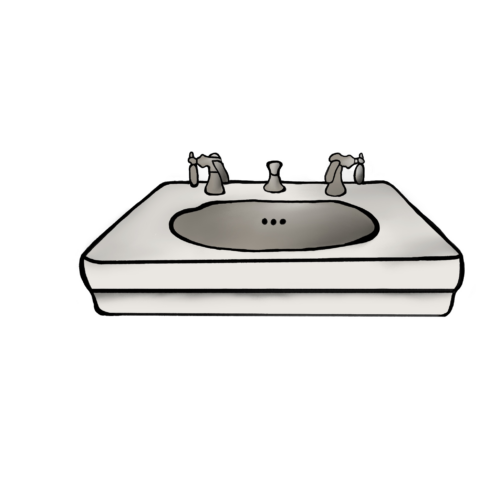
Kitchen Sink No. 2
Graphic by Christiana Zembrowski

The train moved north through grey morning light, steady enough that the countryside seemed to glide rather than pass. Fields, hedgerows, and the occasional cluster of sheep standing in the drizzle as if waiting for instruction. I had a book open on my lap, but I wasn’t reading. At some point, the page turned, yet I didn’t register it until much later.
The carriage smelled faintly of damp wool and coal. Someone coughed behind me. The window rattled when the train picked up speed, then settled again. I adjusted my bags with my foot and watched the reflection of my face in the glass appear and then vanish as the light changed.
I was aware, with mild annoyance, that this was the sort of detail I tended to register—the small mechanical shifts, the way light misbehaved on glass—rather than anything properly useful. I told myself to stop cataloguing and read.
London was already behind us: Clerkenwell, the spalling brick streets, the stairs with the bowing wood, and the kettle that took too long to boil. My father had been at the table when I left, newspaper folded neatly beside his plate. He asked whether I had everything. I said yes. He nodded. When I reached the door, he reminded me to write if I needed money. We shook hands. That seemed sufficient.
Crossing another bridge, I looked down at the water—dark, slow-moving. I couldn’t have named the river. There are a great many rivers in England, and most of them go unremarked upon, which raises the question of what made any of them great in the first place—length, history, usefulness, how often they were written down—though this did not seem important at the time. I shifted in my seat and returned my attention to the window. Trees gave way to open fields again. The book remained open, waiting. I let it be. I straightened it anyway, though there was nothing wrong with the way it lay, and then adjusted it again, less because it needed correction than because I disliked leaving an object in a position I hadn’t consciously chosen.
But that was the old thinking. The London way of thinking. I was going somewhere new, away from places where two and two were already settled. Somewhere I could build something from the texts and lectures and conversations that had nothing to do with that silent house—that house in Clerkenwell, my father at the table with his folded paper, the kettle cooling on the hob. I told myself this place would not resemble that one. I told myself the vacancy would leave room for something else.
The meadows in the window were empty, recently harvested, the soil turned, and waiting. I watched them flow by and found myself thinking of the way a room looks after the furniture has been removed—not absent, exactly, but prepared, holding its breath for whatever came next. I straightened in my seat, adjusted my collar, and closed the book, sliding it back into my satchel.
I had always assumed, without quite deciding to, that I noticed more than other people—that I saw the joints and seams where things were put together, the underbelly and the scratches. This belief did not make me happier, kinder, or even more certain; it only made me impatient, as though I were being held back by people who did not realize they were slow.
…
The university gates rose before me—massive slabs of oak scarred with figures I hadn’t been able to identify from the moving cab—and beyond them a courtyard of pale stone that seemed to glow faintly even under the grey sky. I paid the driver and stood there with my trunk at my feet while he stared at me, mistaking his pause for thought.
I did not move immediately, aware of the slight impropriety of having settled my fare and yet still standing with my trunk at my feet as though something further were expected of me, and while he waited with the reins slack in his hands, I watched two porters cross the courtyard with boxes and heard someone behind the gate call out directions; the stone beneath me was worn smooth in places, the corners of the paving dipped as if years of feet had pressed them down.
I tried—without much success—to imagine being one of those earlier arrivals, equally burdened and equally convinced that the present moment mattered more than it probably did. I shifted the trunk a few inches for no reason I could explain and felt mildly irritated by having done so. The gate stood open with no one preventing me from entering except myself, a realization I preferred not to linger on. So, I adjusted my grip and went through.
Whatever significance the day was meant to have failed to announce itself. By the time I lay down, my melancholy had reduced itself to a fatigue and a mild irritation at having paid so much attention to it in the first place.
…
Sleep came in pieces. I stirred to the sound of footsteps in the corridor, lay still until they passed, then drifted off again without remembering. When I woke for the second time, the room was already drab with morning, and for a moment I did not know where I was. This did not alarm me. On the contrary, I took a certain satisfaction in it, as if confusion were proof that I had not yet surrendered to habit. It seemed reasonable, given that the day before had been full and unfamiliar. I lay there and let the room reintroduce itself: the desk, the wardrobe, the sink, the window, the dark oak against the pale sky.
Room fourteen was small: a bed pushed against one wall, narrow, with a thin mattress. A desk beneath the window. A wardrobe that looked older than my father. And bolted to the wall beside the door, a white porcelain sink with two taps—one for hot water, one for cold. I tested them. The cold worked. The hot produced a thin trickle of rust-colored water that eventually cleared. I washed my hands and dried them on my trousers, left with the faint impression that the sink had been waiting.
I dressed quickly, conscious of the pause before the hot water came on, my reflection in the mirror above the sink lagging a moment behind me. The delay annoyed me more than it should have. I counted silently while I waited—one, two, three—until the water changed temperature, then stopped counting as soon as it did, unsettled by how ready the numbers had been. I had always distrusted anything that presented itself too easily, particularly my own compliance.
I was fastening the last button of my shirt when there was a knock at the door. Not sharp, not tentative—simply there, as though the person on the other side had assumed I would hear it and respond accordingly. I opened it to find a young man standing in the corridor, angled slightly away, his posture suggesting familiarity with the space rather than with me. He gave his name as Henry—Henry Collins, after a pause that seemed unnecessary—and said he was just down the hall. His voice was even, practiced, and I found myself resisting the impulse to distrust it purely on that basis.
He held out his hand. I took it. The exchange lasted no longer than required, though I could not have said what the requirement was myself. He said he had seen me arrive the day before and thought he ought to introduce himself. This struck me as a convention rather than a desire, and I resented the convention for having decided on his behalf.
He glanced past me into the room. Not rudely. Merely confirming that it existed. Fourteen, he said. A decent room. Better light than most. I wondered how many rooms he had already judged in this way and how distinctly he remembered them afterward.
He asked what I was studying. I told him Classics, Greek mostly, and immediately wished I had not been so precise. Precision invites interpretation. And interpretation, once invited, rarely asks permission. He nodded, as though this aligned with something he had already assumed, which irritated me further, though I could not have explained why.
Breakfast would be starting soon, he said. The hall filled quickly on the first morning. He was heading down now, if I wanted to join him. The phrasing was casual, but the expectation beneath it was unmistakable: refusal would require justification. I felt, abruptly, the weight of having arrived in a place where even solitude demanded explanation.
All right, I said, and heard in my own voice a compliance I did not entirely approve of.
We walked downstairs together. He spoke about practical matters—the layout of the buildings, which staircases were quicker than they appeared. I listened and did not listen at the same time, already aware of a quiet resentment taking shape, not toward him specifically, but toward the ease with which he seemed to inhabit the place, as though belonging were something one acquired simply by showing up early enough.
At the bottom of the stairs, he stopped and said we would probably overlap. Same lectures, most likely.
Perhaps, I said. The word pleased me. It conceded nothing. I was aware, even then, of the childish satisfaction this gave me.
He nodded once and left, absorbed immediately into the general movement of the courtyard. I watched him go and felt, to my annoyance, a faint sense of having failed some small, undefined test, though I could not have said what the test was or why it should matter to me at all.
On Henry’s suggestion, I went to the bursar’s office to collect the remaining forms I had apparently neglected to sign the day before. The room was low-ceilinged and close, smelling faintly of ink and dust, the air stale in a way that suggested it was rarely disturbed. A woman behind a narrow desk slid a ledger toward me without looking up and asked for my name. I gave it, aware of how deliberate my voice sounded in the confined space. She ran her finger slowly down the page, paused, then turned the book slightly so that the columns faced her more directly, as though adjusting it for her own comfort rather than clarity.
You were here earlier, she said, still scanning, her finger pressing lightly into the paper. I told her I had only arrived that afternoon. She made a brief, indistinct sound that might have been an apology and traced the line again, more carefully this time, lingering. Initialed, she said. Room fourteen.
I leaned forward instinctively, though I could see nothing from where I stood, and immediately felt foolish for having done so. She had already closed the ledger and reached for another stack of papers, the moment foreclosed. Probably a mistake, she added, and pushed a form toward me, indicating the bottom with a small, precise motion. I signed where she had pointed, conscious of the pressure of the pen, the exaggerated care I was taking with each letter, as though neatness might resolve whatever uncertainty had passed between us.
When I handed the paper back, she glanced at it briefly, nodded once, and turned to the next student without further comment, leaving me with the uncomfortable sense that something had been completed without my fully understanding what it was.
Back in my room, I sat at the desk and opened my notebook. The page was blank. I wrote the date at the top, then paused, reading it back to myself with unnecessary care. October. Yes. October. There was nothing ambiguous about October, and yet I found myself underlining it, as though the act of writing alone were insufficient proof.
The sink drew my attention: white porcelain, two taps, arranged with an almost clerical neatness, as though cleanliness were a doctrine it enforced rather than a service it provided. A faint rusted mark clung to the basin where the hot water had once misbehaved, the trace left behind when something was corrected rather than forgiven. I turned the hot tap. Nothing happened. I waited—one, two—aware of the pause, which felt less like a malfunction than an appraisal. When the water finally arrived, it did so thinly, reluctantly, as if indulging me. I washed my hands, with the uneasy sense that the gesture was being noted, then dried them on my trousers, unnerved by how readily I had complied.
Outside the window, the oak tree stood where it had stood the day before. This was reassuring in a way that embarrassed me. I lay back on the bed and told myself I would rest for a moment before going out again, though I had nowhere in particular to go and no real desire to be seen.
The water continued to run. I listened to it longer than necessary before getting up to turn it off, annoyed with myself for having let it go on and equally annoyed by the certainty that, had I not noticed it when I did, it would have continued indefinitely.
Written by Luke Wagner ’26 (lukewagner@college.harvard.edu) and Jonah Karafiol ’26 (jonahkarafiol@college.harvard.edu).