Kitchen Sink No. 4
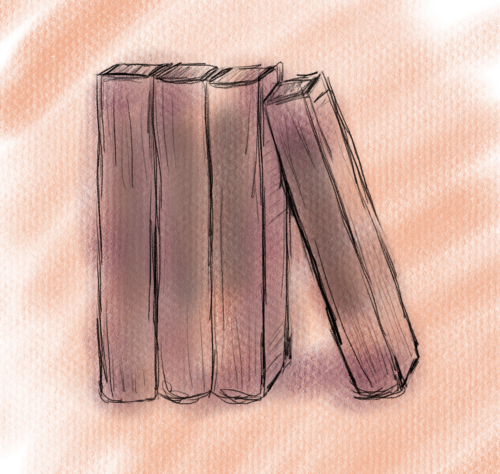
Graphic by Trischelle Afihene

I had been watching her for six days.
This was not unusual. I watch most things. But I had been watching her with a specificity that surprised me—the way she replaced books on the shelves, for instance, running two fingers along the spine before releasing it, as though verifying it was properly returned. The angle at which she held her head when reading. The restraint—no wasted motion—of her movements, which suggested either training or temperament, and I found myself constructing histories to account for her grace: a governess, perhaps, or a mother who did not tolerate fidgeting. I noted when she arrived and when she left. I noted which aisles she favoured and how long she lingered in each. I noted how her amber hair glistened in the afternoon light. Everything about her seemed practiced, and I couldn’t tell what for.
On the sixth day, she was not at her post.
I immediately noticed and resented myself for it. I stayed an hour longer than necessary, copying the lines when Troilus hides and watches Cressida turn towards Diomedes. The words refused to hold their meaning. I underlined a sentence, looked back at it, and found it had already gone inert—marks on a page signifying only themselves. I closed the notebook and sat with my hands flat on the table and breathed and waited for the agitation to pass. It did not pass. By evening, I needed air.
The town received me without comment. I walked without direction, though I noticed my feet carried me toward the public houses, and I didn’t correct them. The King’s Arms was louder than the hour warranted. I paused at the door, still deciding whether to enter, before it swung open and the noise spilled out—warm and sour and irresistible—and against my better judgment, I stepped inside. My eyes adjusted.
She stood near the hearth.
The fire behind her made it difficult to see her face clearly, but I knew her immediately by the posture: by the particular stillness I’d been cataloguing for days. She held a glass but was not drinking from it. She was watching the room with the expression of someone conducting an inventory, and when her gaze reached me, it did not slide past. It stopped. You again, she said, and there was no smile attached to this remark, nor was there hostility—only recognition, as though we had already established terms I could not recall agreeing to.
I closed the distance. Have we met properly, I asked, and she repeated the word properly as though testing it for cracks. You were in the library, she said. So were you, I replied. You were measuring things, she said, and I told her I measure most things, and she said not tonight, and the observation irritated me and pleased me at once because I wasn’t aware of having altered my method, and yet she sounded certain—she had, apparently, been watching me with something like the attention I had been paying her. The symmetry was satisfying. I examined it for flaws and found none.
We stood closer than the noise required. Someone dropped a glass across the room. The fire shifted and resettled. I found I did not wish to look away from her, and I did not examine why.
She asked what I was studying, and I told her it didn’t matter. She nodded as though I had confirmed something she had already suspected. And do you believe it, she asked. When I asked, believe what, she responded, Any of it. I told her I wasn’t certain what she meant, and she said, That is not the same thing as no. I agreed that it wasn’t. Her gaze didn’t waver.
The conversation moved without effort, and this fact alone should have warned me, but I wasn’t in a condition to heed warnings. I spoke of Hendricks and his contempt for coherence. I spoke of the way tragedy flatters its audience by pretending that suffering concludes. The words arranged themselves without my supervision. I was, I realized, attempting to impress her, which was not unusual; what was unusual was the fluency of the attempt—the sense that I had stepped outside my habitual hesitations into some more capable version of myself. The self-consciousness that typically accompanied speech had simply vanished. I spoke, and the words were correct, and I didn’t have to watch myself speak them.
At some point, she asked my name.
The question arrived without weight. Edward, I said without flinching. It felt precise. Correct in its proportions. She repeated it once, and the repetition sealed something, made it true in a way it hadn’t been before she spoke it.
We left together without declaring that we would.
The night air had sharpened, and the gas lamps held their small territories along the street. Between them, the dark remained intact, not threatening but indifferent, and she didn’t ask where we were going, and I didn’t explain. I couldn’t have explained. The walk to the college felt wrong in its brevity, as if the town had offered us a passage it didn’t offer in the daylight.
Room fourteen carried the cold of an open afternoon, the particular freshness that arrives when a room has been emptied of itself for a few hours and not yet filled back in. The window admitted a sliver of moonlight. The desk stood where it always had, though it appeared somehow altered, angled slightly as though it had been reconsidering its position and had frozen when I opened the door.
I closed the door behind us.
The click of the latch felt disproportionate to its size.
She removed her gloves first. Slowly. The fabric withdrew from each finger with a kind of obedience that struck me as obscene—not because it was indecent, but because it was so willing, so entirely without resistance, as though even the gloves had already agreed to what would happen. She laid them on the desk beside my notebook. Then she turned to me and asked if I was certain.
I said yes at once—too quickly—before I had even granted myself the dignity of examining the question, as if speed could make it innocent. And what is that, certainty? A word we use when we are tired of thinking. A shortcut, an abdication. I knew this; I have always known it. Yet the yes came out of me like something physical, something that did not consult my mind at all.
The rest doesn’t submit to the sequence. There were hands and breath and the temporary loss of distance. The temporary collapse of distance. At some point, the desk chair struck the wall. A book slid from its stack to the floor with a sound like a single syllable of protest. The lamp tilted but didn’t fall.
And beneath it—beneath all of it—there was a sensation I hadn’t anticipated: the experience of occupying my own body without commentary, without the constant interior narration that typically accompanied my movements through the world. I wasn’t watching myself. I was simply there. And the relief of this was so profound—so humiliatingly profound—that I might have wept, had I been the sort of person who permits himself that kind of honesty.
She said my name at one point. Edward. It sounded different when spoken aloud in that room, in that context. It sounded—terribly—like it belonged to someone else.
Afterward, the lamp burned lower. The sheets lay disordered in a manner that suggested enthusiasm rather than accident. She lay on her side and regarded me with an expression that was neither romantic nor triumphant, merely assessing. For a moment, I had the impression that she was somewhere I could not locate—present in the room but oriented toward something I couldn’t see, some interior calculation she had not suspended even here.
You are calmer now, she said. I told her I had always been calm, and she said, No, before you were watching yourself. I denied this, though I knew she was right. Perhaps I have mistaken you for someone else, she said, and her voice contained something I couldn’t identify—some knowledge or suspicion that hovered at the edge of articulation and then receded.
When she rose, she dressed without haste. Buttons restored symmetry. Gloves returned to her hands with the same slow compliance. She paused at the door. Goodnight, Edward, she said, and the name sounded correct in the room, and then she was gone, and the silence that followed did not feel empty. It felt adjusted. Rearranged around an absence.
I stood for several minutes.
The desk leaned at a subtle angle. The fallen book lay open as though stunned mid-sentence. Then I turned toward the sink. There was nothing visible on my hands. I washed them anyway. The water grew warmer and then hot and then hotter still, and the skin reddened, and I did not withdraw. In the mirror above the basin, my face appeared composed. Alert. There was a brightness in the eyes that did not belong to fatigue. Behind it, faint but discernible, a narrowing. A calculation. For a moment, I had the impression of having stepped aside, of having allowed something forward that had been waiting in me, unlit, assembling itself. The impression passed. The pipes clicked within the walls. The chapel bell struck once and then twice, and I counted and then stopped counting.
Only afterward did it occur to me that I could not precisely remember deciding to bring her upstairs.
…
Three days later, I saw her across the quad.
She stood beneath the oak tree, the one whose branches held their configuration with such constancy that I had begun to suspect it of deliberate composure. She was not alone. A man stood planted beside her, his back to me, and they were speaking with an ease that suggested familiarity. I stopped on the path with my books beneath my arm. I did not decide to stop. My feet simply ceased their forward motion.
The distance was considerable. I could not hear them. I could not see his face. But I could see the angle of her body toward his, the slight incline of her head, the way she laughed at something he said—a laugh I hadn’t heard from her. One I hadn’t known she was capable of producing. I found myself cataloguing the particulars of this laugh as I had catalogued everything else about her. It wasn’t the laugh of polite conversation. It was the laugh of someone surprised into genuine pleasure. I hadn’t made her laugh like that. I was certain of this. I searched my memory of our evening together and found nothing that would have produced such a sound, no moment of levity that had escaped my attention, and the absence felt suddenly like an indictment.
The man bent and leaned closer. His hand rose and touched her arm just above the elbow, a gesture so casual and proprietary that I understood at once they had touched before. The hand knew where it was going. It didn’t hesitate or negotiate. It simply arrived. She did not flinch or withdraw; she only continued speaking, and the intimacy of this—the way his touch didn’t interrupt her sentence, the way it didn’t even register as an event—was worse than if she had kissed him. It suggested history. It suggested habit.
I became aware that my hands were trembling.
I told myself to walk on. I told myself that it did not matter, that she owed me nothing, that a single evening did not constitute a claim. These arguments were sound. I believe them. I didn’t believe them.
The trembling migrated upward into my chest, where it became something tighter, more dangerous, and I thought of her saying my name in the dark of my room—Edward—and of the way the word had seemed to belong to someone. I wondered, now, to whom.
The man turned slightly. I caught the edge of his profile: the shape of his jaw, something familiar in the architecture of his face, though I couldn’t place it. He didn’t turn far enough for me to see him fully. It was as though he knew I was watching and was denying me the satisfaction of confirmation.
My mind began constructing narratives. They had been lovers before I arrived—had quarreled, had returned to one another in cycles I was only now witnessing. Or they had not been lovers yet, but would be soon, and I had been nothing but a preliminary, a rehearsal, practice. Each story was worse than the last. Each demanded revision even as I built it—the addition of details that made it more painful and therefore more plausible, because pain has always seemed to me like evidence, like the surest sign that one has arrived at the truth. I could feel my pulse in my throat.
She laughed again. The sound reached me across the quad, thin and bright, and I thought I’d be sick. I thought my body might simply reject the morning, might purge itself of everything I had consumed since waking, and I pressed my books harder against my ribs and breathed through my nose and waited for the nausea to pass. It didn’t pass. It transformed. Cold clarity. I was no longer trembling. I was very still.
I was watching them with an attention that felt almost surgical, noting every flicker of expression that crossed her face, and I understood that I would remember this. I would remember all of it. I would carry it with me like a shard of glass lodged somewhere inoperable, and it would cut me every time I moved.
The chapel bell struck the hour.
The man stepped back from her. He said something I couldn’t hear. She nodded, and then he turned and walked away across the quad, and still I couldn’t see his face—only the back of his head, the set of his shoulders, the particular rhythm of his gait. Something in that rhythm nagged at me, something almost recognizable, but before I could place it, he had disappeared around the corner of the library. She was alone beneath the oak tree. She hadn’t seen me.
I don’t know how long I stood there. The bell had finished its tolling. The quad had emptied. She gathered her things and walked toward the north gate without looking back. I remained on the path with my books beneath my arm and my hands now perfectly steady, my mind running through the catalogues I had been compiling since I first saw her, searching for discrepancies—for evidence of duplicity I might have missed. I found nothing conclusive. I found only the ordinary opacity of another person, the way she had withheld herself even in moments of apparent surrender, and I understood. I hadn’t known her at all.
I walked back to my room.
Written by Luke Wagner ’26 (lukewagner@college.harvard.edu)and Jonah Karafiol ’26 (jonahkarafiol@college.harvard.edu).