Kitchen Sink No. 5
Graphic by Hafsah Kahn

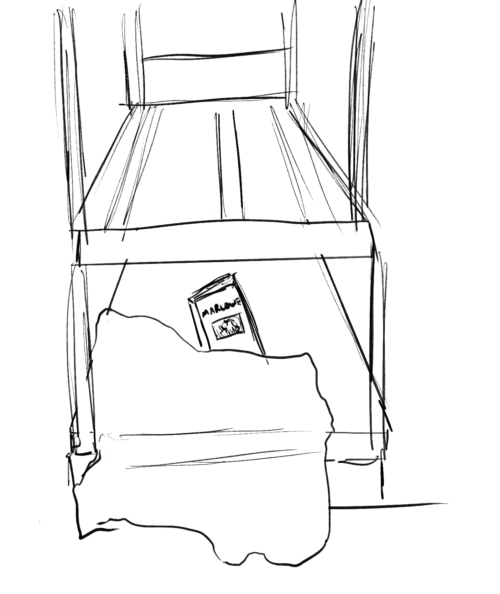
The ward was quieter than it should have been. Not silent—the ward was never silent, there were always pipes rumbling in the walls, footsteps somewhere above and the low moaning of a man three doors down who had not stopped since Tuesday—but the particular stillness of Edward’s bunk sat in the room like a new piece of furniture I had not asked for, now stark in the absence of his breathing.
They had moved him two days ago. Or three. I was not certain. The attendant had come in the morning and said only that arrangements had been made, and Edward had gone without protest, which was unlike him, carrying nothing because there was nothing to carry. He had not looked back at me. He had not said goodbye. I sat on my bunk and listened to the door close and then to the fading sound of his footsteps as he walked down the corridor until they were indistinguishable from the rest of the building’s restlessness, and then I sat in the quiet that followed.
I ought to have felt relieved. Edward was volatile. He talked too much and slept too little and had a way of watching me that made me feel as though my skin had been removed and all the machinery beneath was set out for inspection. The incident—I did not like to think about it—had been proof enough that the arrangement was untenable. And yet now that the room held only myself, I felt not relief, but a kind of diminishment—as if a draught were coming in from somewhere I could not locate, thinning me by degrees.
I washed my hands at the sink. The water was cold, and I held them under it longer than was necessary, working the soap between my fingers with a thoroughness that had nothing to do with dirt. I had always been particular about my hands. I could not remember when this had started. I dried them on a thin towel, examined them, and then washed them again. I wrung them, wiped them again, and folded the towel back into fourths, laying it back on the counter.
The book was on my bed where I had left it. I had asked the attendant for Shakespeare weeks ago and had been given Marlowe instead—a volume of plays, foxed and water-stained, the binding cracked along the spine so that it always fell open to the same place. Doctor Faustus. The same scene, the same grand bargaining. It was alright. It wasn’t Shakespeare.
That’s the trouble with the ward, you can’t have anything exactly your way, because everything is exactly their way, and they call that “order”, they call that “care”, they call that “routine.” You ask for one thing, one precise thing—one name, one voice, one cadence you know will catch in the mind the way a hook catches in cloth—and they give you the adjacent object, the approximation, the consolation prize.
I set the book aside and lay back and looked at the ceiling. There was a crack in the plaster that ran from the corner to approximately the centre of the room, one whose path I had traced many times. It branched, near the light fixture, into two thinner lines that diverged and did not meet again.
The moaning man three doors down fell quiet. In the silence, I heard my own breathing very clearly, and for a moment it seemed to me that there was a second rhythm beneath it, a half-beat off, the way a voice echoes in a room that is too large. I held my breath to listen. Nothing. My own lungs. I exhaled, and the sound filled the room, and I thought of my mother.
I did not choose to think of her. She arrived the way she always did when I was very tired or very empty, not as a memory but as a sensation—a warmth hovering in my peripherals, like the last heat from a fire that has been out for hours. I could not see her face. I had not been able to see her face for years. What remained was the weight of a hand on my head, the smell of something I could not name but that I associated with the colour white, the sound of fabric moving in another room. These fragments did not assemble into a person. They floated separately, and when I reached for one, it dissolved, another taking its place, equally formless, equally impossible to hold.
She had died when I was seven. This was a fact I carried the way one carries a stone in a pocket—always present, worn smooth by years of handling until it no longer resembled whatever it had originally been. I did not think of the death itself. I thought about it, the way water moves around a stone in a riverbed. There had been a winter. There had been a room. I had been in the house. Beyond these facts, the memory became fog that condensed the harder I tried to see through it, and I had long ago stopped trying.
In the ward, lying on my bunk with the cracked ceiling above me and the not-Shakespeare beside me, I let the fragments come. I was too tired to keep them out—and here something flickered, a darkness at the edge of the warmth, and I turned from it instinctively. There was something else in the memory. Something behind the door or underneath the floorboards of the house where she had been alive and then had not been. I did not look at it. I lay still and breathed, and after a time the fragments receded, and there was only the ceiling and the crack and the faint sound of the man three doors down beginning his low and formless grieving once again.
…
The first time it happened, I was standing in a marsh.
I did not know the field. I did not know how I had come to be in it. The last thing I remembered was my rooms at Oxbridge—the desk, the lamp, the open page I had been annotating—and then I was here, standing in spiked grass in the dark with my shoes soaked through and my shirt untucked and the taste of smoke in my mouth. Not the taste of a pipe or a fireplace. Something larger. Something chemical and wrong.
There is a particular terror in losing hours. Not the panic of forgetting a name or misplacing a book but something deeper, a wrongness in the machinery itself—the knowledge that your body has been somewhere, doing something, and that the person who was doing it was not, in any way you can retrieve, you.
Behind me, perhaps a quarter mile back toward the road, an outbuilding was burning.
I could see it clearly. The flames had taken the roof and worked through the timbers with a steady, almost mechanical patience, and the light they threw was orange and shifting and made the trees along the field’s edge look as though they were moving. There was no one else. No shouts, no lanterns, no one running with water. Just the building and the fire and myself standing at a distance that suggested I had walked away from it, though I had no memory of walking, no memory of the fire, no memory of anything between the lamp on my desk and this.
My hands were black. I raised them and turned them over in the light from the burning, and there was soot in the creases of my palms and beneath my fingernails, and the skin along my right forearm was tight and pink in a way that meant heat, proximity, that I had been close to something very hot not long ago. I smelled my fingers. Paraffin. The sharp, sweet reek of it was on my skin, and my shirt cuffs, and I understood what this meant even as I refused to understand it.
I did not run. I did not go back. I stood in the field and watched the roof collapse inward in a shower of sparks that rose and scattered and went dark against the sky, and I felt nothing. That was the worst of it. Not horror, not guilt, not even confusion. A blankness where a response should have been, as though the part of me that was supposed to react to this had been neatly excised, removed the way a surgeon removes a growth, leaving the surrounding tissue intact but the essential thing gone.
I walked back to the college. I do not know how long it took. I washed my hands in my room—washed them twice, three times, until the water ran clear and the paraffin smell was replaced by soap—and I changed my shirt and I sat at my desk and the page of Macbeth was still open to where I had left it and the lamp was still burning and nothing in the room suggested that I had ever left. I read a line. Is this a dagger which I see before me, The handle toward my hand? I read it again, and this time the meaning held because my mind had decided to work again, had decided to be mine again, and I closed the book and sat very still and did not think about the field or the fire or my blackened hands.
I folded it away. This was what I did with the things I could not account for—I folded them small, and I placed them somewhere I would not have to look at them, and I went on. There had been other gaps before this one. Smaller ones. An afternoon I could not recover. A conversation someone referenced that I had no memory of having. But this was different. This had evidence. This had soot under my fingernails, and a building turned to cinders.
In the ward, I let myself look at the fragment. I lay on my bunk, and I looked at the memory of the field and the fire, and I tried to feel something about it, but I could not. The blankness was still there. It had been there for months, sitting over that night like a stone over a well, and I did not know if the blankness was protecting me from something I had done or from the knowledge that I had not been the one doing it.
…
Dr. Whitmore’s office smelled of pipe tobacco and old paper. There was a window behind the desk that looked onto a walled garden where nothing grew at this time of year, and the light that came through it was grey and flat and seemed to occupy the room without brightening it. I sat in the chair opposite the desk, placed my hands in my lap, and waited.
I had been cooperative. I understood this about myself—that my first response to authority was compliance, that I sought approval the way a plant seeks light, automatically, without deciding to. There was a simplicity to being in someone else’s care, to having the architecture of your day decided for you. I had always been good at living within structures. It was the absence of structure that undid me.
Tell me about your mother, Whitmore said while chewing his pipe, and something in me shifted, very slightly, the way a crack will run through plaster before you see it.
She died when I was young, I said. I said it the way I always said it, evenly, as a fact among other facts. Seven. I was seven. She was ill. It was winter. I was in the house.
These were the facts as I knew them. They were not quite a story. A story would have sequence and causation and an ending that explained itself, and what I had was a collection of images that did not connect. My father’s hand on my shoulder was heavier than it should have been. The smell I associated with the colour white, which I understood now was carbolic, or something like it, the smell of sickness leaving a house.
Whitmore asked me to continue, and I found that I could not. The facts were a path that led to a wall, and beyond the wall was the fog, and I had never been through the fog. I told him this. I said: There is a part of it I cannot see. He made a note. He did not press. I was grateful for this and also, obscurely, disappointed. I had wanted to be pushed through. I could not do it alone.
We talked of other things. Whitmore asked about Oxbridge with a clinical specificity that suggested he already knew the answers and was listening for something else. I told him about Carlisle. About the tragedies. About the essay on Macbeth. He listened and then said, You believe tragedy is about consciousness.
I said yes. The worst thing was not what happened to you but that you were there for it. That you watched. That you knew.
Whitmore said, And the gaps in your memory. When did those begin?
I went quiet. Not the way Edward would have—Edward, I suspected, would have bristled, would have turned the question back, or refused it outright. I did not have that capacity. I folded inward instead, something in me trying to make itself compact enough to disappear.
I said I was not sure. I said they were small things. An evening I could not account for. A conversation I did not remember. I said I had always assumed it was a distraction, fatigue, the ordinary failures of an overtaxed mind. I said this and heard myself saying it and understood, in the grey light of Whitmore’s office, that I did not believe it. That I had never believed it. That the explanations I had given myself were a kind of scaffolding erected over an absence, and I had been living in the scaffolding and calling it a house.
Whitmore asked: when did you first meet Edward?
November, I said. The fourteenth. I said it with a precision that surprised me, because who remembers the exact date they met a stranger in a ward? But I was certain. I could see the day clearly. Edward arriving. The attendant. The way he had looked at me—that way he had of looking, as though he could read the underside of everything I presented to the world and found it both interesting and faintly amusing.
Whitmore wrote something down. He did not tell me that Edward had given a different date. I would learn this later, or I would not, and it would not matter because by then I would have begun to understand that the discrepancy was not between our memories but between the versions of the story we had each constructed to survive.
The session ended. I stood. I felt lighter than when I had entered, but it was not a good lightness—it was the lightness of something being taken from me, of weight that had also been ballast. Whitmore said my name. Thomas. And I paused at the door, my hand on the frame, because for a moment the name sounded like a word in a language I was only beginning to forget.
In my room, the other bunk was still empty. I lay down and looked at the crack in the ceiling and followed its path to the place where it branched and diverged. I thought about what Whitmore had asked and what I had answered and what I had not been able to answer. I thought about the fog beyond the wall. I thought about my mother’s hand on my head, which was the last clear thing before the fog began, and I wondered whether the hand had been saying goodbye or holding me back from something she did not want me to see.
I closed my eyes. I could hear my own breathing again, and beneath it, or beside it, the faintest second rhythm that was and was not my own. I did not hold my breath this time. I let it be there. I let it breathe with me, and after a while, I could not tell which rhythm was mine. One of us fell asleep, and the other did not.
Written by Luke Wagner ’26 (lukewagner@college.harvard.edu)and Jonah Karafiol ’26 (jonahkarafiol@college.harvard.edu).