Kitchen Sink No. 6
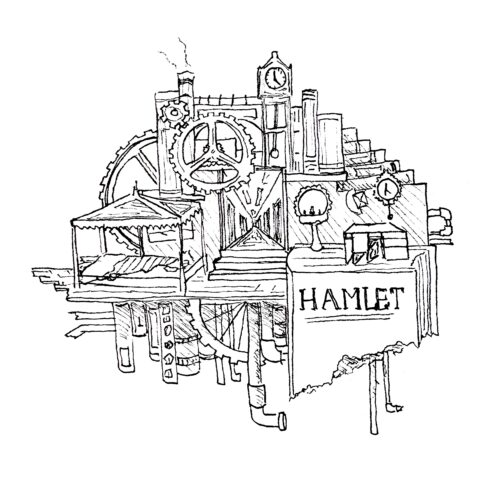
Graphic by Caleb Boyce

The weeks accumulated like dust on the library’s upper shelves—fine at first, then enough to blur the edge of the wood, dulling the days until it was unclear where one ended, and the next began.
At first, I had mistaken this for stability—an order upheld gently by schedule and certainty, the comforting tyranny of bells and deadlines and meal-times. But by the middle of the term, it began to feel mechanical, autonomous—the same corridors presenting themselves with the slightest variations of light, the same phrases uttered by different mouths. If you watched closely, you could see the university doing what it did best: molding more of the same.
But I, of course, was not watching closely. Instead, I was watching the rain. It had been raining all afternoon, and when I returned to the quad, my shoes left dark prints on the flagstones that held for a few seconds before fading. The oak tree outside my window had dropped a handful of leaves; they lay in the wet like discarded notes. I paused at the entrance to the stairs and looked up at the third-floor landing that led to my room. Room fourteen. The number did not feel like a name, but it had the obstinacy of one.
Inside, the room was unchanged. The two beds. The desk beneath the window. The wardrobe with its old brass handle that was always colder than expected. And beside the door, fixed to the wall with a kind of municipal confidence, the sink—white porcelain, two taps, a faint rusted mark clinging to the basin like a reprimand. The hot water had its habitual delay. It liked to make you wait. It liked to remind you that there were rules, even for water.
I washed my hands anyway. I had not touched anything filthy. My hands simply felt wrong—too present, too capable. I worked the soap in until my knuckles burned slightly and the skin tightened. I had barely dried them when there was a knock. It was a quick, private rhythm—two taps, a pause, one more—like someone reminding you of something you had already agreed to.
I opened the door. She slipped in without pausing, coat damp at the shoulders, gloves still on, the rain in her hair darkened by lamplight. She did not look around in the tentative way visitors do. She looked past me, into the room, then back to my face, and I resented the way the impatience in her eyes steadied me.
You’re late, she said. Late for what? I questioned. For the decision, she replied, and began undoing the buttons of her coat. She hung it over the back of the chair with the ease of someone who had done it before, then drew off her gloves and set them on the desk beside my papers. The sight of her hands—bare, unprotected—registered as an intimacy before I had decided it was one. She flexed her fingers once, as if relieved to have them back, and then her attention moved to the page on top of my stack.
Hamlet again, she said. You love a man who can talk himself out of any act.
I had the immediate impulse to defend myself, which was childish, and the secondary impulse to agree, which was worse. I said nothing. Silence never sat comfortably between us; it sharpened instead, became a tool she could use.
You’ve been watching yourself, she continued, scanning the ink as if it were evidence.
You sit here and narrate your own life. It makes you feel safe, she said.
I felt heat rise at my neck. The accusation landed too close to whatever was true.
And you? I asked. I don’t have time for that, she said, and finally looked up. Her eyes held mine without apology. You’re going to do something, Thomas, or you’re going to spend the whole term rehearsing what you might have done.
The name did not snag. It came out of her mouth and entered the room like a key turning, as if it had been waiting. I crossed the space between us with a kind of obedience I would have denied in any other context. There was no declaration, no negotiation—only the sudden collapse of distance and the unmistakable relief of being in the body without commentary. The bed springs complained. The chair struck the wall. Somewhere in the building, a pipe clicked, indifferent. Rain tapped the window in steady, patient strokes.
…
Later, she lay on her back and studied the crack in the ceiling as if it were a problem to solve. The lamplight had lowered; the room’s edges softened. She seemed untroubled. I began gathering myself back into place—sheet pulled higher, breath measured, mind returning to its officiousness—until she turned her head and said, almost lazily, You have an ugly room.
It isn’t mine, I said too quickly.
She rolled onto her side, propped her head on her hand, and regarded me with that look of hers that made me feel I had offered the wrong answer on purpose. Whose is it, then?
The question should have been absurd. It was my room by every measure the university cared about. My name on the roster. My trunk under the bed. My books on the desk. But the question lodged anyway, because the room did not always feel like an extension of me; sometimes it felt like something I inhabited provisionally, a space that tolerated me so long as I performed the right routine. I swallowed.
Mine, I said.
She watched me for a moment longer, then let it go, the way she let most things go when they ceased to amuse her. She sat up, reached for her stockings, and began to dress with the brisk restoration of order that mother left early. Buttons, hooks, the return of symmetry. Her gloves went back on last. She stood, smoothing her skirt, and the whole room seemed to tighten around her, leaving.
Hendricks mentioned you at tea, she said without looking at me. Hendricks does not take tea with you, I said.
Not with me. With my uncle. My uncle likes the illusion of influence. She said it casually, but I heard the effort beneath it; she had been holding in the sentence for some time. Maybe since she entered. I stayed quiet. I could feel that the next thing she said would matter.
He asked if I knew you. I said I did. He said he was glad. He said you were—how did he put it?—capable of a certain kind of penetration. She paused, almost smiling. He meant it as praise. Men like him always mean it as praise.
I laughed once, sharp and involuntary, because the phrasing was so perfectly Hendricks that it made my lips tighten.
Then her voice altered slightly. He also asked about Edward.
The name struck the room with a weight the earlier one had not. I felt my stomach tighten, the way it tightens before you step onto a slippery stone. I made myself answer evenly.
Edward?
She nodded. He said Edward wrote something too. On madness. On tragedy. He said it was strange, having two students with such different temperaments arrive at the same conclusion.
I said, I don’t know anyone named Edward. I heard how thin it sounded, even to me. Not because I disbelieved it, but because the name had arrived with an odd familiarity that I could not locate. The mind hates an unplaced familiarity; it treats it like a threat.
She held my gaze. I could see her deciding whether to accept my denial as truth or as performance. Finally, she shrugged, a gesture of temporary dismissal rather than belief.
He is old, she said. They all are. They mix up names. They call people the wrong thing and then act astonished when the wrong thing answers.
She went to the door, hand on the latch, and looked back once.
Come tomorrow, she said.
Where?
Do you need to be told everything twice?
And then she was gone, footsteps diminishing down the corridor, the building swallowing her whole. I stood for a long moment in the aftermath, listening to the quiet settle. Only then did it occur to me that I could not place the exact instant she had arrived. I remembered the knock, opening the door, the damp coat at her shoulders; between those moments, the lines had blurred, as though someone had rubbed a thumb over wet ink.
I went to the sink. The hot tap hesitated—one, two—then complied. I washed my hands again, though there was nothing on them. The gesture felt necessary in a way I could not justify. The skin along my knuckles was already red from earlier; I scrubbed until it tightened and the pain gave me something clean to hold. When I dried them, my hands looked like hands that belonged to someone else, attached to me only by habit.
…
The next day, Hendricks asked me to stay after lecture. The others filed out, chairs scraping, papers gathered, the room emptying in that orderly exodus that always made me feel slightly ill. Hendricks stacked his books with deliberate irritation, then looked up, and his eyes narrowed not with suspicion but with a kind of bored appraisal, the look of a man who has seen enough students to believe none of them are exceptional except in their failures.
Mr. Hartley, he said. Yes, sir, I retorted. How are you finding Hamlet? he followed.
The question pretended to be casual. It was aimed at something else, and we both knew it. I answered anyway.
Difficult.
Everything worth reading is difficult, he said. The question is whether the difficulty instructs you, or merely flatters you.
He leaned forward. Your essay was very good. It had a clarity that suggests intelligence or desperation. Possibly both. Consider something for me. Tragedy is not guilt, Mr. Hartley. It is the structure that manufactures guilt as the only coherent end. Macbeth does not become guilty by accident; the play constructs a man for whom guilt is inevitable. You wrote as if guilt were a moral achievement.
I felt irritation rise—not at the criticism, but at the sensation of being handled, being shaped by his certainty. I held it down. Hendricks loved obedience almost as much as he despised it.
I understand, I said. Do you? Hendricks replied, and then, without changing tone, said, Because Mr. Edward’s work suggests you do.
I felt my throat tighten. Whose work? I said. Your friend, he responded. The student in room fourteen.
Room fourteen. My room. He said it with the calm certainty of a registrar reading from a ledger. For a second, I thought I must have misheard him. Then I realized he had placed the words carefully, and he was watching to see what they did to my face.
There is no student in room fourteen but me, I said.
Hendricks’s mouth tightened with impatience. Then you are lying, he said, or you have not been paying attention. He tapped the desk once, a small act of punctuation. Edward arrived in October. He writes with a kind of severity, not unlike yours, but with less theatre. He will become either a judge or a priest, depending on where his fear settles.
I stared at him. I could feel a laugh rising, then dying—laughter had no place to land here; it would have been interpreted as confession. Panic had rules. Silence had rules. I stayed within them.
I do not know an Edward, I said, and hated myself for how defensive it sounded.
If you insist, Hendricks replied, then explain why I have two essays with near-identical architecture. Two temperaments, one conclusion. Do you think I cannot tell when one mind has written in two hands?
Heat climbed my face. I said nothing. Hendricks watched me a moment longer, then dismissed me with a flick of the fingers.
You may go.
I left and walked quickly down the corridor, past portraits of dead men who had expected their names to outlast their bodies, down the stairs, and into the quad, where cold air hit me with a clarity that felt punitive. Students crossed the grass with books held to their chests. The oak tree stood where it always stood. Nothing in the scene registered what had just been said, and that was the most frightening part of it: the world’s refusal to participate in my confusion.
I went back to room fourteen with the urgency of someone returning to a scene to see whether the evidence still exists. The room opened onto its familiar shape—bed, desk, wardrobe, sink—and for a moment I felt relief at its sameness. Then I saw the desk. The papers were not arranged as I had left them. A stack sat slightly left of its usual position. Someone had tried to put it back and missed by a fraction.
I crossed the room and lifted the top page.
The handwriting was not mine.
It was neat, restrained, the sentences built with an iron patience. At the top, I caught a glimpse of the title, etched in a hand that felt more confident than my own: “Orestes: Madness as Duty.” I flipped through and found quotations from Aeschylus, Euripides, Sophocles; marginal notes on fate, recognition, and blood as inheritance. Words I did not use. Words I knew anyway. My stomach tightened, and with it came a childish impulse to search the room for a hiding place—behind the wardrobe, under the bed—as though a second person might be crouched there with a candle and a secret. There was nothing. Only my breathing and the room’s ordinary noises: a board settling, a pipe shifting in the wall.
I sat at the desk and read the pages. The argument held together. It held together too well. It read like someone trying to prove inevitability to himself. I looked down at my hands on the paper. There was a thin dark line beneath my thumbnail. Ink, I thought. Dirt. I scraped at it; it held.
I went to the sink and turned on the hot water. Under the stream, the dark line loosened. It was soot. I stared at it until my eyes began to ache. I washed, rinsed, and washed again. The soap lathered; the water ran clear; the soot disappeared. The sensation remained, lodged somewhere deeper than skin. My hands, never clean.
After a time, the door opened and my neighbor stood there, book under his arm, smile prepared. He said my name and stopped when he saw my face. Are you all right? he asked. I watched him watch me: a student at a sink, hands wet, posture too still. I said I was fine. He stepped in, glanced at the desk, and relief crossed his face in a way that made me want to strike him. Ah, he said. You have been working. That will do it. He picked up the top page without asking, read the title, and nodded, approving. This is good, he said. You have got an angle.
It is not mine, I said.
He blinked, then gave a soft laugh. Do not be modest. Hendricks will be pleased.
It is not mine, I repeated, and heard the strain.
His laughter died. His eyes flicked to my hands. You have been washing a lot, he said, with the careful tone people use when they do not want to name what they are thinking. He began to offer kindness—stone does this, the first term is unsettling, everyone feels measured—and the words slid off me without entering. He left soon after, claiming another lecture, another engagement, and when the door shut, the room did not change; it simply became quieter, more exposed.
I did not go to supper. I sat in room fourteen and tried to lay the day out in order: Hendricks, the lecture hall, the corridor, the quad, the cold door handle, the papers on the desk, the soot under my nail. The sequence held until it did not. There was a small gap, a missing turn, and I could not tell whether the gap belonged to memory or to the day itself. The name Edward returned, uninvited, and sat in my mind with the dull insistence of a stain.
I went back to the sink. I turned the hot tap. It hesitated, then ran. I washed my hands again, and the skin reddened. Pain stayed honest. I shut off the water and listened to the silence. My breathing sounded too loud in the room; then, beside it, a second rhythm appeared—faint, misaligned, present enough that I could not pretend it was nothing. I held my breath. The rhythm stopped. I let mine resume, alone again, and for a moment I did not feel comfort so much as warning.
Written by Luke Wagner ’26 (lukewagner@college.harvard.edu)and Jonah Karafiol ’26 (jonahkarafiol@college.harvard.edu).