Kitchen Sink No. 7
Graphic by Hafsah Kahn

The ash was under my left thumbnail when I woke.
I noticed it before I noticed anything else—before the grey light coming through the curtain, before the cold, before the particular silence of early morning that the building produced when it was trying to pass as uninhabited. I lay still and held my hand up and looked at it. A thin dark crescent. Not ink. Not dirt. I knew the difference by now. I pressed it with my other thumb, and it held, the way soot holds, the way it settles into the skin and declares itself permanent.
I sat up. My clothes were on. I had fallen asleep at the desk again and must have moved to the bed at some point, though I didn’t remember moving. The lamp had burned out. The Bacchae was open on the desk to the Agave scene, and I had left notes in the margins that I didn’t remember writing: small, close letters that looked like mine but weren’t quite mine, the handwriting of someone concentrating harder than I had been. I read one back: the blood is still on the hands even if the hands don’t remember holding it. A quotation from the tutorial, I thought. Or something I’d added myself. I couldn’t separate them.
The window gave me the quad. The oak tree. The pale stone turning grey in the early light. Nothing in the scene was wrong, which was the most unsettling thing about it. The world does not rearrange itself to accommodate what you’ve lost. It continues, indifferent, presenting its usual face.
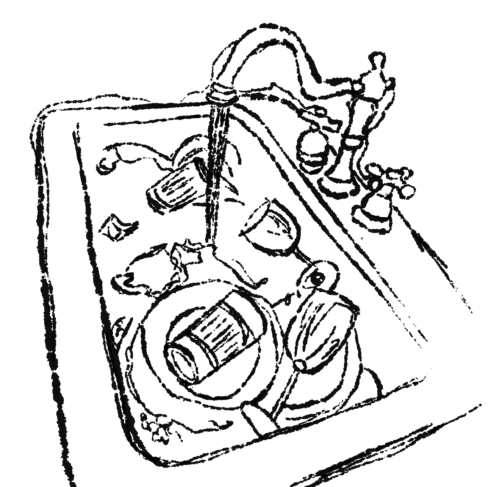
I went to the sink. The hot water took its time—one, two, three—then came through in a thin, reddish stream that cleared. I held my hand under it and worked at the thumbnail with the nail of my other hand until the ash came loose and spiraled toward the drain. The water ran grey for a moment, then clean. I dried my hands on my trousers and stood there, not yet ready for the day to have started.
I didn’t remember the fire.
That was the precise shape of it. Not: I had been careful with the lamp and had no idea how soot came to be on my hands. And not: I had been burning papers, and the ash had transferred without my noticing. The shape was simply a gap—the lecture hall at four in the afternoon, and then waking just now, and between them nothing. A few hours that belonged to someone else, or to no one, hours I could not reach.
There were fragments, but I distrusted them. A smell. Not quite the lamp. Larger. The smell of something that had been wood and had chosen to become smoke instead. And a sound—low, continuous, the patient sound of something being consumed. And a feeling of warmth on my face, closer than the fireplace, closer than was comfortable. I could not tell if I was remembering or constructing. I have never been certain of the difference, but usually the uncertainty is manageable. This morning it was not.
I changed my shirt, which smelled of smoke.
…
Tutorial was at nine. I had been awake since before the light came, so by the time I climbed the stairs to Hendricks’s room, I had been alone with myself for too long, which is never a good condition in which to be examined.
He was standing when I entered. Not at his desk but at the window, looking down at the same quad with his hands behind his back, and he did not turn when I came in. I stood in the doorway for a moment, wondering if I had the wrong hour, then closed the door and sat. He let me sit. The fire had been going long enough that the room was almost too warm, the air thick with tobacco and the sweetish smell of old paper, and I felt my thoughts begin to slow in it the way thoughts do when the body is more comfortable than it should be.
He said, still at the window: Tell me what Agave feels when she comes back to herself.
Not what I had prepared. I had prepared the philosophical argument—guilt, consciousness, the structure of divine madness. This was different. This was asking me to be inside her.
I said: I think she feels nothing yet. For a moment. There’s a delay between what the eyes receive and what the mind will accept.
He turned then. He looked at me with the expression I had always found difficult to interpret—not unkind, not kind, the expression of a man watching something move that he is not yet certain is alive.
He said: And in that delay—in that gap between the seeing and the knowing—who is she?
I opened my mouth and then closed it. The fire in the grate shifted. Outside, someone crossed the quad, and Hendricks’s eyes moved to follow them without his head turning, a movement that struck me as slightly wrong, slightly too controlled, and I thought: he is not actually asking about Agave.
I said: She’s no one. In that gap, she’s no one. She hasn’t received herself back yet.
Hendricks said: Yes. He said it quietly, the way you say yes when someone has confirmed something you wished they hadn’t. He moved to his desk and sat, and I watched him open a folder, extract two pages, and lay them side by side on the surface between us with the deliberateness of a man laying down evidence.
Your essay, he said, touching the left page. Then: This one arrived yesterday. He touched the right. I looked at them. The handwriting on the right was not mine, though something in its formation—the angle of certain letters, the particular way the t’s were crossed—was familiar in the way a stranger’s face can be familiar, the way you can recognize a structure without being able to name where you know it from.
Whose is it? I said. He said a name I had never heard. A student apparently on my floor, apparently known to Hendricks well enough that he produced the name from memory, immediate and certain, without consulting any paper.
I don’t know him, I said.
Hendricks looked at me. Not with surprise. With a quality I can only describe as watchfulness—the quality of a man who has decided to observe rather than intervene, who believes the situation will produce its own conclusion if he simply waits long enough.
He said: He writes about Orestes. The son who is commanded to commit an act he cannot survive committing. He said it without emphasis, without apparent intention, the way you might read aloud from a register. Then, He argues that Orestes is not mad. That he is perfectly lucid. That lucidity and horror are not opposites.
I said nothing. The fire was very warm. The two pages lay between us, and I did not look at the one on the right again because looking at it produced a sensation I did not have a name for—somewhere between recognition and nausea, the feeling of almost remembering something that never happened to you.
Hendricks closed the folder. The tutorial, apparently, was over. I stood. At the door, he said, without looking up: Get some sleep. I’m fine, I replied.
Yes. That’s what concerns me, he said.
…
The quad at midday was cold and full of movement—gowns, books, voices that rose and fell and were carried off by the wind before they could be deciphered. I walked through it without direction, which was unlike me. I preferred to have a destination. Destinations organize a body’s passage through space. Without them, you are only moving, and moving without direction looks from the outside like agitation, which I did not want to project.
I was thinking about the essay Hendricks had described when someone said my name.
I stopped. Turned. He was a second-year, I thought, though I didn’t know his name. We had nodded at each other in the dining hall once or twice, the brief acknowledgement of people who share a building but have no other claim on each other. He had a book under his arm and an expression of mild, genuine friendliness that I found immediately difficult to process.
I saw you last night, he said. In the quad. He said it lightly, conversationally, as though he were paying me a trivial compliment.
I told him I had been in my room last night.
He shook his head, still smiling. Late, he said. Past eleven. You were standing under the oak tree. I nearly called out, but you seemed—occupied. He paused, then added, You were laughing. I didn’t know what. I assumed you’d had a better evening than I had.
I held his gaze and said nothing. I was working to keep my face in its ordinary arrangement. He looked at me a moment longer, then seemed to decide that nothing further was required of him and went on across the quad, already opening his book. I watched him until he turned the corner.
Past eleven. Standing under the oak tree. Laughing.
The oak tree was directly below my window. I could see it from my desk when I was working. I had looked at it every morning since I arrived. I knew its shape—the particular way its branches distributed themselves, the way its shadow crossed the quad in the afternoon. I knew the flagstones below it, worn smooth, a slightly different shade from the ones around them.
I had no memory of standing under it. None at all. Not a fragment, not a smell, not the ridges of bark under my palm. Standing there and laughing, apparently, at something I could not name, and then returning to my room and falling into the kind of sleep I sometimes fell into when my body had been doing things my mind had chosen not to register.
I turned and walked back to the building.
…
The library was quiet in the late afternoon. The usual arrangement—long tables, brass lamps, the particular smell of paper doing its slow work of becoming dust. I had come for Aeschylus, or I had told myself I had come for Aeschylus, but I stood at the entrance for a moment before going to the shelves and looked at the room as though something had already happened there.
She was shelving in the classical section when I found it. Her back to me, moving with that efficiency I had catalogued early and often—each book placed without hesitation, her body angled slightly forward, sleeves rolled. I stood at the end of the aisle and watched her for a moment before she heard me, or felt me, and turned.
The expression that crossed her face was brief and quickly managed. Not a surprise exactly. Something closer to the look of someone who has been expecting a conversation they have not fully prepared for.
She said my name. Then she said: You smell like smoke. I said I had been burning old notes. I had changed my shirt. I was less sure about my hands.
She held my gaze for a moment in a way that meant she had decided to accept this, not because she believed it, but because she had chosen not to press. She turned back to the books. I stood where I was.
I asked if she had seen me recently. In the last few days. Outside of the library. The question came out more carefully than I intended, and she heard the care in it, and turned back again.
When she said: Last night, I said: Or recently. I wanted to know if she had seen me somewhere I might not have been fully present.
She looked at me for a long moment. The lamp at the end of the aisle threw her shadow down the length of the floor. When she finally spoke, her voice was measured, the voice of someone deciding how much of what they know to release at once.
She said: I saw someone last night. Under the oak tree, quite late. I thought it was you. She paused. But he was—different. The way he was standing. Something in the posture. I thought I was wrong. I thought it was someone else.
I asked: What was different about him.
She considered this. Then, He looked like he was listening to something. Not watching, not thinking. Listening. As though someone were speaking to him that no one else could hear.
The aisle was very quiet. Somewhere above us, a board settled.
I said: But you thought it was me. She said: I thought it was you.
She picked up the last book from her pile and shelved it with the same unhesitating precision. Then she looked at her hands for a moment—I noticed this, the way her attention dropped to her own hands and rested there briefly, as though checking they were still in the right condition. Then she looked back at me. Whatever she had been about to say, she chose not to say it. She picked up her empty cart and wheeled it toward the door without speaking again.
I stood alone in the classical section. Aeschylus above my right shoulder. Sophocles. Euripides. All the Greek tragedians arranged in their accustomed order, witnessing nothing, as always. I pulled The Oresteia from the shelf and stood there with it in my hands, not opening it, only holding it, the weight of it, while the lamp burned behind me and the shadow of the shelves fell across the floor in long, patient bars.
There was a man who stood under the oak tree past eleven, laughing at something no one else could hear. He had my face and my height and my hands, and he was not me, and there is no language for that that does not make it worse.
I put The Oresteia back.
…
Room 14 was cold when I returned. I had left the window open a crack, and the afternoon had come in and settled there. I closed it and stood in the room’s center for a moment, aware of it in the way you are aware of a space you have returned to after it has been occupied by something else. The desk was as I had left it—The Bacchae, the margined notes I didn’t fully remember writing. The bed. The wardrobe. The cold brass handle of the closet door.
I sat on the bed without undressing. The Oresteia was still in my hands. I hadn’t decided to bring it—I had put it back on the shelf, or I thought I had—but here it was. The cover worn at the corners, the binding cracked along the spine. I set it on the mattress beside me and looked at it for a moment, and then looked away.
The chapel bell struck the hour. I counted without meaning to, and when it stopped, I couldn’t have said what number I had reached.
The room settled into its evening sounds—pipes, boards, the low movement of the building doing whatever buildings do when they believe themselves unobserved. I lay back without pulling the covers up, the way I had apparently done the night before, and looked at the ceiling. The plaster had a crack running from the corner toward the center that I had been aware of since I arrived and had never examined closely, preferring not to know how far it went.
After a while, I turned my head toward the window.
The oak tree stood where it always stood. Its branches held their shape against the darkening sky with the patience of something that has never been required to explain itself. The flagstones below it were empty. The quad was empty. There was no one laughing, no figure standing in the particular posture of a man listening to a voice no one else could hear. There was only the tree, doing what the tree did, which was persist.
I watched the tree until the light was gone and the window gave me only my own reflection, pale and approximate, floating above the dark quad. I watched that too, for a moment. Then I closed my eyes.
Whatever was next came in the dark, in the hours I could not account for, arriving the way it always arrived—without announcement, without permission, taking what it needed and leaving me in the morning with the evidence of its passage and no language for what it was or what I was when it was using me.
Written by Luke Wagner ’26 (lukewagner@college.harvard.edu)and Jonah Karafiol ’26 (jonahkarafiol@college.harvard.edu).