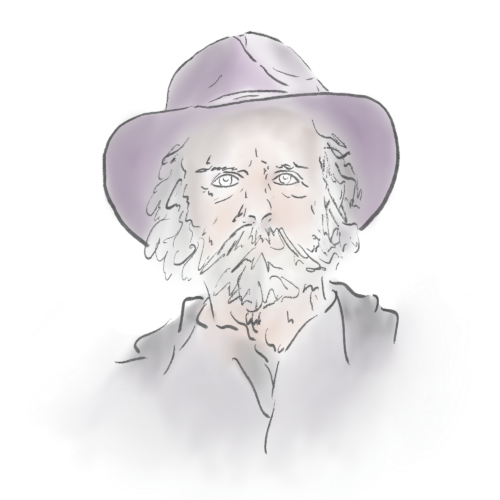
“Leave a Ripple:” A Memorial to Bob Weir
Graphic by Kerrie Zhu

“…Let your life proceed by its own design. Nothing to tell now. Let the words be yours, I’m done with mine.”
Bob Weir, a founding member of one of America’s most iconic bands, the Grateful Dead, passed away on Saturday, Jan. 10, surrounded by friends and family. After a July 2025 cancer diagnosis, he performed for the last time in August. The three-night event celebrated more than 60 years of music since Grateful Dead’s founding in 1965.
Weir left an enduring musical legacy: from his work with the Dead, to his solo projects, to his role in keeping their sound alive long after the original group disbanded in 1995. His songs will echo in musical halls and stoners’ living rooms alike for years to come.
Fate, Fireworks, and a Banjo
Born October 16, 1947, in San Francisco, Robert Parber was adopted and raised by Frederic and Eleanor Weir in Atherton, California (legally changing his name to Robert Hall Weir). After early unsuccessful efforts to play the piano and trumpet, he settled on the guitar as his instrument of choice at 13. His academic trajectory mirrored his early musical efforts; he was kicked out of numerous institutions, including Fountain Valley School, where he returned 50 years later to receive an honorary diploma after being expelled for smoking weed in 1963.
One fateful New Year’s Eve in 1963, in Palo Alto, California, Weir was wandering the streets looking for a club to celebrate the holiday when banjo music caught his attention. In a fable-like fashion, he traced the music to its source and found 21-year-old Jerry Garcia, waiting for his music students to arrive.
Weir and Garcia spent the night jamming together and decided to form a band. The two, along with Ron “Pigpen” McKernan, founded “Mother McCree’s Uptown Jug Champions.” Catchy, right? The band changed its name twice, first to “Warlocks,” finally settling on the Grateful Dead, supposedly after Garcia opened a dictionary at random and saw the term referring to a style of folk legend. Along the way, they added Phil Lesh on bass guitar and Bill Kreutzmann on drums, making up the “Core Five” of the band—although numerous other artists would play in the band over its history.
Bob “The Kid” Weir
As the youngest member of the band at 17, Weir initially played rhythm guitar and sang both backup and lead vocals. Although often overshadowed by Jerry Garcia’s voice, a number of the Dead’s most famous songs feature Weir as lead singer—perhaps most famously, “Sugar Magnolia.” Guitar, however, was where he really shone.
Throughout his career, Weir demonstrated mastery across a wide range of genres, including country, folk, acoustic rock, blues, and more. His guitar-playing spanned a wide array of skill sets: from effortless slide guitar to deftly mixing challenging chords in a way that brought out new sounds in every performance.
Although he later became a Kennedy Center Honoree, a Rock and Roll Hall of Fame inductee, and a recipient of a lifetime achievement Grammy Award, his musical journey was not free of hardships. Famously, in the early days of the Dead, Weir and Pigpen were kicked from the band, as Jerry Garcia and Phil Lesh thought the two could not play at their level. Eventually, the pair were reinstated; however, the setback pushed Weir to develop his skills, which dramatically improved the band as a whole and enabled him to find success as a musician outside the Dead.
The Identity of the Dead
From the earliest days as “The Warlocks” to the wildly successful Dead & Company performances at the Las Vegas Sphere more than 60 years later, the Grateful Dead have maintained a distinct and iconic identity. Since its infancy, the band was synonymous with LSD and the psychedelic movement in California. Members of the band reportedly “took LSD every Saturday for an entire year,” and the band’s home was notoriously raided by the police in a drug bust in 1967. They played their first major gigs as the house band for the famous San Francisco LSD block parties dubbed “Acid Tests.” The band’s first albums, especially “Aoxomoxoa” and “Anthem of the Sun,” serve as fundamental pillars of the psychedelic rock genre.
Of course, the Dead are known for more than their drug usage. Across their 13 studio albums, the band ranged from gritty country rock to jazz, constantly attempting to fuse their classic sounds with the latest trends. The song “Ripple” is a shining example of their ability to build layered harmonies, as well as write story-like lyrics that seem to have more to say every time you listen to them. The result was a wild cacophony of albums that never quite penetrated the musical mainstream; instead, their eagerness to experiment built a lasting, cult-classic following.
The band made its true name onstage. Grateful Dead concerts were characterized by a vibrant fanbase. Attendees were often affectionately clad in tie-dye and unmistakable band merchandise, and they never knew what to expect from the musicians. The wild diversity of their songs and their tendency to play them differently every night made for a live music experience few bands could replicate, and kept their loyal fans coming back for more.
The Dead and Beyond
Weir was a core piece of the Grateful Dead’s iconic sound, with one New York Times article describing him as the band’s “invisible thread.” His work outside the band, however, was what really solidified his presence among the musical greats. He played in countless side bands, including Kingfish, Bobby and the Midnites, Ratdog, and several groups that continued the Grateful Dead’s story after Jerry Garcia’s death in 1995. Weir’s solo album “Ace” highlighted his vocals and songwriting skills. The countless revival performances by the Dead’s surviving members, alongside rotating collaborators, ensured that the Deadhead nation spanned generations and reached every corner of the country.
Weir was also passionate about social causes, especially later in his career. He performed a number of benefit concerts and was heavily involved in charitable organizations and foundations, particularly those focused on environmentalism. This included co-founding the Furthur Foundation, which supports environmental, educational, and youth-oriented programs in the Bay Area. Weir was dedicated to improving the world around him, cementing his legacy as both a musician and an advocate for change.
We should not mourn Weir’s loss as just another great gone, but celebrate what his life gave. Weir’s family has spoken of a “three-hundred-year” legacy carried forward through his music. In addition to the outpouring of support for his family, the fond “Homecoming” concert held in his memory on Jan. 17 speaks to a life and musical career that will stand the test of time.
Weir once said, “I tend to think of death as the last and best reward for a life well-lived.” I think most Deadheads would agree—Weir lived exceptionally well.
If there is one last thing to take from this article, it is this: do not wait. College trains us to delay joy until after the problem set, after the interview, after the internship is finished. Weir’s career quietly rebels against that instinct though. The Grateful Dead were never in a hurry. Their music rewarded those who showed up, stayed late, and remained in the present moment.
So go to that concert. Go see your favorite band when their tour stops in Boston, or take a road trip to see them with some friends. You never know when it will be the last time, and nothing quite compares to a live performance.
I have included a list of some of Bob Weir’s greatest songs, as well as some personal Grateful Dead favorites, suitable for die-hard Deadheads and new listeners alike. I know I, and many others, will be listening to Bob’s music for a long time yet—and it would not shock me in the slightest if people are still listening 300 years from now.
Bob Weir Must-Listens
“Sugar Magnolia” – Grateful Dead (1970)
“Playing in the Band” – Bob Weir (1972)
“Truckin’” – Grateful Dead (1970)
“Greatest Story Ever Told” – Bob Weir (1972)
Grateful Dead Personal Favorites
“Workingman’s Dead” – Yes, the entire album (1970)
“Friend of the Devil” – American Beauty (1970)
“I Need a Miracle” – Shakedown Street (1978)
“Ramble on Rose” – Europe ‘72 (1972)
Mr. Weir is survived by his wife, Natascha Muenter Weir, and his daughters, Monet Weir and Chloe Weir.
Grayson Caffrey ’28 (gecaffrey@college.harvard.edu) is a guest writer for the Harvard Independent.