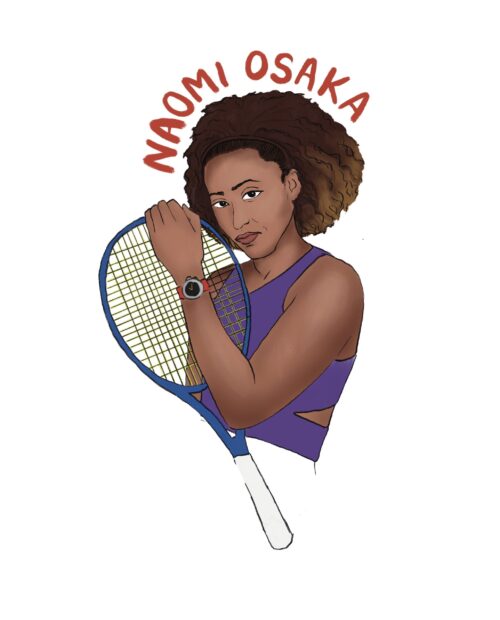
Love, All: Racism in Sports Media Makes Everyone Lose
Graphic by Neshama Ryman

It’s unusual for someone to be reprimanded for being in the right. But for certain athletes, criticism will follow them regardless of their conduct.
On Jan. 22, the second-round 2026 Australian Open match between Naomi Osaka, a four-time Grand Slam singles champion and former world No. 1, and four-time titleholder Sorana Cîrstea turned sour. Osaka’s self-motivation before a serve agitated her opponent, sparking a terse back-and-forth between Cîrstea and the umpire.
Osaka: “C’mon, C’mon!” she said to herself.
Cîrstea: “Is this okay? To do ‘C’mon’ between points?”
Umpire: “Between serves, yeah, you hadn’t got the ball yet either. This is fine.”
As Cîrstea’s appeals were unfruitful, the match continued, ending in Osaka’s (6-3, 4-6, 6-2) victory. Contrary to typical tennis fashion, Cîrstea’s emotions overtook any semblance of good sportsmanship, offering merely a cold handshake before hastily leaving the court.
In her post-match, on-court interview, Osaka expressed frustration at the situation that had unfolded just hours earlier. The reporter raised the question of what it took to get through the tough match. “Apparently, a lot of ‘c’mons’ that she was angry about, but whatever … I tried my best. She’s a great player. I think this was her last Australian Open, so okay. Sorry, she was mad about it,” Osaka responded.
This commentary elicited mixed reactions from the crowd, with both supportive cheers and shocked gasps. She appeared visibly upset, her voice wavering while still maintaining poise and composure before a crowd of thousands.
Following this interview, Osaka graciously addressed the situation in her post-match press conference. “I think the first couple things I said on the court [were] disrespectful, and I don’t like disrespecting people, that’s not what I do … when I’m pumping myself up, I’m not like, ‘okay, and now I’m going to distract the other person.’ It’s purely for me.”
Cîrstea kept her remarks cordial and reserved during her own press conference. “We just had a chat [after the game], nothing big. I don’t think that’s the main thing after tonight’s match … Yeah, she deserved the win.” Yet the one thing notably absent from Cîrstea’s remarks was an apology for her behavior.
I find little fault with the way the two athletes handled the situation; for a tough, highly charged tense match, their two press conferences reflected their professionalism. However, I take issue with the fact that Osaka alone had to apologize for her conduct—especially since the umpire ruled in her favor. It’s egregious and points to the fact that Black women are continuously scrutinized—regardless of the scenario, regardless of their talent.
This phenomenon can be better understood by the term misogynoir, which refers to the effects of both anti-Black racism and misogyny for Black women in our society.
Sports media only exacerbated this racialized judgment. Subsequent headlines read:
“Novak Djokovic’s wife lashes ‘disrespectful’ Naomi Osaka ahead of showdown with Aussie qualifier on Rod Laver Arena.”
“Naomi Osaka accused of ‘disrespecting tennis’ after what she did at the Australian Open.”
“The real trouble with Naomi Osaka.”
“Naomi Osaka criticised by two former world No. 1s after Sorana Cîrstea controversy at Australian Open.”
One notable video was posted to a major tennis news outlet, Tennis Channel, titled, “Was Naomi Osaka in the Wrong Against Cîrstea?” Endless users in the video’s comment section continued to harp on her, claiming it was “poor umpiring not to penalise Osaka” and “Osaka is extremely immature and hypersensitive.”
It seems like the tennis world has forgotten that she apologized, instead exclusively sensationalizing Osaka’s “c’mons” during the match and antagonizing statements she made during the on-court interview. Most seem to ignore the fact that Cîrstea was the one who prolonged the situation through the back-and-forth banter with the umpire.
For sports media, this phenomenon is nothing new. Other Black female athletes, including tennis megastar Serena Williams and Olympic gold-medalist Simone Biles, have faced notable criticism in their careers. Conspiracy theorists have falsely alleged that Williams was born as a man, while Biles was called a “quitter” for her brave decision to drop out of the 2021 Tokyo Olympics for mental health reasons.
To make matters worse, these outlets are often quick to pit Black women against one another. In the 2018 U.S. Open women’s singles championship, featuring Osaka and Williams, the Japanese player claimed a 6-2, 6-4 victory. Williams had a tough game, receiving multiple code violations for receiving illicit sideline coaching, racket smashing, and heated discourse with the umpire.
Following the match, political commentators created drawings of Williams’s behavior, depicting her as an angry caricature jumping on the racquet, while Osaka was drawn as a skinny blonde woman standing next to the umpire. Critics referred to the drawing as racist, as it was reminiscent of the Jim Crow-era minstrel cartoons; I agree with this sentiment.
Moreover, I find it telling that, when Osaka’s behavior wasn’t called into question, the Australian publication depicted her as white.
It’s not that I support any of Williams’s behavior, but this is yet another example of the sports media simply going too far.
Perhaps said criticism is baked into the original culture of the sport. Tennis, at least the way we know it today, rose to prominence among royal and aristocratic circles during the 16th century. Many of the sport’s rules are based on traditions of “proper etiquette and controlled behaviour.”
As its history is fundamentally intertwined with white, colonial society, modern-day tennis’s restrictive treatment of Black women becomes less surprising. However, I see no reason as to why the sport’s culture can’t join the rest of us in the 21st century.
Maybe the headlines aren’t intentional. Maybe they’re just playing a numbers game, hoping to draw clicks and views to their pages. Regardless of the reason, it’s time for the media to make a change. Racism in tennis media is not doing anyone any favors. For the athletes, I can only imagine the mental toll of being constantly scrutinized for every action and word.
In Williams’s case, she took a break due to suffering from depression and a knee injury; her coach stated that “she has a level of expectation that is much higher than anyone.”
Osaka’s story reads the same way: “The truth is that I have suffered long bouts of depression since the U.S. Open in 2018 and I have had a really hard time coping with that,” she said. She withdrew from the French Open in 2021 as a result of these struggles, despite being ranked No. 2 in the world. She even went as far as to mention not wanting her stardom to steer media attention away from the tournament at hand. “I never wanted to be a distraction, and I accept that my timing was not ideal and my message could have been clearer. More importantly, I would never trivialize mental health or use the term lightly.”
These players are remarkable: Black, female, and excelling at their craft—each of them was ranked No. 1 in the world at some point in their respective careers.
This stardom understandably attracts media attention. Excellence should not be accompanied by racism. The mental health concerns that these athletes experience are exacerbated by the pressure they’re under from the public eye, let alone bigotry and prejudice.
Tennis news outlets must consider their role in this story. Targeted, biased headlines weaken the game by artificially inducing stress that can push players to withdraw from tournaments, losing out on matches that strengthen competition and improve the sport. For audiences seeking to enjoy a good match, this hypercritical environment can take away from the love of the game, distracting us all from the true skill and prowess these players possess.
It’s time that sports media takes the agency to realize its role in fueling unnecessary division; sports should be a uniting force we can all enjoy together, regardless of our personal identities.
Seyi Amosun ’29 (samosun@college.harvard.edu) thinks Osaka’s on-court fashion looks are fire.