Memories of Oktoberfest
Graphic by Mia Stewart

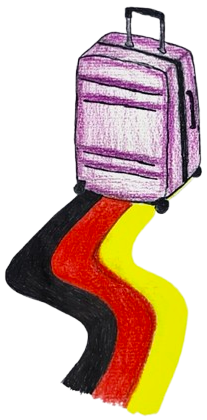
Once again, the time of the year has snuck up on me: it’s October—or, as it’s esoterically translated in German, Oktober—and that means it’s time for Oktoberfest (literally “October Festival,” another toughie to figure out). Now a college sophomore, it’s been two years since I’ve celebrated Oktoberfest in Germany with friends. While I haven’t shuffled into my Lederhosen and hit the town until the rides stopped, the memories are still clear enough that I can recall the important parts.
Oktoberfest dates back to the 1800s, a time when, aside from chores like milking cows, the main pastime was drinking with neighbors and making the torchlit walk back home. But it’s come a long way since: Fest is now the event of the year (or of early October, I guess). That’s true not just for Germany: though the event began in Deutschland, Fest’s impact on culture has been worldwide, with spinoff Oktoberfests taking place everywhere from Ohio to Brazil! Foot-long pretzels, frosted gingerbread Lebkuchen, and steaming hot Bratwursts have gained worldwide fame—especially here, where people often take pride in calling themselves German, Irish, or Polish.
The tradition has made its way across the Atlantic to Boston, but your author will unfortunately not be taking part this year due to an onslaught of Stat 110 problem sets—hoping my expected value of survival is greater than zero. Instead, I’ll use this time to reminisce on my years in Germany, when it was socially acceptable for high schoolers to go out, get drunk, and then casually tell your teachers about it on Monday—ideally once the hangover had worn off.
But before we get started, let me clarify something: I’m not German. My family moved there for my high school years, and I attended an American high school, so I definitely still lived in an American bubble. Beyond that, I’ve lived in a handful of states—including Alabama, where my kindergarten teacher seemed determined to make my life miserable. So, would I call myself international? Perhaps during my years in Germany, though I still returned to the States several times a year, enough to keep my American roots firmly intact.
Being an American, even when I was just starting school in Germany, I began to notice some differences in German and American culture surrounding drinking. A few years after moving to Germany, my friends and I were getting wasted every weekend. As such, the unacquainted may wonder: how could high schoolers just go out and drink in public? Wasn’t there someone carding you? Well, the thing about Europe is that drinking laws are…lax, one could say. First, you only need to be 16 to buy beer or wine for personal consumption in Germany. Second, most Germans have already started drinking at restaurants with their parents at 14! And if you’re worried about open containers on the street—Germans don’t care, and why should they? “Open container” doesn’t seem to be an idea that crossed their minds. I’m not complaining: it’s a great way to save on Red Solo cups. So yeah, drinking in Europe is something else.
Now for the main attraction: beer. Yes, I know you’ve heard of the famously dark, thick German beers. Yes, the heavy glass steins exist, perfect for pouring your leckerschmecker Bier von Fass. After a simple “Einmal Bier, bitte,” your waiter will get you a special mug called a Stein filled with carbonated bliss, foaming beer that’s just asking you to drink it. With the thumping traditional Volkmusik playing, the fest-goers dancing in their Lederhosen and Dreidls, and the near-overwhelming background chatter accented by traditional chants—Zigga Zigga Zigga! Oy Oy Oy! The offer of alcoholic delight is impossible to resist.
If you’re going to Fest in Stuttgart, the town where I lived, you best believe you’ll be drinking one beer—and one beer only: Wulle. Anyone who claims to be from Stuttgart and doesn’t know Wulle is lying. The signature red logo, the satisfying pop of the flip-top, and the deep, hoppy flavor are unforgettable. It feels like every sip represents the Germans I’ve come to know: serious, bold, and just a little fun.
But you’d be mistaken to think that Fest is just drinking (though—let’s be real—it basically is). The other big pull that keeps us coming back for more is the rides. Imagine that! It’s like Six Flags, but drinking is encouraged! And thank God for it: Stuttgart is a pretty big city, but honestly, its industrial vibe makes it pretty dull (great if you want to check out Bosch or Mercedes—the latter is so ubiquitous that there are even literal Mercedes garbage trucks). During Fest, the city redeems itself with the second-largest Oktoberfest in Germany, complete with some of the best rides ever.
One ride that stuck with me was called the Airwolf, a spinning, whirling attraction moving in patterns reminiscent of a Lorenz butterfly. Thinking about riding it? Alright, but before stepping on the coaster, consider this equation: Four Beers + Fast, Jerky Roller Coaster = Bad Time. Not that I’m speaking from personal experience, of course. I’m very fastidious. And you don’t have to feel bad about having fun: in a way, the roller coaster is scientific. What better way to feel the effects of 4G while twisting left, right, up, down, and sideways than physics in action? Just remember to save the beer tents for after, not before.
Ah, Fest, how I miss you. I still get flashbacks to the flashing lights, the whirling rides, the seemingly endless nights of Wulle. It pains me to say it, but for now, Oktoberfest is a thing of the past. This year, I traded Lederhosen for lock-ins and replaced drinking with a slow demise at the hands of Stat 110. I could’ve gone to the Boston Oktoberfest, sure, but I figured it’d be the equivalent of “visiting Mexico” by eating a Taco Bell Nacho Cheese Baja Blast Heart Attack Diabetes Burrito, so that was a no-go. Still, even continents and years away, my memories of Oktoberfest—well, the parts I was sober enough to remember—remain. I almost hear the sounds ringing in my ears: Oy Oy Oy!
The Oktoberfest Alcoholic still goes out in America, but is tired of the vodka parties—what are we, Russians?