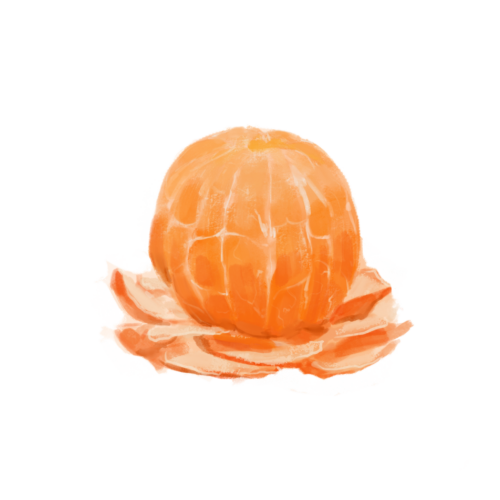
My Love Language is Clementines
Graphic by Cameron Bernier

On every door hangs the symbol for fortune, “福.” Under every pillow, red envelopes rest. Aromas of oyster and soy sauce fill the air. These are the indicators of the Lunar New Year’s arrival. For me, this holiday is bittersweet, filled with celebration, but also a reminder of loss.
I grew up looking forward to the holiday every year: the food, the people, the comfort of being surrounded by everyone I love. My family and I have always been extremely superstitious in practicing the New Year traditions. In the weeks leading up to the long-awaited day, we sweep and clean religiously, get haircuts, buy new clothes, and hang decorations to ward off the misfortune from the past year. We go to our place of worship: the Asian grocery store an hour away, to find the perfect ingredients and wander the familiar aisles. Mama lets me pick out paper lanterns, and Baba tells me to pick out the best cabbage. My sister and I used to nibble on lucky white rabbit candy—giddy on a feeling we couldn’t quite place—the kind we would outgrow a few years later.
My Baba’s mother, my Nai Nai, thumbs clementines that we use for offerings to our ancestors, picking out the roundest and prettiest shades of orange. She tells me they remind her of my chubby newborn cheeks, when she picked my Mandarin nickname, little clementine: “橘橘.” She tells me she knew I would be her favorite, her lucky little clementine. As I grew older, I never lost that feature: the cheeks like full moons that dimple when I laugh. Even after losing her, I still wear the name she gave me like a feeling I can’t shake.
The year after her death, when Lunar New Year rolled around, I couldn’t bear to go back to the Asian grocery store or unwrap a clementine. There was nothing I could do to feel “lucky” when the year before we had done everything right to prepare, and here I was left without my Nai Nai—now only the scent and memory of her, stained on the holiday I once loved most.
I could not fathom that the woman who cut my hair, sewed me new clothes, sang with me as I rolled out dumpling dough, and picked me the sweetest oranges was no longer here. I could not face the idea that the woman who had taught me my language and life was the one whose photograph I would be kneeling in front of, offering those clementines and incense to.
Nai Nai was diagnosed with Alzheimer’s ten years before my first Lunar New Year without her. At the age of six, I barely understood what Alzheimer’s meant. No one has the heart to tell a child that the woman who means the most to her would slowly deteriorate in front of her eyes, ripening and rotting like neglected clementines left out for months after the holiday.
And even if someone had told me, I never could have understood that Alzheimer’s would be the thing that would make her unrecognizable to me; that I’d watch over the years as she slowly lost the ability to walk, talk, relieve herself, and eat. Over these ten years, I’d visit my Nai Nai at her nursing home, laughing with her on the good days and caring for her on days worse than I could’ve imagined. I’d learn to embody the value of taking care, or “孝顺,” as the person who took my first steps with me hardly remembered how to take her last ones.
Even on the bad days, I never lost hope. When she could no longer walk, Baba and I brought New Year’s to her, bringing the decorations and festivities to the nursing home tables, picking out the best clementines we could find to share with the other members.
But nothing could have prepared me for the emptiness we would feel when she was gone, how everything that once felt vibrant and festive became another reminder of her absence.
I did my best to fill this silence and space where she used to be as I cut out paper “福” symbols to hang on my Canaday doorway, cut off my split ends, and took the Red Line to pick out only the best clementines I knew my Nai Nai would approve of.
This year, as I returned to my childhood home for the holiday, I was overwhelmed with Nai Nai’s pervasive presence. My family and I practiced our annual love language as Baba prepared the lucky cabbages, Mama marinated the fish, and I rolled out dumpling dough as the careful harmony of tradition was restored—as we set out an empty place set at the head of the table for Nai Nai and opened the door to welcome in our ancestors. We knelt at their pictures and bowed our heads, offering an unspoken understanding, unraveling ourselves like the little clementines, praying because it was the only thing left that we could remember how to do.
Even after the incense had burned, the decorations were stashed away, and the holiday ended, I was still left with the sticky scent of clementines on my palms.
Audrey Wu ’29 (audreywu@college.harvard.edu) is still searching for the perfect clementine.