“No Kings” in the Boston Common
Graphic by Alex Mullen

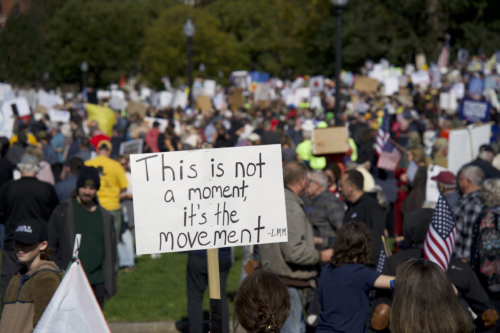
“No Kings” protests swept across America on June 18 in opposition to President Donald Trump’s Military Parade celebrating the U.S. Army’s 250th anniversary, which coincided with his own 79th birthday. The summer unrest amassed approximately five million participants across nearly 2,600 rallies—one of the largest single-day rallies in history. Four months later, on Oct. 18, the movement reignited nationwide; seven million assembled across 2,700 events in all corners of the nation. Now emerging as a recurring theme in American mass demonstrations, the “No Kings” movement has evolved as both a symbol of defiance and democratic endurance for its participants.
Boston Common has long been a gathering place for peaceful assembly, from the Vietnam War protests in 1969 to the Black Lives Matter marches of 2020. Recently, International Women’s Day sparked a march from the Common and through major Boston locations in defense of female rights. This legacy continues with the “No Kings” movement.
On Oct. 18, peaceful protesters rallied with signs, music, and chants in dissent against the current presidential administration. The Common hosted the pro-democracy protest from noon to 3 p.m. The Boston Police Department reported no arrests during the event, which drew an estimated 100,000 attendees.
“We’re not protesting, we’re rallying for democracy,” 74-year-old retired architect and protester Tommy Quirk said in an interview with the Independent.
At the rally, Boston Mayor Michelle Wu ’07 addressed the crowd. She recalled the city’s long history of liberty, praised the determination and positivity of the protesters, and called for the continued fight for freedom. “In Boston, every day is ‘No Kings’ day,” Wu said. Wu’s appearance came as she pushed back against Trump administration demands in an ongoing legal battle against the Department of Justice. The case challenges Boston’s status as a sanctuary city—a stance the city describes as a commitment to protect all Boston residents, according to its website.
Among the signs, banners, and speeches, Quirk and friends draped the U.S. flag across their backs. “My father was a veteran of World War II,” Quirk said, holding back tears, “This flag is from his casket. These people in Washington despise everything my father fought Nazis for. That’s why we’re here.”
For others, the motivation was rooted in fear rather than memory.
An immigrant protester who wished to remain anonymous due to recent anti-immigrant sentiment joined the demonstration to represent those who want to attend but are worried about possible federal retaliation. “I’m standing up here for many immigrants, like myself, who cannot speak up, who are afraid,” they said.
Protesters on Saturday directed much of their attention toward the Trump administration’s immigration policies. Participants focused much of their frustration on recent actions by U.S. Immigration and Customs Enforcement, which, according to the Department of Homeland Security, has deported nearly two million undocumented immigrants in recent months. Protesters objected to this reinvigoration of the Department with signs like “I like my ICE crushed,” and “Abolish ICE.”
“Immigrants. We don’t just dream the American dream. We build it. We feel it. We keep it alive,” another immigrant’s banner read.
One young dissenter came with her family. “I’m scared for my friends,” Charlotte, an elementary school student in the Boston area whose last name was withheld for privacy, told the Independent.
“For us, protesting is a normal thing, but I think it becomes more and more important as more and more freedoms are taken away,” Allison, Charlotte’s mother and a local teacher, added. “We’re not going to be around as long as they are,” she said, motioning to her daughter and family friends. “The future is theirs, and I would like the United States to remain a democracy where they have a voice.”
The words of featured speakers rippled across the Common, reflecting the surrounding community’s anxiety and anger. Dressed in costumes, inflatable suits, and everyday streetwear, people danced, sang, and posed with signs mocking Trump to messages like “Power to the Peaceful.”
“We’re not burning the place down, we’re just doing joyful dissent,” J.C. Howard and Nancy Lyons, Boston teachers dressed in inflatable chicken costumes, told the Independent. “We decided to dress up like chickens because we want to show that we’re not a threat.”
Among the diverse crowd, the desire for change was equally met with hope. “It’s a party, people are here to celebrate democracy. I have enjoyed the signs: people are patriotic, they are hopeful, and they are united,” Lyons said.
As echoed by participants, the demonstration focused on the unity of public and private causes—many saw it as a moment to bring Americans together, regardless of background, to fight for their vision of the nation’s future.
“[The protests] are not divisive. They’re inclusive of everybody who actually loves America. Anyone who says it’s divisive is not paying attention. The whole purpose here is to be inclusive,” Quirk said. “We have to come together. We’re here for so many things… I don’t think we are here for just one issue,” said the immigrant protester.
“If we stay silent, we’re complicit; we need to speak up, we need to rally to get a movement going. They want us to be afraid,” they continued.
“This is our Clucking City,” Lyons’s sign read. “That’s a nod to Big Papi.” A slogan many native Bostonians are familiar with, made by Red Sox player David Ortiz in his “Boston Strong” speech following the 2013 Boston Marathon Bombing.
The scale of “No Kings” evokes memories of past movements that took the nation by storm; many on Saturday were seasoned protesters. “We’ve been coming out since the Women’s March,” Paul said, Allison’s partner and Charlotte’s father.
“It’s not as big, I think, as the Women’s March. But it’s really hard to tell, we also marched through the middle [of the Common] and there was a lot of movement.”
For the organizers of “No Kings,” this rally is not the end but a beginning. On their website, they describe it as “a reminder that power belongs to the people, not those who rule over us.” One of the organizers, a grassroots coalition known as 50501, aims to hold 50 protests across 50 states in one day. They have brought together numerous protests in the past, from “Stand Up for the Constitution” to “Boston Strong Forever.” 50501 and other leaders plan to release their next update on Oct. 21.
“My sign says, ‘Grandma fought Nazis for this?’… She was a part of the French Resistance in World War II,” Paul said, holding up a sign with her picture. “She would be so angry if she were still alive, and we have to represent her.”
After 3 p.m., signs filled not only the Common, but the MBTA as protesters headed home. The familiar chant, “Show me what democracy looks like: This is what democracy looks like!” reverberated behind them.
Sophia Gonzalez ’28 (sophiagonzalez@college.harvard.edu) writes News for the Independent.