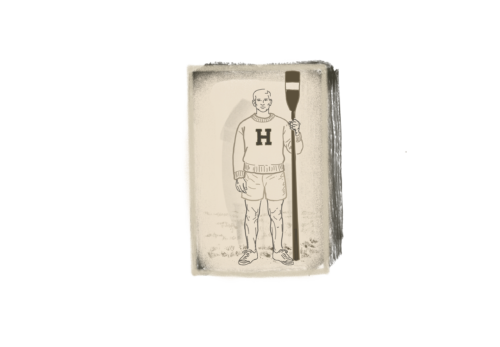
Oars and Origins: The History Behind Harvard Crew
Graphic by Angie Li

One often overlooked part of Harvard College’s identity is its enduring connection to the Charles River. Though it may go unnoticed, the College’s rhythm and structure are shaped by this neighboring waterway. On one side of the river lies the hub of student life—bustling classrooms, historic houses, and academic excellence. On the other side stands the proud home of athletic dedication, historic games, and intense competition. Much like the Tigris and Euphrates rivers sustained the civilizations of the Fertile Crescent, the Charles River has provided Harvard undergraduates with a setting that sustains both intellectual and athletic eminence.
All this is to say, the river has never been merely a boundary. It has long served as the stage for one of Harvard University’s defining traditions: crew.
But despite the sport’s modern-day significance within the Harvard community, its origins were relatively humble. Crew at Harvard began as a student experiment rather than a formal varsity team. In the mid‑1840s, Horace Cunningham ’1846, alongside his peers, launched Harvard’s first rowing club after purchasing what would become the team’s first shell, a boat they named Star.
The program quickly developed from there, and a mere year later, Harvard undergraduates had begun competing against outside opponents. One of Harvard’s earliest crews claimed victory in a grueling three-mile race at the 1858 Boston City Regatta, beating six rival boats from Boston, New York, and St. John. This race gave rise to a symbol that would come to define Harvard’s identity: its color.
Up until the late 1850s, Harvard’s unofficial mascot had been John Orangeman, a popular campus figure known for selling and delivering fruit to undergraduates. However, this would come to change in late June of that year. While preparing for the Boston City Regatta, Harvard’s eight‑man crew faced a problem: their supporters couldn’t tell which boat was theirs. Charles Eliot, Class of 1853, who would later go on to serve as Harvard’s 21st president, solved the issue by purchasing eight handkerchiefs that just so happened to be a shade of dark red. The crew tied them to their oars so spectators could spot their boat. This Harvard boat, named Huron, went on to win the race, defeating six other teams over the three‑mile course, bearing the now-iconic crimson hue. The color stuck as crimson came to symbolize the spirit of Harvard students, even before its official adoption in 1910 as the University’s color.
Harvard’s rowing legacy also lives on in one of its most famous rivalries. Today, most people associate the Harvard-Yale rivalry with the annual football game—a frenzy of travel logistics, housing hunts, and overpriced bus tickets. However, the rivalry actually began on the water with the crew. Though both schools had established boat clubs by the early 1840s, they were mostly social groups. This dynamic changed when Yale challenged Harvard to a race “to test the superiority of the oarsmen of the two colleges.”
On Aug. 3, 1852, the two crews met on New Hampshire’s Lake Winnipesaukee for what became the first collegiate athletic event in the United States. Harvard’s shell, the Oneida, defeated Yale’s Shattuck in a two‑mile course, earning a pair of black walnut oars as trophies, which are still recognized today as the oldest intercollegiate athletic prize in North America.
This race not only marked the beginning of the rivalry but also launched collegiate athletic competition in the United States. Harvard and Yale varsity heavyweight teams now meet each year for a four-mile race on the Thames River in New London, Connecticut—the longest collegiate rowing event of its type in the United States. In recent years, the Harvard Men’s Heavyweight team has continued that tradition, including a sweep at the 185th Regatta.
Beyond influencing domestic rivalries, crew at Harvard played a role in inspiring international competition. In the late 1860s, an unprecedented rowing match captured the public’s imagination on both sides of the Atlantic. Half a million people gathered along London’s Thames to watch boats from the oldest and most prestigious schools of each country battle for victory.
The excitement surrounding the event was amplified by the recent invention of the transatlantic telegraph cable. This device allowed news of the race to be transmitted across the Atlantic and followed in real time in the United States. Though Oxford ultimately won after a hard-fought contest, this race had a broader impact than the result. It was a competition that ultimately elevated the status of American collegiate rowing, inspiring new clubs and competitions across the United States.
More than a century later, that surge of attention still reverberates along the Charles. The legacy of those landmark races endures not only in record books, but in the landscape itself—where crew continues to quietly shape the rhythms and scenery of everyday campus life.
When crossing a footbridge, the shouts of coxswains and the rhythmic splash of oars cutting through the water can be heard. Whether jogging along the riverbank, walking to a tailgate before the big game, or heading back to Harvard Square after practice, the journey is accompanied by this steady pulse—a soundtrack to campus life itself.
I first noticed this on a cold, gray morning run. The air was damp, and everything felt unusually still. When I stopped halfway across a bridge to catch my breath, I glanced down and realized what was missing: the river’s usual movement and sound. It had frozen over during the previous weeks, and with it, the echoes of the crew teams had fallen silent. The emptiness was striking—a reminder of how vital that hidden rhythm is to Harvard’s atmosphere.
The home of this ever-present emblem is the boathouses, steeped in history.
On one side of the river sits the Newell Boathouse, named for football player Marshall Newell, Class of 1894, known throughout Harvard for his compassionate nature. Across the river, the Weld Boathouse was rebuilt in 1907 thanks to a $100,000 gift from George Walker Weld, Class of 1860. The boathouse stands out as Harvard’s intramural sports epicenter and hosts events for all 12 undergraduate Houses alongside women’s varsity and recreational teams, realizing Weld’s dream of “university-wide rowing.” Both physical testaments to crew’s legacy, cemented into Harvard’s campus.
When spring finally breaks through the bleakness of March, it can feel as though all of Harvard flocks back to the riverbanks, gathering in warm patches of sunlight to cheer on friendly House rivalries. Each year, more than 1,500 contests unfold. These competitions ultimately culminate in the presentation of the Straus Cup, which is awarded to the first‑place House in May.
Many of these casual showdowns—kickball, soccer, spikeball—play out on nearby fields and stretches of grass, where boats glide by, completing the picturesque scene, all grounded in rowing’s original, inclusive vision of what sport at Harvard could be.
Today, both the men’s and women’s teams—united under Harvard Athletics after the 1974 merger of the Harvard and Radcliffe athletic departments—carry this legacy forward. Most mornings, as the sun rises over the Charles, you can spot rowers crossing over the footbridges, returning from their early practice and continuing a tradition nearly two centuries in the making.
Aurora Charbonneau ’29 (auroracharbonneau@college.harvard.edu) is comping the “Independent.”