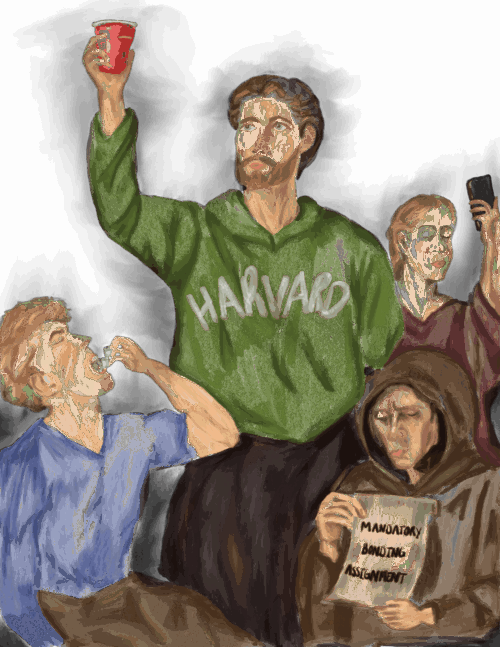
Ode to a Dying Art: In Defense of Hazing
Graphic by Trischelle Afihene

After the fall of the Western Roman Empire, much of Europe fell into a period of cultural and intellectual stagnation named the “Dark Ages.” For hundreds of years, European nations saw a decline in the production of literature and science—a production that had once been customary. This intellectual catastrophe in history has robbed modern generations of countless classics and innovations.
Today, we find ourselves in our own modern “Dark Ages,” not because of any political strife or conflicts, but due to the unwarranted attack on initiation rituals—formally acknowledged as hazing.
The practice of hazing on campus represents the quintessential way to welcome new members into an organization. How else would audacious and shameless first-years learn the social hierarchy that chains them to the bottom of the campus caste system? Without hazing, they saunter around the Yard with chests puffed out as though they have accomplished something. Did they forget that we all also got into Harvard? They’re not special. The absence of hazing prevents these first-years from learning who’s really in charge on campus.
Given the many organizations with member counts in the hundreds and comp classes containing students from around the world, how are new members expected to bond, if not for hazing? How could the piccolo players meet the trombone section when their every hour is spent locked in the basement music rooms? How might first-years, hoping to enter consulting, learn each other’s names when they struggle for hours on work that others get paid thousands to do? The solution to this problem: mandatory bonding!
Imagine: you’re studying for your LS1A midterm when suddenly, a phone buzzes. It’s your mandatory comp assignment of the week—you and three other compers must record a TikTok of the latest trends. You drop everything, rush to create a group chat with your fellow compers, and put on your game face. After performing the most humiliating rendition of the KATSEYE GAP ad, you publish the video for the whole world to see.
These initiation rituals give preexisting members (and even fellow compers) a great laugh at your expense—and what’s so wrong with that? It is healthy to laugh at ourselves, so hazing is actually good for you! And for all the government majors who believe that maintaining a clean public image is necessary to succeed in politics, Justin Trudeau’s costume choice of the past has proven otherwise.
Hazing is healthy too, providing a safe environment for compers to find their limits. How can we be expected to know the exact number of drinks necessary to reach a buzz without trying it for ourselves? Are we to just blindly trust some graphic that the school shows us in the mandatory alcohol training?
Any good scientist or statistician would tell you about the importance of experiments to understand the accuracy of a claim. If someone claims that they can fit up to five marshmallows in their mouth, they must actually fit those marshmallows in their mouth before I believe them. In the same way, hazing allows us to find the maximum number of marshmallows they can fit. There’s no better way to discover how many drinks they can consume than being forced to take shot after shot of hard liquor! A first-year that has never had alcohol in their life can be very dangerous come river-run. So, you’re welcome, Harvard, for protecting your bathrooms from puke and your students from hospitals.
Most important of all: hazing builds character. When I was younger and watched the first Harry Potter movie, I was inspired by the tragic story: How dare they drop this random baby boy at the Dursleys’ door! There are drastic financial tolls that one must consider when having to feed another mouth. But the Dursleys showed strength despite the setbacks. They grew from the challenges put against them and were eventually able to succeed in ditching that loser Harry. Without adversity, would the Dursleys have become the functioning members of society that we love? Hazing provides the necessary push that many need to blossom in this world.
This campus has gone soft. First, it was our take-out boxes; now the campus administration is after hazing—that’s where I draw the line. What happened to the campus I love! Since when was exorbitant consumption of alcohol an issue? Clearly, the University staff can’t hang.
Harvard hopes that we will relinquish our right to bully and harass others while calling it “community building.” But I say no. I won’t allow for this indispensable part of campus—no—human life to be lost to future generations. We cannot let this tyrannical University administration take away our self-evident rights. As a great president once said on the sixth of the first month, “We fight like hell. And if you don’t fight like hell, you’re not going to have a [campus-life] anymore!”
Thayer J. Y. Gauldin would definitely report any instance of hazing.