Out Of Your League: The Dying Art of Mundane Interaction
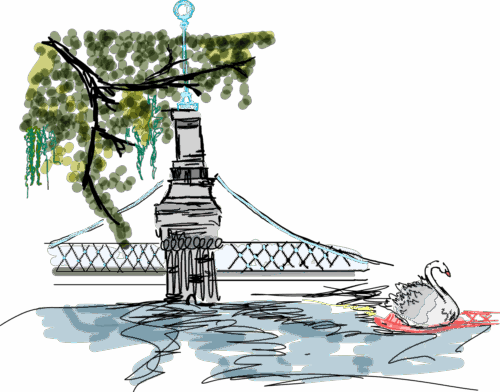
Graphic by Megan Legault

“But midst the crowd, the hurry, the shock of men,
To hear, to see, to feel and to possess,
And roam alone, the world’s tired denizen,
With none who bless us, none whom we can bless…”
Solitude, Lord Byron
Solitude.
As the youngest sibling of three and one of the younger grandchildren in a sprawling family, solitude has forever been unfamiliar to me. I never truly experienced it until I left my communal hometown of Las Cruces, New Mexico—a small, vibrant, Hispanic college town—for the big, bad, hustle-cultured East Coast. There, in a city of millions, I had my first taste of being utterly and entirely alone.
The paradox struck me: in a crowded metropolis, where everyone is forced into proximity, I found that people had never seemed so distant.
Sociologists, psychologists, philosophers, and the common man alike have speculated the causes of this phenomenon. Did industrialization lead to the deconstruction of societies interconnectedness? Is technological advancement responsible for the modern adaptations of the human experience, one that is increasingly individualistic?
In my succinct two semesters at Harvard, I have had the distinct privilege of indulging my humanistic romances outside of my typical, laborious STEM coursework as an Integrative Biology concentrator. Although limited in scope, in each of the courses I have taken outside the brutalist walls of the Science Center, discussion regarding space appears to be ever-present.
I first encountered this notion analyzing the novels of Jane Austen with the guiding hand of Professor Deidre Lynch in “English 145a: Jane Austen’s Fiction and Fans.” Unabashedly, I will admit that my original intention for enrolling in this course wasn’t academic in the slightest. My sole reason was that my sister had made me watch the 2005 adaptation of “Pride and Prejudice” ad nauseum and insisted I take a “fun” class instead of LS50. And yes, we are big fans of the infamous hand flex.
This course ended up being my favorite that semester. Among the many themes of Austenian literature, we discussed how Austen brilliantly used the notion of place, manipulated setting, even, to implicitly provide social commentary and express the metamorphosis occurring within her characters.
Although I didn’t recognize it then, I know now that, ironically, the manipulations I was studying on paper were simultaneously happening around me.
I had unintentionally ripped myself out of the comfort of familiarity and placed myself in an alternate reality. In every way you can imagine—weather, people, food—Cambridge is entirely antithetical to the place where the roots of my existence are planted.
I spent the first months here in a dissociative state: entirely overstimulated and engulfed by the novice world that surrounded me.
As much as I had believed that my identity was concretely fixed, upon arriving in Cambridge it became almost entirely detached. The social customs I had grown up unconsciously mimicking—something as simple as gesturing a thank-you to drivers as they allowed me to cross the street—slowly disappeared as I tried to adapt to my new environment.
I felt an internal war waging between who I knew myself to be and who I felt I must become to belong. My humility seemed to be irreconcilable with the self confidence I needed to thrive, or at least so I thought.
One of the biggest attractions to Harvard we generally discuss is the dialogue that happens within its gates. But truth be told, the best and most grounding conversations I have had here have been with complete strangers. People who remind me that the world extends beyond the Harvard bubble—coming up for air from the world outside.
The Uber driver who first picked me up from the airport asked me about the social culture of the University, drawing upon his experiences immigrating to the United States from Trinidad. Having struggled adjusting from the communalistic nature of home himself, he transposed the wisdom he could muster about finding community in the big city.
The unhoused woman I gave my change to outside of Blank Street before the last dreaded LS1b final told me that I looked like I needed a hug. Granted, I hadn’t slept for days, but her keen observation reminded me that the simplest gesture of kindness never goes unappreciated. Together, we shared a mutually therapeutic embrace.
The historian seated outside the Granary Cemetery who handed me a self-guided tour he had meticulously assembled for pedestrians who take the time to engage, rather than just blowing past. The sparkle in his eyes throughout the duration of our conversation following my promenade of the monument. An unspoken look that expressed his gratitude that I took the time to enjoy the fruits of his labour and intellectual contribution to the history of Boston.
Something even as simple as the man I met just the other day while I was sitting against the tree I have claimed as my own at the Boston Public Garden—a proud employee of the Home Depot plant department who just wanted to show someone the colossal plant encyclopedia he had freshly purchased from the Brattle Book Store. A purchase he believed would help him aid others find the “plant of their dreams.”
Each of these interactions echoed a sentiment that I had unintentionally buried 2,000 miles away. I wish I could express it more profoundly, but it is simple in nature: we all shared the desire to connect. Anyone to talk to. Anyone to make us feel less alone.
Returning to Cambridge for the second year, it is in these subtle interactions that I have come to realize the substantial metamorphosis I have undergone. Having spent the summer at home, this immediate frame of reference has allowed me to contrast the sense of self I have developed unaffixed to space. By no means am I the same person who arrived at Greenough Hall last August, but in the same breath I am not entirely different.
I have learned that in order to truly be the best person, best and brightest Harvard scholar I can be, it is pivotal that I remain embedded in the world that exists beyond our gates. No longer will I rush through the streets of Cambridge disengaged from my surroundings out of fear that I will do something socially unacceptable—something that will tarnish my shiny Harvard identity. Who I was, and where I was before coming to Cambridge, is equally, if not more, important than who I will be when I leave it.
A person who stops to talk to strangers. A person who smiles at random people in the street. A host for the narratives of others. Someone who, despite the unwilling desire for solitude “midst the crowd, the hurry, the shock of men,” chooses to remain connected to humanity, even in the most mundane of fashions.
Megan Legault (mlegault@college.harvard.edu) is a sentient creature who seeks out humanity in the most desolate of places; a creature who also writes for the Harvard Independent.