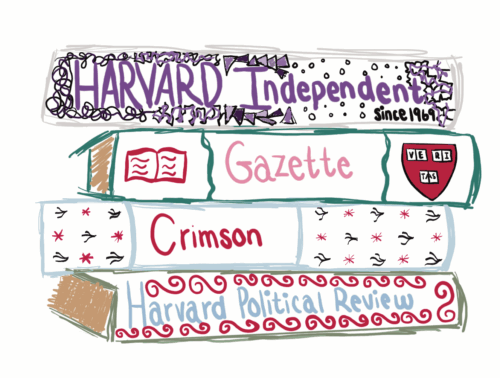
Paper Trails: Journalists Putting Politics and Pen To Paper
Graphic by Amelie Lima

Months of contention between American universities and the federal government have placed student journalism at the epicenter of political commentary. Student publications across the nation have devoted considerable portions of their content to documenting recent public demonstrations and administrative action taking place on college campuses. However, the latest crackdowns from the presidential administration regarding student activism leave creative production in a precarious position.
A recent article written in The New York Sun recognized how Trump’s attacks on higher education are not only generating more coverage but also increasing the readership of various student publications.
“College student reporters are living in the eye of the storms that have embroiled their campuses over the last couple of years. To meet the torrent of headlines erupting from their schools, their newsrooms have scaled up,” writes Sun reporter and former Independent Editor-in-Chief M.J. Koch ’23. “Their readership has skyrocketed. And they’re breaking news in real time—often beating professional journalists to the punch.”
At Harvard College, publications like the Independent and the Harvard Crimson have been keeping students as well as external audiences updated with their extensive and prompt coverage of the legal battles between Harvard and the federal government. Coverage by these student papers includes daily breaking news updates and long form investigative developments.
Outside of Harvard’s gates, other university publications have proven equally vital in reporting on internal unrest to their campus communities and outsiders. The Columbia Spectator has been closely documenting altercations between campus administration, student activists, and the federal government. Similarly, the Yale Daily has been publishing articles addressing student protests, Yale’s private equity sale, and most publicly, Yale’s decision to back Harvard in their legal battle with the federal government.
“When I first started reporting, campus journalism felt like it lived in a more closed world, pivoting around mostly student government, weekly political debates, sports, and student life,” said Daily reporter Baala Shakya ’28 in an interview with the Harvard Independent. “It mattered, but it felt self-contained.”
“Since Trump took office, or even the months leading up to the November election, that wall collapsed,” Shakya continued.
Although Yale has not been the focal point of federal disputes like Harvard and other elite universities, the university has felt the impact of national cuts on federal funding. Over the last year, Yale saw a 33.8% decrease in NIH funding and researchers have expressed concerns over declining budgets, which make it difficult to carry out and fund projects.
“My campus, like Harvard, has become dominant in national conversations about free speech, academic freedom, endowment politics, DEI, protests, financial regulation, the war on Gaza. All of those national debates taking place outside of the university are directly shaping what I cover at Yale,” Shakya said. “That means that almost every story I write now has two audiences: one is the student body here, who live the consequences of these decisions; the other is the broader public.”
“What happens on elite campuses has become so symbolic of larger national tensions and anxieties.”
For Shakya, the current political landscape has reshaped her experience as an active student journalist.
“My responsibilities have changed, but maybe more than that, the emotional weight of those responsibilities has changed,” she said.
Shakya’s dedication to journalism covering important stories for the Daily News has not come without sacrifice, often working long days covering stories until midnight, leaving as late as 2 or 3 a.m. to finish coursework. For Shakya and fellow student journalists, keeping up with a demanding schedule is only part of the resilience needed—a sentiment felt deeply this past month, particularly on Columbia’s campus.
On May 7, four student journalists from the Columbia Spectator and the University’s radio station, WKCR 89.9 FM, were suspended for covering a pro-Palestine protest in their campus library.
The protest, publicized as an “Emergency Rally” by Columbia University Apartheid Divest, was a pro-Palestine demonstration demanding that the University divest from the conflict in Gaza. Around 100 protesters, frustrated with the decisions of the Columbia administration, occupied the Lawrence A. Wien Reading Room in the University’s largest campus library. They put up banners and renamed it “Basel Al-Araj Popular” after the Palestinian writer and activist who was killed by Israeli forces in 2017. Columbia President Claire Shipman authorized the NYPD to sweep the building, reportedly barring protesters from leaving without presenting identification. 109 protesters were arrested and another 65 students were suspended in the days that followed.
According to an article written days after by the Spectator’s News Editor, student journalists from Columbia and Barnard College who were reporting at the site of the incident received email notifications of suspension from their respective college administration although they had identified themselves as press to the public safety officials present at the protest. In a statement released by Shipman, the disciplinary actions resulted from student disturbances and their refusal to leave after being asked by public safety officials. “These actions not only represented a violation of University policies, but they also posed a serious risk to our students and campus safety,” the announcement read.
Just last year, a reporter for the Crimson was also wrongfully sent a leave of absence notice after they covered the University’s pro-Palestinian encampment outside of encampment bounds. Although their academic punishments were lifted, these actions, alongside rising tensions between universities and the federal government, raised concerns across the nation as the right to free press was seemingly being infringed upon at a time when student journalism is at the forefront. Among those concerned is Katy Aronoff, Barnard College ’04 and former editorial page editor for the Spectator.
“It seemed like the disciplinary measures that were being applied were being applied with a very heavy hand, and that in ways that…were different from what we had seen happen as students, and what we sort of understood the standard practices to be,” said Aronoff in an interview with the Independent.
Aronoff’s tenure in undergraduate journalism at Barnard occurred during the tumultuous years that followed 9/11—an experience that she now relates to current political polarization.
“I never once felt like we really had anybody in the administration trying to pressure us to cover or not cover things a certain way… Columbia has always been an incredibly political campus… That’s just the way that it is, and that’s one thing I love about it,” Arnooff said. “I never felt like there was any danger to me or any of my opinion writers, from printing pieces with controversial viewpoints or viewpoints that the university administration or national politicians wouldn’t like.”
However, Aronoff’s feelings drastically changed following the incident at Butler Library—within three days, she and 17 other Spectator alumni signed a letter in which they articulated their concerns and called on their alma mater to respect student journalism and open dialogue. “Ensuring student journalists can perform their duties without fear of reprisal is fundamental to preserving trust and accountability on campus,” Aronoff said.
“People were coming from various political viewpoints on this and that…but we just felt like the way that the student journalists are being treated, at the very least, wasn’t fair, and that at a time, it’s not conducive to good dialogue on campus,” she continued.
Aronoff emphasized that what occurred at Butler Library is not an isolated incident of concern for unrestricted student journalism. “Even before any of this…I was really shaken up by what had happened at Tufts… I used to work at Tufts, so I know Tufts very well, and that really shook me to my core,” she said.
At Tufts, the footage of graduate student Rümeysa Öztürk’s detainment, an international student from Turkey who had previously co-authored an op-ed for the Tufts Daily criticizing their response to the ongoing war in Gaza, went viral.
“The ability of student journalists to be on the ground is really unmatched by other outlets and publications. So I think it’s important to keep doing this,” Aronoff said. “If you’re doing really serious student journalism, it is taking up a lot of your time, but I think that the work that all of you who are student journalists are doing right now is really important. It will be part of the historical record. I think it’s the best source in some cases that we have on what’s going on on campuses.”
Columbia, which gained the title as the “activist ivy” has had its fair share of events documented by student journalists at the Spectator recently. Spectator journalists covered the controversial detainment of international scholars Mohsen Mahdawi and Mahmoud Khalil as well as the protests which transpired in response to their detainment from campus perspectives. Last month, they documented Columbia’s 2025 Commencement where Shipman was met with boos as she gave her ceremonial speech. They remain committed to covering historic developments as they unfold, such as Khalil’s release on June 20.
Shakya affirmed that the commitment to being an active student journalist can be demanding both physically and emotionally.
“You’re 18 or 19 years old, writing stories that challenge people decades older than you who have the means to retaliate if they want to. Sometimes the fear isn’t explicit,” she echoed. “It’s more subtle: the critical conversations in class you hear about after a tough story runs, the discomfort you feel when you show up to an event, the knowledge that your relationships with sources may shift and change or even become severed depending on what you publish.”
“And then there are the emails: some angry, some mocking, some cruel that show up in my inbox after a particularly controversial piece,” she continued.
With the nation’s attention now on universities and the press, journalists and student activists alike have expressed an increasing concern over their safety and reputations in light of recent events. Last year, 13 Harvard students who had participated in on-campus encampments had their diplomas withheld.
This year, international students expressed feeling intimidated when participating in campus activism, afraid of disciplinary action that could have severe consequences on their academic opportunities. Despite these obstacles, and the overall feeling of uncertainty many feel in lieu of recent attacks on higher education and misplaced disciplinary action, Shakya, like Aronoff, ascertains the importance of unrestricted student journalism.
“As student journalists, we do it knowing that we’re still learning, that every story carries risks, that every word matters,” she said. “We lose sleep over mistakes we might have made. We agonize between submitting a piece and seeing it published, wondering if we’ve missed something or accidentally harmed someone. But we carry that weight because we know that if we don’t do it, no one else will.”
“At its best, student journalism isn’t just practice for the future, it’s not some pre-professional activity to fill our time with. It’s very real and it matters now. We feel that responsibility every single day, even when we’re far from campus.”
Megan Legault ’28 (mlegault@college.harvard.edu) is a proud student journalist for the Harvard Independent.