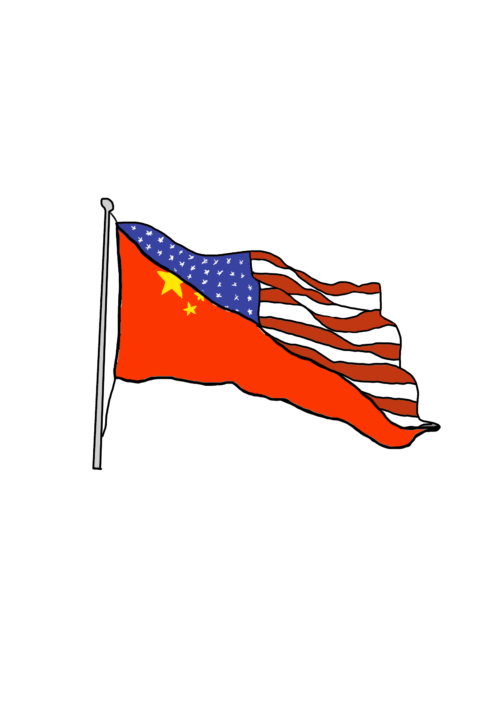
Point/Counterpoint: Should Eileen Gu Have Represented China?
Graphic by Sophia Rascoff

Eileen Gu and Alysa Liu are two of the most prominent young athletes in international winter sports, whose lives seem to run in parallel. Both were born in the United States to Chinese single parents who had their children by surrogacy with white American donors, and both rose quickly to the top of their respective disciplines.
Gu competed in freestyle skiing, representing China at the 2022 Beijing Winter Olympics, where she won one gold and two silver medals. Liu is a figure skater who has represented the United States in many international competitions, earning national titles and global recognition, and now has two gold medals at this year’s Winter Olympics in Milan. Their athletic achievements and national identities have placed them at the center of international attention.
Gu’s decision to compete for China, despite being raised and trained primarily in the United States, created widespread public controversy. The International Olympic Committee requires athletes to compete as nationals of the country they represent, making questions of affiliation part of the broader conversation. Because the Olympics function not only as a sporting event but also as a global platform for national representation, her choice prompted debate about identity, citizenship, and the relationship between sport and geopolitics.
Courtney: Before Kalvin and I get into what will inevitably be an international relations debate, I think this conversation needs to start with recognizing the pure skill and bravery both these women have. They are clearly two amazing athletes. I may be exhibiting bias, but to me their wins feel personal, given both Eileen Gu and Alysa Liu are half Chinese and half White—just like me! Their backgrounds and stories reflect my own. Beyond their decisions to represent different countries, they’ve largely helped the same people: fans from all countries who were simply amazed by the power both possess.
Kalvin: I think this is such an interesting debate. Considering I am on the counterpoint side, before I start critiquing someone who has achieved feats beyond the abilities of 99.99% of humans, I do believe that Eileen Gu and Alysa Liu are great people and role models for people everywhere. That said, I strongly disagree with Gu’s decision to compete for China.
Courtney: While it’s true she was raised in the United States, I’ve found that most criticisms of Gu’s decision flatten what it means to have a Chinese parent, Chinese language and culture at home, and a childhood spent in China every year. Gu’s mother is Chinese, and she has spent every summer in China throughout her childhood; I think it’s more complicated than simply competing for another country. For someone who’s genuinely bicultural, choosing which flag to compete under isn’t automatically betrayal. In that same vein, if the moral logic is “you should compete for where you were trained,” then lots of athletes, across many sports, would be morally suspect. But we don’t treat most of them that way.
Kalvin: I don’t think Gu’s decision was made with nefarious intent; outside of maybe the millions more she would make by competing for China (which is not a valid criticism, we are a monetary society). My main problem is not that she is representing a country other than the United States; it’s the country she is competing for that I take issue with. A common argument is that it’s sinophobic to focus on Gu because many athletes live in the United States and compete for a foreign country. This argument entirely ignores why there is a problem with competing for China: it’s the United States’ number one geopolitical adversary.
Do we really think everyone would have been fine with an American citizen competing for the Soviet Union in the 1970s at the height of the Cold War? My argument is not that we should deny multinational people the right to choose another country, but rather that a born-and-raised American, morally, should not compete for a country the United States is actively competing with militarily, economically, and institutionally.
Courtney: I can understand how the Chinese optics feel different, and I agree it isn’t automatically “sinophobic” to name geopolitics. But while you can disagree with China’s government, it’s inconsistent to treat multiethnic athletes’ choices as neutral until the country is politically unpopular. Still, if we were to follow that principle, we need to create a criterion: What counts as an adversary? Who decides? Is it war? Human rights? Cyber? Trade? “Adversary” status shifts with administrations and headlines.
On the Cold War analogy: The height of the Cold War is exactly when societies imposed loyalty tests and treated bicultural identity as suspicious, which we now recognize as a moral failure. This bleeds into another point: representing a country in sport is not the same as endorsing its regime. Otherwise, every athlete becomes a proxy ambassador for every policy of their state, which is an impossible moral burden. I think your main ethical concern is the Chinese Communist Party’s use of athletes, not a bicultural person choosing to represent part of her heritage.
Kalvin: If the world were perfect, I think that your point would be 100% valid, but unfortunately, the Olympics are and have always been political. The United States, its allies, and its adversaries use it to project power and stability on the world stage. They effectively use it to say we built athletes like these. I don’t argue that Gu endorses the Chinese government, but that doesn’t mean she’s not used by Chinese state media for propaganda. It is a media win for China that a gold-medalist American athlete competes for us.
You pose the question of who decides our adversaries; we honestly don’t have the time to say. Because of the number and complexity of the factors that determine them, it would take a textbook to explain. What is important is the fact that China is a competing economic, government, and military system. While her reasons might not be anti-American, competing for China just is that: joining an opposing force.
Courtney: I agree with you that the Olympics are political and that states use athletes symbolically, but if the standard shifts to participating in a sport that authoritarian states can spin as propaganda, then no athlete is morally safe. The United States constantly uses Olympians to project institutional superiority and multicultural success. In Alysa Liu’s case, for example, competing for the United States is a soft-power win that the media has similarly used to signal American opportunity and freedom, and that same coverage does not claim that she’s morally implicated in the United States foreign policy.
The problem with calling Gu’s choice a “media win” is that it treats her as if she were exclusively American who defected, rather than a genuinely bicultural person choosing which part of her heritage to represent. The “switching sides” language restricts her identity to heighten the geopolitical symbolism.
If the real principle is now to not represent states with human rights abuses, then that standard would disqualify a large portion of the international community. Telling athletes not to represent U.S. adversaries is more of a nationalist loyalty standard, not a human rights one. The deeper question isn’t whether China uses athletes politically; it does, as do other nations, including the United States. Instead, we should be asking whether bicultural individuals should have to structure their identities around American strategic interests, and I argue that this is not a reasonable moral demand.
Kalvin: I never argued that Gu endorsed China’s foreign policy or political nature; however, “freedom of expression” is heavily restricted in China, so publicly opposing the government’s stances is near-impossible. Every American athlete has the power to disagree with the government, so in effect, they aren’t endorsing it; some of them even choose to critique it. Chinese athletes do not. Gu chose to represent a country that doesn’t grant its own people the basic right to publicly express an opinion. Because the International Olympic Committee requires that you be a national citizen of the country you compete for, it is then clear that Gu either revoked her American citizenship for Chinese or was given special treatment by the CCP. Because of her decision, she can’t critique anything the Chinese government does; is it morally acceptable that she signed up for a state to control what she says?
Touching on your question about whether people should structure their identities around our strategic interests, I think this framing is wrong. In the United States, you have the freedom to identify however you want, including as culturally and ethnically Chinese. But this isn’t just an identity; Gu has legally become a national of an adversarial government to compete for them in the Olympics. I would understand Gu if it were as simple as identity and supporting the people of China, but her decision is much more.
Courtney: China does restrict freedom of expression, and that matters. But just because China limits speech does not mean Gu’s decision to compete for China endorses those limits. If representing a country makes you implicated in its political constraints, that standard applies everywhere. American athletes would then be implicated in U.S. foreign policy or structural injustices simply by wearing the flag. That collapses into collective guilt instead of individual responsibility.
You argue that American athletes can publicly criticize their government, which distances them from endorsement. But in practice, most Olympians, regardless of country, cannot operate as political dissidents. The IOC itself restricts political expression, so all athletes face institutional pressures that discourage overt political speech. More importantly, your framework effectively requires that diaspora athletes represent only liberal democracies to remain morally clean. That turns identity into regime validation.
Alysa Liu, competing for the United States, signals American freedom, yet we don’t treat her as morally implicated in every dimension of U.S. policy. Her political silence isn’t called complicity in that case. Why is it only complicity when the country is China? Should China scrutinize her the same way the United States scrutinizes Gu?
The Olympics are political at the state level, but athletes don’t primarily represent governments: they represent people. They represent families, communities, diasporas, and millions of viewers who see themselves reflected in these athletes across borders. States may try to instrumentalize that symbolism, but the meaning of athletic representation isn’t reducible to regime endorsement. If we treat it that way, we turn individuals into extensions of governments, when really, each athlete is an autonomous actor navigating complex identities.
Kalvin: Gu is not just representing the people when she joins the country as a national and chooses to subject herself to these restrictive speech policies. The distinction becomes immediately clear when you consider that many Americans have critiqued the Trump administration at these Olympics. There are very few Chinese athletes competing internationally who have ever spoken against the government. The most notable incident was when tennis player Peng Shuai accused a senior CCP official of sexual assault and demanded a full investigation on the Chinese social media app, “Weibo.” Not too long after, the post was deleted, and Shuai made a statement calling the situation a “misunderstanding.” To this day, Shuai’s name is blacklisted on the Chinese internet, and she has publicly disappeared, not to be seen.
Pretty understandable why Chinese athletes don’t speak out against the country, right?
In the end, I recognize Gu as someone who has done amazing things and seems like a good person. That being said, I also call into question her decision to legally join an adversary country. It is no one’s responsibility to talk politics, but should you not still have the right? When someone asked Gu about China’s human rights offenses against the Uyghur Muslims, she responded, “I haven’t done the research. I don’t think it’s my business. I’m not going to make big claims on my social media.” Is this a belief, or is it because history proves what happens to Chinese athletes who respond differently? In choosing to become a Chinese national, she is complicit, in part, in her own silencing.
Courtney & Kalvin: Despite the debate over joining the Chinese Ski Team, Gu has been wildly successful, winning multiple medals. Her stated goal of increasing youth skiing participation in China is working, with a 12% increase in ski days year-over-year for the 2024-25 season. Gu was the fourth-highest-paid female athlete in 2025, excluding the millions she received from the Beijing Municipal Sports Bureau. She is an undergraduate at Stanford, where she is majoring in International Relations. The world will watch on as Gu continues to push the sport of freestyle skiing to new limits, regardless of her chosen country of representation.
Courtney Hines ’28 (courtneyhines@college.harvard.edu) is the News Editor, and Kalvin Frank ’28 (kfrank@college.harvard.edu)is the Arts Editor for the “Independent.”